The short answer
Pipes usually split away from the ice, not at it: the ice acts as a stopper and pressure builds in the trapped water between it and the closed tap — which is also why the flood arrives on the thaw rather than the freeze, often when nobody is home. The autumn routine is: disconnect every hose, close the indoor isolation valve, then leave the outdoor tap open all winter so residual water can drain and expand. A frost-proof tap still bursts if a hose is left attached, because the hose stops it draining down.
A burst pipe from a frozen outdoor tap is one of the most expensive failures in an ordinary house, and it is entirely preventable in about twenty minutes each autumn.
Why it bursts, and why not where you think
Water expands by roughly 9% when it freezes. In a closed pipe that expansion has nowhere to go, and pressure builds.
The counter-intuitive part: the pipe usually does not split at the ice. The ice plug acts as a stopper, and pressure builds in the trapped water between the ice and the closed tap. The split happens there, often several centimetres away — and frequently inside the wall.
Which explains the other characteristic of frozen-pipe damage: the flood happens on the thaw, not the freeze. The pipe splits while frozen, nothing escapes because the ice is still blocking it, and water starts pouring out when it melts — often while nobody is home to notice.
The autumn routine
1. Disconnect every hose
This is the most important single step and the most commonly skipped. A hose left attached holds water in the tap and prevents it draining. The tap freezes, and the split propagates back into the wall.
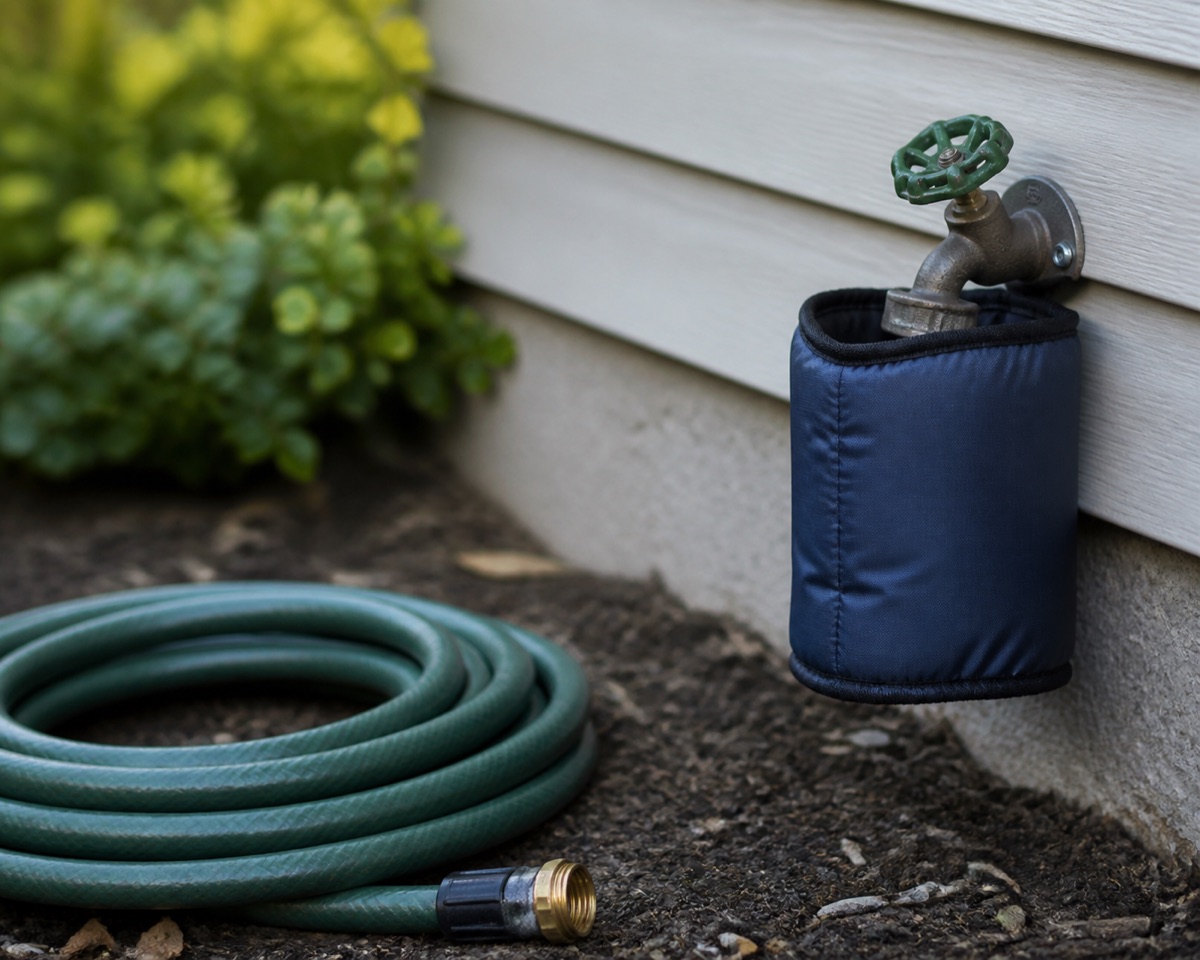
Drain each hose fully, coil it and store it somewhere it will not be crushed.
2. Shut off the indoor isolation valve
Most outdoor taps have a dedicated stop valve on the supply inside the house — in a basement, a utility room, or under the sink on that wall. Close it.
If you cannot find one, follow the pipe back from where it passes through the wall. If there genuinely is not one, fitting an isolation valve is a worthwhile small plumbing job.
3. Drain the outdoor tap
With the indoor valve closed, open the outdoor tap fully and leave it open all winter. This lets any remaining water drain out and gives expansion room if a little is left.
Leaving it open is the part people undo out of tidiness. It should stay open until spring.
4. Drain the isolation valve
Many isolation valves have a small bleed screw or drain cap. Put a container underneath and open it to let the short section of pipe between the valve and the tap empty. Close it again afterwards.
5. Insulate the tap
Fit an insulated tap cover — a moulded foam or plastic jacket. They cost very little and they buy several degrees of margin on a marginal night.
6. Lag exposed pipework
Any pipe running through an unheated space — garage, loft, crawl space, outbuilding — needs foam pipe lagging. Fit it with no gaps, and pay particular attention to bends and valves, which are usually left bare and are where freezing starts.
Frost-proof taps
A frost-proof (or frost-free) sillcock has a long stem so the valve seat sits inside the heated part of the building, with the pipe sloping slightly down toward the outside so it self-drains.
Two things to know:
- They still fail if a hose is left attached, because the hose stops the drain-down. This is by far the most common cause of a burst frost-proof tap
- They must be installed with a slight fall to the outside. Fitted level or falling inward, they do not drain and they are no better than an ordinary tap
Other outdoor water
- Irrigation systems — drain, or blow out with compressed air. In hard-freeze climates a professional blow-out is the standard approach
- Water butts — drain to below half full, or empty. A full butt that freezes solid will split
- Ponds and water features — remove and drain the pump, and float something to keep a gas exchange hole open if there are fish
- Outbuilding supplies — isolate and drain entirely if unheated and unused
If a pipe freezes anyway
- Turn off the water at the main stop tap immediately. Do this first — you do not know yet whether the pipe has split.
- Open the affected tap so meltwater has somewhere to go.
- Warm the pipe gently, starting at the tap end and working back toward the frozen section. A hot water bottle, warm towels, or a hair dryer on low.
- Never use a blowtorch or any open flame. Fire risk, and localised boiling can burst the pipe outright.
- Watch for leaks as it thaws. This is when a split reveals itself.
Spring reconnection
- Check the tap and visible pipework for splits or bulges before turning anything on.
- Close the outdoor tap — you left it open all winter.
- Close any bleed screw on the isolation valve.
- Open the indoor isolation valve slowly, listening for running water.
- Open the outdoor tap and check for leaks at the tap, at the wall penetration and at the isolation valve.
- Then reconnect hoses.
Going away in winter
If the house will be empty during freezing weather:
- Leave the heating on at a low background temperature — around 12–14 °C. Cheaper than any burst pipe
- Open the loft hatch and internal doors so warmth reaches pipework
- Consider draining the system entirely for an extended absence
- Ask someone to check the property, and make sure they know where the main stop tap is
Common questions
Why does the pipe split away from the ice?
Because the ice plug acts as a stopper and pressure builds in the trapped water between it and the closed tap. The split happens there, often several centimetres back and frequently inside the wall — which is also why the flood arrives on the thaw rather than during the freeze.
Do I really need to leave the outdoor tap open all winter?
Yes. With the indoor isolation valve closed, leaving the tap open lets residual water drain and gives expansion room for anything left. Closing it again out of tidiness undoes the protection.
I have a frost-proof tap. Am I safe?
Only if you disconnect the hose. A hose left attached stops the tap draining down, which defeats the entire mechanism — this is by far the most common cause of a burst frost-proof tap. It also has to be installed with a slight fall to the outside, or it does not self-drain.
A pipe has frozen. What do I do first?
Turn off the water at the main stop tap before anything else, because you do not yet know whether the pipe has split. Then open the affected tap and warm the pipe gently from the tap end backwards. Never use a blowtorch or open flame.
What should I do if the house will be empty over winter?
Leave the heating on at 12–14 °C background, open the loft hatch and internal doors so warmth reaches pipework, and have someone check the property who knows where the main stop tap is. For a long absence, draining the system entirely is the safer option.