The short answer
Each of these appliances has one component that decides its lifespan, and in every case it is not the one people clean. In an air fryer it is the heating element and fan above the basket, where aerosolised fat carbonises — that, not a fault, is why a fryer starts smoking. In a toaster it is the crumb tray, a genuine fire load under exposed elements. In a blender it is the gasket under the blade assembly, where dried food lets liquid reach the bearing. Turn the air fryer upside down to clean the element every two to four weeks.
Blenders, toasters and air fryers all fail for the same underlying reason: residue in a place the design makes awkward to reach. Each has one component that decides its lifespan, and in every case it is not the one people clean.
Air fryers
The part that matters is the heating element and the fan above the basket, not the basket itself.
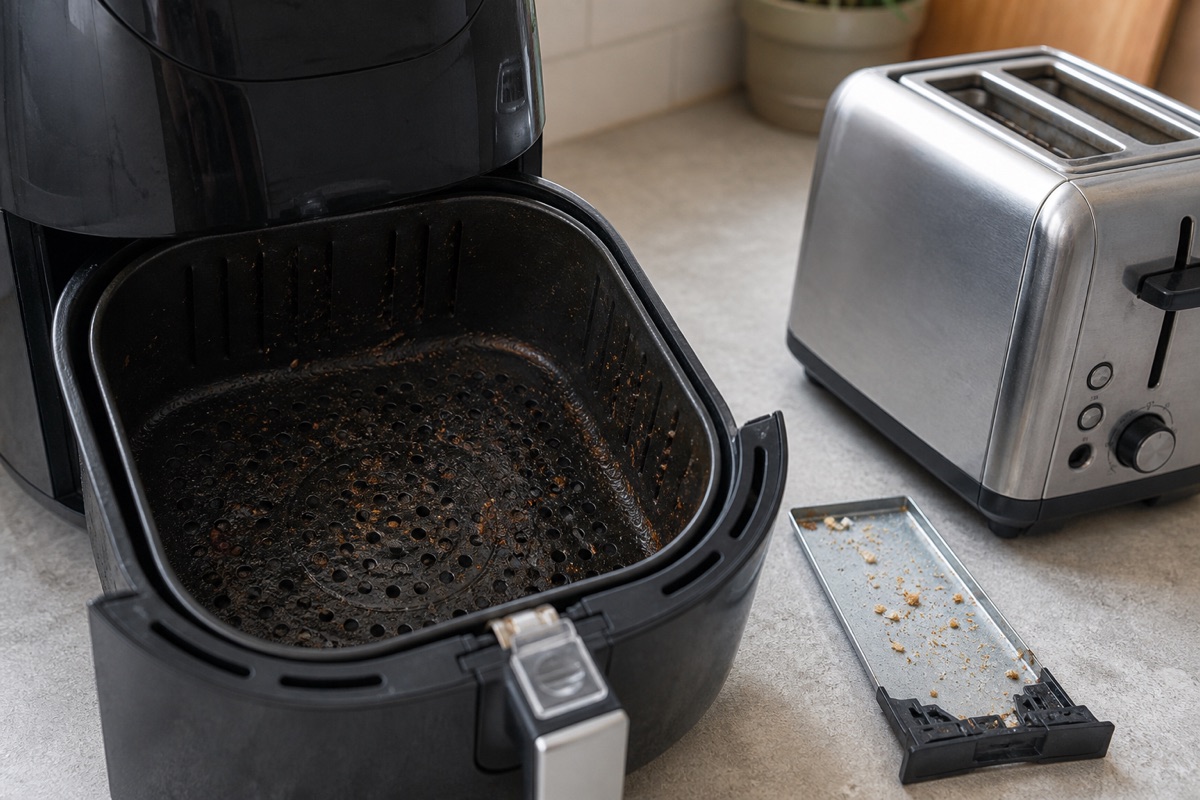
Fat aerosolises during cooking, settles on the element, and carbonises with each subsequent use. That carbon layer insulates the element, so the fryer takes longer to reach temperature, runs hotter internally to compensate, and eventually produces smoke from the deposits rather than the food.
Cleaning it
- Unplug and let it cool completely.
- Remove the basket and drawer. Most are dishwasher-safe but hand washing preserves the non-stick coating considerably longer.
- Turn the unit upside down — this is the step people miss. The element and fan are now accessible from above.
- Wipe the element with a barely damp cloth and a little washing-up liquid. Nothing abrasive; the coating on the element is thin.
- Soft brush around the fan housing.
- Dry completely before use.
Do this every two to four weeks with regular use. An air fryer that has started to smoke almost always has a loaded element, not a fault.
Protecting the basket coating
- Silicone or wooden tongs only — metal scratches the non-stick, and it is the same PTFE chemistry as a frying pan
- Do not cut food in the basket
- Perforated parchment liners protect the coating, but never run the fryer with a liner and no food — it lifts into the element
Toasters
The crumb tray is the obvious one and still gets neglected for years. Accumulated crumbs are a genuine fire load sitting directly under heating elements.
- Unplug. Never put anything into a toaster that is plugged in, even switched off.
- Slide out the crumb tray, empty and wash it. Weekly.
- Turn the toaster upside down over a bin and shake firmly — a surprising amount sits on the ledges the tray does not catch.
- Blow out the slots with a can of compressed air or a hairdryer on cool.
- Never use a knife or fork in the slots. The elements are exposed and fragile, and this is how people both destroy toasters and get electric shocks.
A soft pastry brush on a long handle clears the slots better than anything improvised.
Blenders
The failure point is the seal and bearing under the blade assembly. Liquid works past a worn gasket into the bearing, and once that happens the blender leaks and the bearing fails.
Routine cleaning
The quick method works: half fill with warm water, add a drop of washing-up liquid, run for 30 seconds, rinse. That handles everyday use.
Every few weeks, take the blade assembly out — most unscrew from the base of the jug — and clean the gasket and the threads separately. Dried food in the gasket groove is what causes leaks, and it is completely invisible with the assembly in place.
Extending its life
- Do not run it dry or overload it — the motor is the expensive part
- Add liquid before solids so the blades are not starting against a packed load
- Let the motor rest between long runs; most domestic units are not rated for continuous duty
- Never put the jug in the dishwasher unless it explicitly says so — heat clouds polycarbonate and degrades the gasket
- Replace the gasket when it hardens or the blender starts weeping. It is an inexpensive part and it saves the bearing
Kettles, and everything with a heating element
Scale on an element insulates it, so it draws more power for longer to do the same job, and eventually the element fails. The interval depends entirely on water hardness — the method and the schedule are in Descaling a Kettle, Coffee Maker, Iron and Espresso Machine.
A working schedule
| Appliance | Task | Frequency |
|---|---|---|
| Air fryer | Basket and drawer | After each use |
| Air fryer | Element and fan | Every 2–4 weeks |
| Toaster | Crumb tray | Weekly |
| Toaster | Shake out and clear slots | Monthly |
| Blender | Quick blend-clean | After each use |
| Blender | Strip blade assembly and gasket | Every 2–4 weeks |
| Kettle | Descale | By water hardness |
Common questions
Why has my air fryer started smoking?
Carbonised fat on the heating element, nine times out of ten. Unplug, cool, turn the unit upside down, and wipe the element and fan housing. People clean the basket religiously and never look at the part directly above it.
Can I put the air fryer basket in the dishwasher?
Usually yes, but hand washing extends the non-stick coating’s life considerably. Dishwasher detergent is strongly alkaline and the coating is the same PTFE chemistry as a frying pan — the same reasoning applies.
Is it safe to get bread out of a toaster with a fork?
No, and this is not an abundance of caution. The elements are exposed, live when plugged in, and easily damaged. Unplug first, then turn the toaster upside down and shake, or use wooden tongs.
Why is my blender leaking?
Dried food or a hardened gasket in the blade assembly. Unscrew the assembly from the jug, clean the gasket groove and threads properly, and replace the gasket if it has gone stiff. Left alone, liquid reaches the bearing and the blender is finished.
How often does the air fryer element actually need doing?
Every two to four weeks with regular use. It is a five-minute job that most owners never do once, and it is the difference between an air fryer that lasts and one that starts smoking within a year.