The short answer
Seven jobs that take a weekend and prevent the failures winter exposes, in order of what each costs if skipped. First and most valuable: disconnect every outdoor hose and drain the taps — fifteen minutes, and it prevents a pipe splitting inside a wall and flooding on the thaw. Then clear gutters after leaf fall finishes, bleed radiators and reset boiler pressure to 1.0–1.5 bar, seal the loft hatch (often the largest single air leak in a house), measure loft insulation against the 270–300 mm standard, check alarm expiry dates rather than just batteries, and get indoor humidity down to 40–50%.
Winter does not create household problems so much as expose the ones already there. These seven jobs take a weekend between them, and each prevents a failure that costs considerably more than the effort.
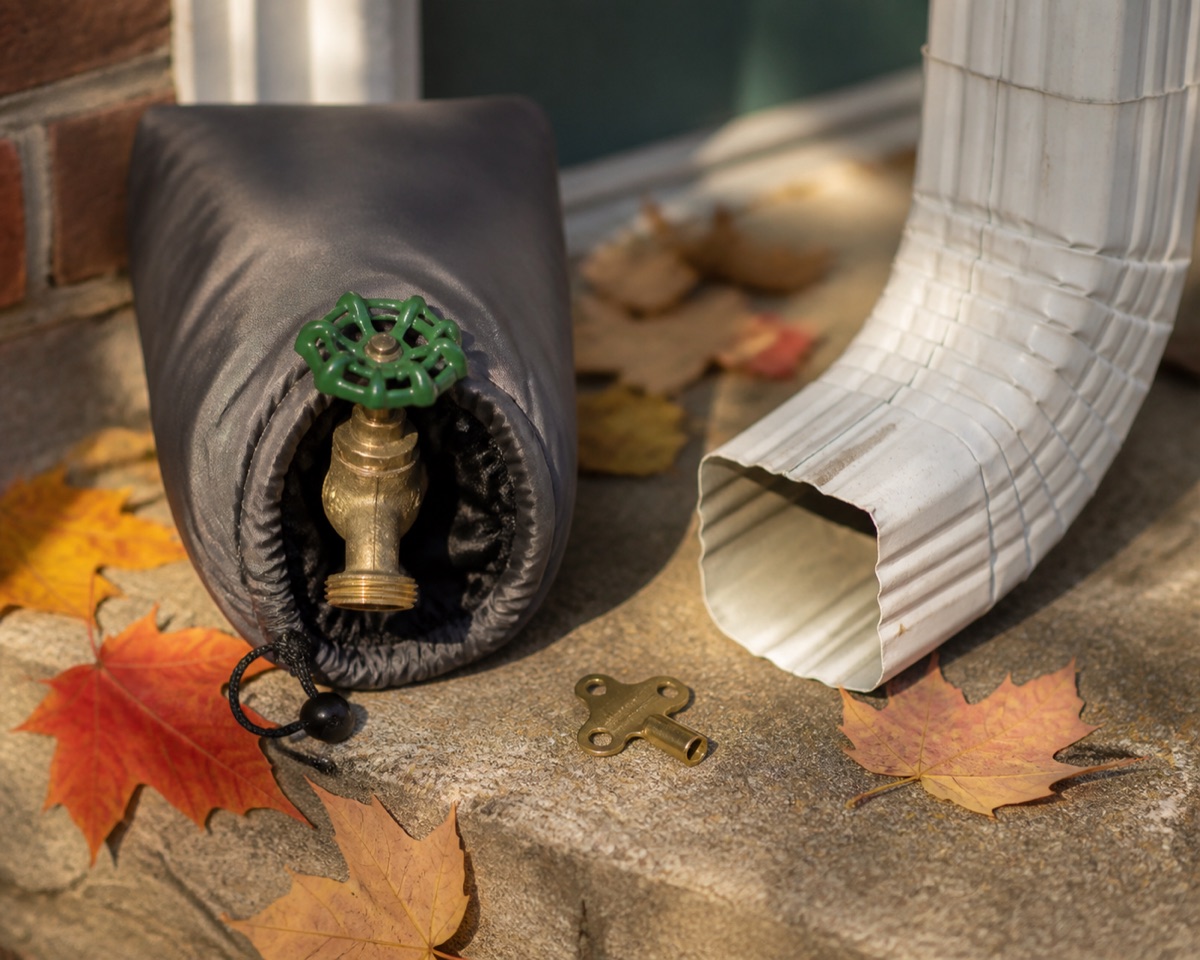
1. Disconnect every outdoor hose
The single highest-value item on this list, and it takes two minutes. A hose left attached stops the tap draining down, water is trapped, and the pipe splits — usually inside the wall, and usually flooding on the thaw when nobody is home.
Then: close the indoor isolation valve and leave the outdoor tap open all winter. This applies to frost-proof taps too. Full guide
2. Clear the gutters — after leaf fall finishes
Blocked gutters do not damage gutters; they saturate the ground against your foundations. Doing it in mid-autumn just means doing it twice.
Also test the downspouts with a hose, and check the discharge is at least a metre from the wall. If the work is above single-storey height, hire someone. Full guide
3. Bleed the radiators and check boiler pressure
Cold at the top means trapped air. Bleed with the heating off and cooled for an hour, working downstairs first and outward from the boiler, then top the pressure back to 1.0–1.5 bar cold.
If one room never warms, that is a balancing problem rather than air. Full guide
4. Seal the draughts — loft hatch first
An uninsulated, unsealed loft hatch is frequently the largest single air leak in a house, because warm air rises to exactly that point. Compression seal, a latch that pulls it tight, and insulation on the upper face.
Do not block air bricks, trickle vents, or any vent serving an open-flued appliance. Full guide
5. Check the loft insulation depth
Current guidance is 270–300 mm. Most houses have whatever was standard when they were built — 100 mm in the 1990s, 50 mm or less before that. Measuring takes two minutes with a tape.
6. Test the smoke and CO alarms — and their expiry dates
Heating season is when CO risk rises. The test button checks the battery and the sounder, not the sensor, so also check the manufacture date on the back: smoke alarms expire at 10 years, CO alarms at 5 to 10.
Book the annual service for any fuel-burning appliance now rather than in December. Full guide
7. Get the humidity under control before the windows stream
Winter condensation is warm moist air meeting cold glass. Target 40–60% relative humidity, toward the lower end in winter, and remember that laundry dried indoors releases one to two litres of water per load.
Full guide · Condensation types
If you have a basement or a sump
Test the sump pump by pouring water in until the float rises — not by lifting the float, which skips the switch that actually fails. Confirm the backup battery is charged and the discharge line cannot freeze.
Time and priority
| Job | Time | Cost if skipped |
|---|---|---|
| Disconnect hoses, drain taps | 15 min | Burst pipe inside a wall |
| Smoke and CO alarms | 15 min | The reason they exist |
| Bleed radiators | 30 min | Cold rooms, higher bills |
| Loft hatch seal | 1 hour | Largest single air leak |
| Gutters | 2 hours | Foundation damp |
| Loft insulation check | 10 min | Heat straight through the ceiling |
| Humidity control | Ongoing | Mould in cold corners |
Common questions
If I only do one thing, which?
Disconnect the outdoor hoses and drain the taps. It takes fifteen minutes and it prevents the most expensive single failure on the list — a pipe that splits inside a wall and floods on the thaw, often while the house is empty.
When is the right time to do all this?
Gutters after leaf fall has finished, not during. Everything else before the first hard frost. The hose disconnection in particular should not wait for a cold snap forecast, because the first one often arrives without one.
Why leave the outdoor tap open all winter?
With the indoor valve closed, an open tap lets residual water drain out and gives any remaining water room to expand rather than building pressure. Closing it again out of tidiness undoes the protection entirely.
Is it worth bleeding radiators every year?
Yes as a check, though if you are bleeding air out every few weeks something else is wrong — usually air being drawn in through a small leak or corrosion generating gas inside the system. That needs an inhibitor and probably a flush.
Should I close trickle vents to keep the heat in?
No. Sealing a house without ventilation is how condensation and mould start, and blocking a vent that serves an open-flued appliance is genuinely dangerous. Seal the unintentional leaks; leave the purpose-provided ventilation alone.