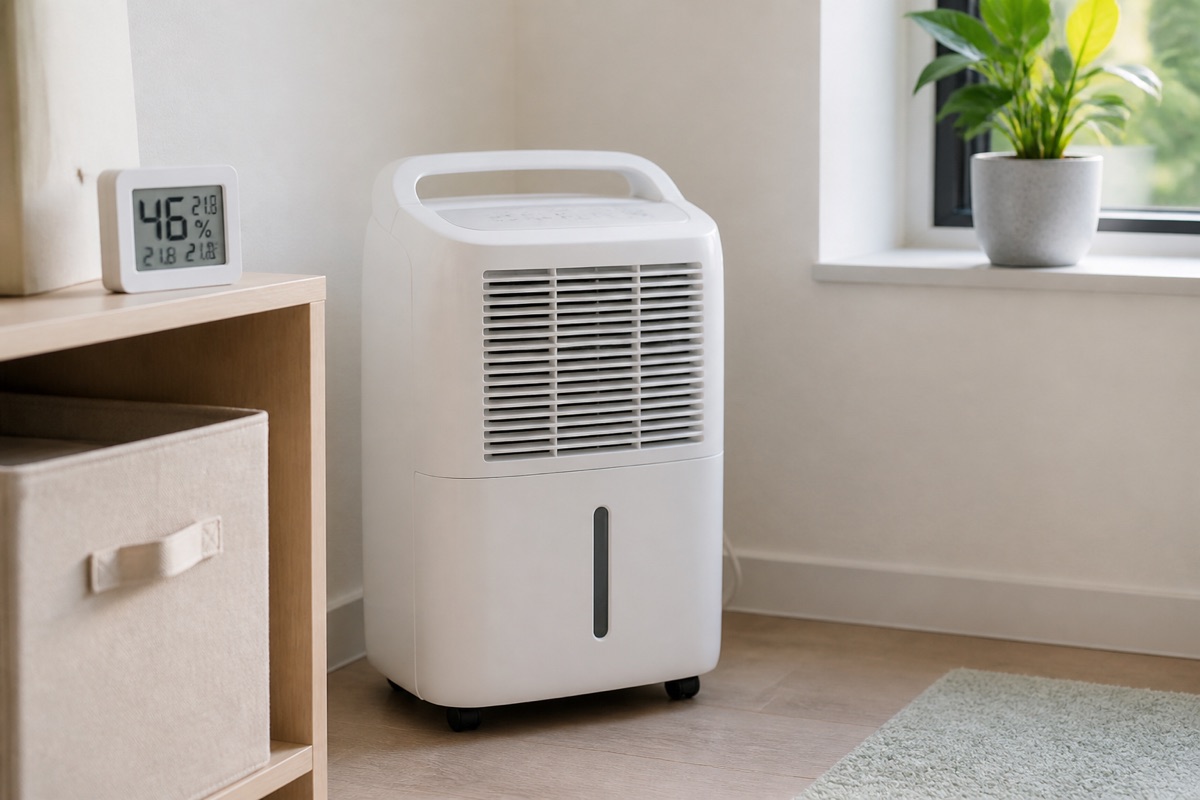
The short answer
Aim for 40–60% relative humidity, toward the lower end in winter. Below 30% causes dry airways, static and timber shrinkage; above 60% dust mites thrive and mould becomes possible on cold surfaces. A household of four generates several litres of water vapour a day, and the underestimated source is laundry dried indoors at one to two litres per load. Refrigerant dehumidifiers suit heated rooms above 15 °C; desiccant units work in cold garages. A dehumidifier alone will not fix corner mould — you also need ventilation and warmer surfaces.
Indoor humidity is one of the few household variables that affects your building, your possessions and your comfort simultaneously, and it is easy to measure and control. Most people never measure it at all.
The target
Aim for 40–60% relative humidity, and toward the lower end in winter.
| RH | What happens |
|---|---|
| Below 30% | Dry skin and airways, static, timber shrinkage — floor gaps, furniture joints opening, instruments going out of tune |
| 30–40% | Acceptable in winter. Slightly dry |
| 40–60% | The target range. Comfortable, and dust mites and mould are both suppressed |
| 60–70% | Dust mites thrive. Mould becomes possible on cold surfaces |
| Above 70% | Mould growth, condensation, musty smell, timber decay |
In winter the constraint is not the room air but the coldest surface in it. Warm air at 60% RH will condense on a single-glazed window or an uninsulated external wall corner, and that is where mould starts. This is why winter targets are lower.
Measure it
A digital hygrometer costs very little. Put one in each problem room — the readings differ substantially between a bathroom, a north-facing bedroom and a living room, and a single reading in the hall tells you nothing useful.
Where the moisture comes from
A household of four generates a surprising volume of water vapour daily:
- Breathing and perspiration — roughly a litre per person per day
- Cooking — one to two litres
- Showering and bathing — around half a litre per shower
- Drying laundry indoors — one to two litres per load
- Unvented tumble dryers
- Houseplants and aquariums
Laundry is the one people underestimate. A load of washing dried on an airer in a closed bedroom puts more water into that room than everything else combined, and a bedroom with mould in the corner very often has an airer in it.
Reduce it at source first
A dehumidifier running against an uncontrolled moisture source is a losing battle and an expensive one. Deal with the sources before buying a machine:
- Run the bathroom fan during and 20 minutes after showering
- Use the cooker hood, and put lids on pans
- Dry laundry outside, or in one ventilated room, or in a vented or condenser dryer
- Ventilate. Trickle vents open, and a short sharp airing — windows wide for five minutes — exchanges the air without cooling the fabric of the building
- Keep furniture off external walls so air can circulate behind it
- Fix the actual leaks — a defective gutter, rising damp, or a failed roof detail is a source no dehumidifier can outrun
Choosing a dehumidifier
| Type | How it works | Best for |
|---|---|---|
| Refrigerant (compressor) | Condenses moisture on a cold coil | Warm rooms, above about 15 °C. More efficient in normal living spaces |
| Desiccant | Absorbent wheel, regenerated with heat | Cold spaces — garages, unheated rooms. Works down to near freezing. Adds some warmth |
Sizing is quoted in litres extracted per day under test conditions, which are warmer and more humid than your house. A unit rated at 12 l/day will extract considerably less in a 18 °C room at 60% RH. Size up rather than down.
Running one well
- Set a target humidity — 50% is a good default — and let it cycle rather than running it continuously
- Close windows and doors in the room being treated. Dehumidifying with a window open dehumidifies the outdoors
- Leave clearance around the unit for airflow, typically 30 cm
- Use the continuous drain hose if you can reach a drain — emptying a tank daily is how dehumidifiers end up switched off
- Clean the filter monthly. A blocked filter cripples extraction, exactly as with any other appliance
The winter condensation pattern
If windows stream with water in the morning and there is mould in room corners and behind furniture, the sequence is almost always: too much moisture generated, not enough ventilation, and cold surfaces for it to condense on.
Fixing it takes all three: reduce the moisture, increase the ventilation, and raise the surface temperature — steady background heating rather than short intense bursts, and insulation where practical. A dehumidifier helps with the first, but a house that is heated for two hours a day and never aired will keep producing condensation whatever machine is running in it.
The other direction
If your readings sit below 30% in winter, which is common in well-heated modern houses in cold climates, the problem is dryness rather than damp. A humidifier helps, and so does simply drying laundry indoors deliberately. Wood floors, wooden furniture and musical instruments all benefit from staying above 35%.
Common questions
What humidity should I actually set it to?
50% is a good default year round. In winter, if you are getting condensation on windows or cold wall corners, drop to 45% — the constraint is not the room air but the coldest surface in the room, and lowering the air’s moisture content is what stops it condensing there.
My dehumidifier runs constantly and never reaches the target. Why?
Three usual causes: the room is not closed, so you are dehumidifying outdoor air; the unit is undersized for the space; or there is an uncontrolled moisture source — laundry drying, an unvented dryer, or an actual leak. Rated extraction figures are measured in warmer, more humid conditions than a British living room, so size up.
Refrigerant or desiccant?
Refrigerant for heated living spaces above about 15 °C, where it is more efficient. Desiccant for garages, unheated rooms and anywhere near freezing, where a compressor unit’s coil ices up and it stops working. Desiccant units also add a little warmth, which some people want and others do not.
Will a dehumidifier fix mould in a bedroom corner?
It removes the moisture but not the cause. Mould in a corner means warm damp air is meeting a cold surface — so you also need ventilation and, ideally, a warmer surface through steady background heating or insulation. A dehumidifier alone in a room that is never aired and heated in short bursts will keep losing.
Is very low humidity a problem too?
Below 30% causes dry airways and static, and it shrinks timber — floor gaps opening in winter, furniture joints loosening, instruments drifting out of tune. If your winter readings sit below 30%, the fix is a humidifier, not a dehumidifier.