The short answer
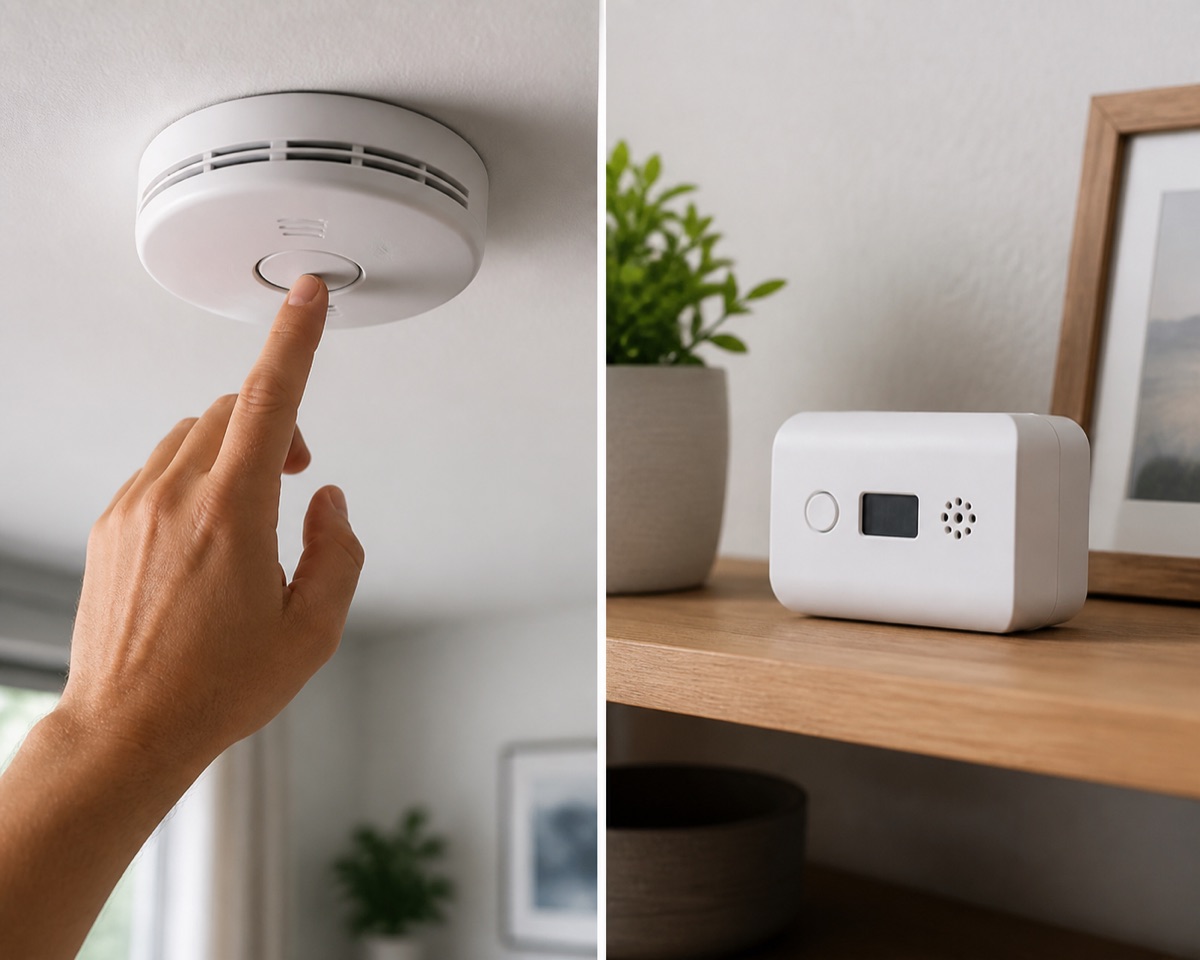
The test button checks the battery and the sounder — not the sensor. Sensors degrade whether or not the alarm is used, so a ten-year-old unit can beep on test and still fail to detect a fire. Check the manufacture date on the back annually and replace smoke alarms every 10 years, CO alarms every 5 to 10. Fit smoke alarms on every storey and in every bedroom, ceiling-mounted at least 300 mm from any wall, and interlink them. Put CO alarms 1 to 3 metres from any fuel-burning appliance, at breathing height.
Smoke and carbon monoxide alarms are the cheapest life-safety equipment in a house and the most likely to be quietly non-functional. Dead batteries, expired sensors, and units mounted in places where they cannot do their job are all extremely common.
The checks below take about ten minutes twice a year.
Two different devices, two different jobs
Smoke alarms detect combustion particles. CO alarms detect a gas that is colourless, odourless and produced by incomplete combustion. They are not interchangeable and neither substitutes for the other. A combination unit is fine, but a smoke alarm alone provides no protection against carbon monoxide whatsoever.
Smoke alarm types
| Type | Faster at | Notes |
|---|---|---|
| Ionisation | Fast, flaming fires | Prone to nuisance alarms from cooking. Being phased out in some markets |
| Photoelectric / optical | Slow, smouldering fires | Fewer false alarms. Smouldering fires are the more common household killer |
| Dual sensor | Both | The best single choice if fitting one type |
| Heat alarm | Rapid temperature rise | For kitchens and garages where smoke alarms nuisance-trip. Not a smoke alarm substitute |
Where to put them
Smoke alarms
- One on every storey, in the circulation space — hall and landing
- One in every bedroom, and outside every sleeping area
- Ceiling-mounted, at least 300 mm from any wall or light fitting. Air movement is poor in the corner where a wall meets a ceiling, and smoke does not reach a detector there promptly
- Not in kitchens or bathrooms — cooking fumes and steam cause nuisance alarms, and nuisance alarms are the main reason people disable detectors. Use a heat alarm in a kitchen
- Not in draughts — near a vent, a window or a ceiling fan
- Interlink them if you can. When one sounds, all sound. This matters enormously in a two-storey house where a fire starting downstairs must wake someone asleep upstairs. Radio-interlinked battery models make this achievable without wiring
CO alarms
- In every room containing a fuel-burning appliance — boiler, gas fire, wood burner, gas cooker
- In or near sleeping areas
- 1 to 3 metres horizontally from the appliance
- At breathing height, or per the manufacturer’s instructions. CO mixes with air rather than rising or sinking — the “CO rises” and “CO sinks” claims are both wrong
- Not directly above an appliance, not in a cupboard, not behind a curtain
Testing and maintenance
| Task | Frequency |
|---|---|
| Press the test button | Monthly |
| Vacuum dust from the casing | Every 6 months |
| Replace replaceable batteries | Annually, or at the first chirp |
| Check the manufacture date | Annually |
| Replace smoke alarms entirely | Every 10 years |
| Replace CO alarms entirely | Every 5–10 years — check the model |
The expiry date is the one people miss
Alarm sensors degrade whether or not the alarm is used. A ten-year-old smoke alarm with a fresh battery that beeps when tested may still fail to detect a fire — the test button confirms the battery and the sounder, not the sensor.
Every unit has a manufacture date printed on the back or inside the battery compartment. Take each alarm down once a year and look. If it is past its stated life, replace it — this is not a maintenance item, it is an expiry.
The chirping
An intermittent chirp every 30 to 60 seconds means one of three things: low battery, end of life, or dust in the chamber. Work through them in that order.
Chirping that continues after a new battery, on a unit approaching ten years old, is an end-of-life signal. Replace the unit.
Do not remove the battery to stop the noise and leave it that way. A disabled alarm is the condition found in a large share of homes where a fatal fire has occurred.
If a CO alarm sounds
Treat it as real, every time.
- Get everyone outside into fresh air immediately.
- Open windows and doors on the way out if you can do so without delay.
- Turn off fuel-burning appliances if it is safe and immediate.
- Call the emergency gas number or emergency services from outside.
- Do not go back in until it has been checked by a qualified person.
- Seek medical attention if anyone has headache, dizziness, nausea, confusion or breathlessness — symptoms easily mistaken for flu.
CO poisoning is cumulative and it impairs judgement, which is precisely why an alarm is necessary: the symptoms make people less able to recognise the danger they are in.
Preventing CO at source
- Annual servicing of every fuel-burning appliance by a qualified engineer — Gas Safe registered in the UK, or the equivalent where you live
- Keep flues and chimneys swept and clear
- Never use outdoor equipment indoors — camping stoves, patio heaters, generators, barbecues. This includes garages and porches
- Never block ventilation to a room with an open-flued appliance
- Watch for warning signs: yellow rather than blue flames, sooty staining around an appliance, excessive condensation, a pilot light that keeps going out
Common questions
The test button works, so the alarm is fine — right?
No. The test button confirms the battery and the sounder, not the sensor. Sensors degrade whether or not the alarm is used, so a ten-year-old unit can beep on test and still fail to detect a fire. Check the manufacture date on the back annually.
Why does mine chirp with a brand new battery?
Usually end of life. A unit approaching ten years old that keeps chirping after a battery change is signalling that the sensor has expired. Dust in the chamber is the other possibility — vacuum it first, and if the chirp continues, replace the unit.
Where exactly should a CO alarm go?
One to three metres horizontally from any fuel-burning appliance, at breathing height or as the manufacturer specifies, and not directly above the appliance or inside a cupboard. Carbon monoxide mixes with air — the claims that it rises or sinks are both wrong.
Can one combination alarm cover both jobs?
Yes, provided it is genuinely a combination unit and it is placed where both functions work — which is often a compromise, since ideal smoke placement is on the ceiling and ideal CO placement is lower. Separate units placed correctly beat one unit placed adequately.
Why does everyone insist on interlinked alarms?
Because a fire starting downstairs has to wake someone asleep upstairs. A standalone alarm in the hall may not be audible through a closed bedroom door. Radio-interlinked battery models make this achievable without wiring and it is the single biggest improvement most homes can make.