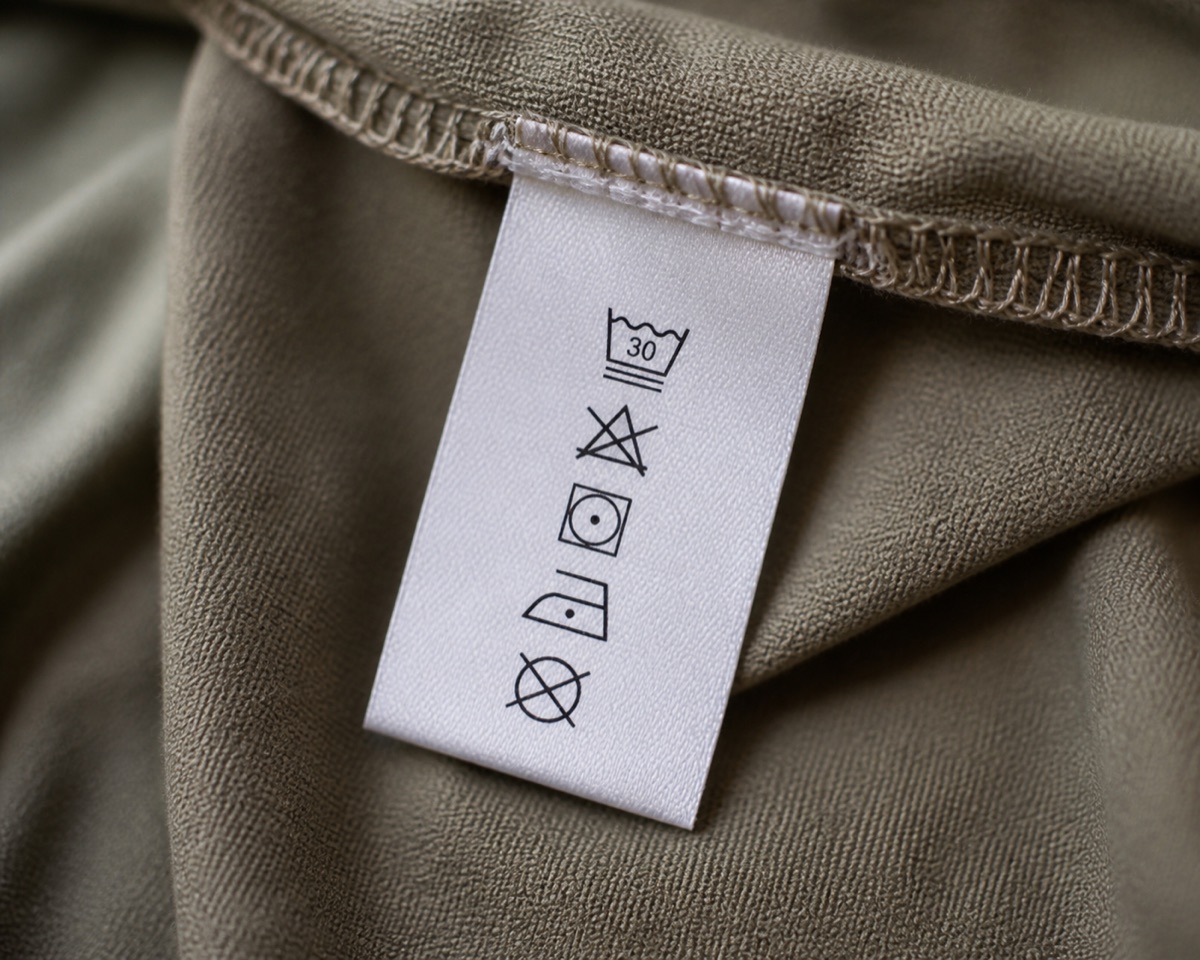
The short answer
Every care symbol is a variation on five shapes: a tub means washing, a triangle bleaching, a square drying, an iron ironing, and a circle professional cleaning. Three modifiers apply to all of them — a cross means never, one bar under means reduced agitation, two bars means much reduced, and dots mean temperature. The number in the tub is a maximum, not a recommendation; washing cooler is always allowed and usually better. When a label is missing, default to 30 °C, gentle cycle, low spin, dry flat, cool iron.
Care labels are deliberately wordless so that one garment can be sold across dozens of markets. The symbols are standardised, they follow an internal logic, and once you know the logic you can read any label without looking anything up.
The five basic shapes
Every symbol is a variation on five outlines, always in this order on the label:
| Shape | Means |
|---|---|
| Tub of water | Washing |
| Triangle | Bleaching |
| Square | Drying |
| Iron | Ironing |
| Circle | Professional cleaning |
The three modifiers
These apply to every shape and carry most of the meaning:
- A cross through the symbol — do not do this. Absolute.
- One bar under the symbol — reduced mechanical action. Use a gentle or synthetics cycle.
- Two bars under the symbol — much reduced action. Delicates or hand-wash cycle, low spin.
- Dots inside the symbol — temperature. More dots means hotter.
That is the whole system. Everything else is detail.
Washing
The tub carries either a number (the maximum temperature in °C) or dots.
| Symbol | Meaning |
|---|---|
| Tub with 30 / one dot | Maximum 30 °C |
| Tub with 40 / two dots | Maximum 40 °C |
| Tub with 60 / three dots | Maximum 60 °C |
| Tub with 95 / six dots | Maximum 95 °C — boil wash |
| Tub with a hand | Hand wash only, below 40 °C |
| Tub crossed out | Do not wash. Professional cleaning only |
The temperature is a maximum, not a recommendation. Washing cooler is always permitted and is nearly always better for the garment.
Bleaching
- Plain triangle — any bleach permitted
- Triangle with two diagonal lines — oxygen (non-chlorine) bleach only
- Triangle crossed out — no bleach of any kind
The two-line version is common and widely ignored. Chlorine bleach on a garment marked for oxygen bleach only will yellow elastane, weaken wool and silk, and strip colour unevenly.
Drying
The square is used two ways.
Tumble drying — a circle inside the square:
- One dot inside the circle — low heat
- Two dots — normal heat
- Circle-in-square crossed out — do not tumble dry
Natural drying — lines inside the square:
- One vertical line — hang to dry
- Two vertical lines — drip dry, do not spin first
- One horizontal line — dry flat. Standard for knitwear; hanging a wet wool jumper stretches it permanently
- A diagonal line in the top-left corner — dry in shade, away from direct sun
Ironing
| Symbol | Setting | Fabrics |
|---|---|---|
| Iron, one dot | Up to 110 °C | Acrylic, nylon, acetate |
| Iron, two dots | Up to 150 °C | Polyester, wool, silk |
| Iron, three dots | Up to 200 °C | Cotton, linen |
| Iron with steam crossed out | No steam — dry iron only | |
| Iron crossed out | Do not iron |
Professional cleaning
The circle is for the dry cleaner, and the letters inside tell them which solvent to use — P for perchloroethylene and hydrocarbons, F for hydrocarbon only, W for professional wet cleaning. A bar underneath means reduced process. A crossed circle means do not dry clean.
You do not need to interpret these. Hand the garment over with the label intact and the cleaner will read it.
Reading the whole label together
Symbols interact. A garment marked 40 °C with two bars, no tumble dry, dry flat, cool iron is telling you it is a knit containing something heat-sensitive — almost certainly wool or a wool blend, possibly with elastane. That is more useful than any single symbol.
The fibre content, usually printed on the same or an adjacent label, fills in the rest. Once you know a garment is 70% wool / 30% polyamide, you know why the label says what it says, and you know how much latitude you actually have.
When the label has gone
Cut-out or illegible labels are common. Sensible defaults:
- Unknown fabric: 30 °C, gentle cycle, low spin, dry flat, cool iron. Almost nothing is damaged by this
- Obvious knitwear: assume wool. Hand wash or wool cycle, dry flat
- Structured tailoring — jackets, coats with interfacing: assume dry clean. Washing destroys the internal construction
- Anything with beading, sequins or leather trim: hand wash at most, and test the trim first
The practical habit: photograph the care label of anything expensive when you buy it. Labels are the first thing to fade, and they always fade before the garment does.
Common questions
Is the number in the tub a recommendation or a maximum?
A maximum. Washing below it is always permitted and is nearly always better for the garment. The only reason to use the stated temperature is hygiene — bedding, towels and anything worn against a wound benefit from 60 °C.
What does it mean when there are bars under the tub but no other change?
The bars are about mechanical action, not temperature. One bar means a synthetics or gentle cycle; two bars means delicates or hand wash. A garment marked 40 °C with two bars is telling you it will tolerate the heat but not the agitation — a knit, or something with delicate construction.
Why does my garment say 30 °C but also “do not tumble dry”?
Because washing and drying stress fabric differently. Tumble drying combines heat with sustained mechanical action, which is what felts wool and destroys elastane recovery. The wash symbol tells you nothing about the dryer symbol and vice versa.
The label was cut out. What should I assume?
30 °C, gentle cycle, low spin, dry flat, cool iron. Almost nothing is damaged by that combination. Then look at the fibre content label if it survives, which is usually printed separately and tells you most of what the care label would have.
Do dry-clean-only labels really mean it?
“Dry clean only” generally does, particularly on structured tailoring where washing destroys the internal interfacing. “Dry clean” without “only” is a recommendation, and many such garments hand wash acceptably — at your own risk, and never on something you cannot replace.