The short answer
Research at UC Davis found bacteria applied to wooden boards did not survive well and did not readily transfer back to food, while the same bacteria persisted on plastic. Wood outperforms its reputation — provided it is looked after. Wash by hand, dry immediately, and stand it on edge rather than flat, which is what causes warping. Oil with food-grade mineral oil only: cooking oils go rancid in the wood and produce a sour smell that cannot be removed. Never put a wooden board in the dishwasher.
Wooden boards are better for knives than any plastic or composite alternative, and the research on their hygiene is more favourable than most people assume. What they need is a maintenance routine, and the two things that destroy them — water and the dishwasher — are both about the same underlying problem.
Grain direction, and why it costs what it costs
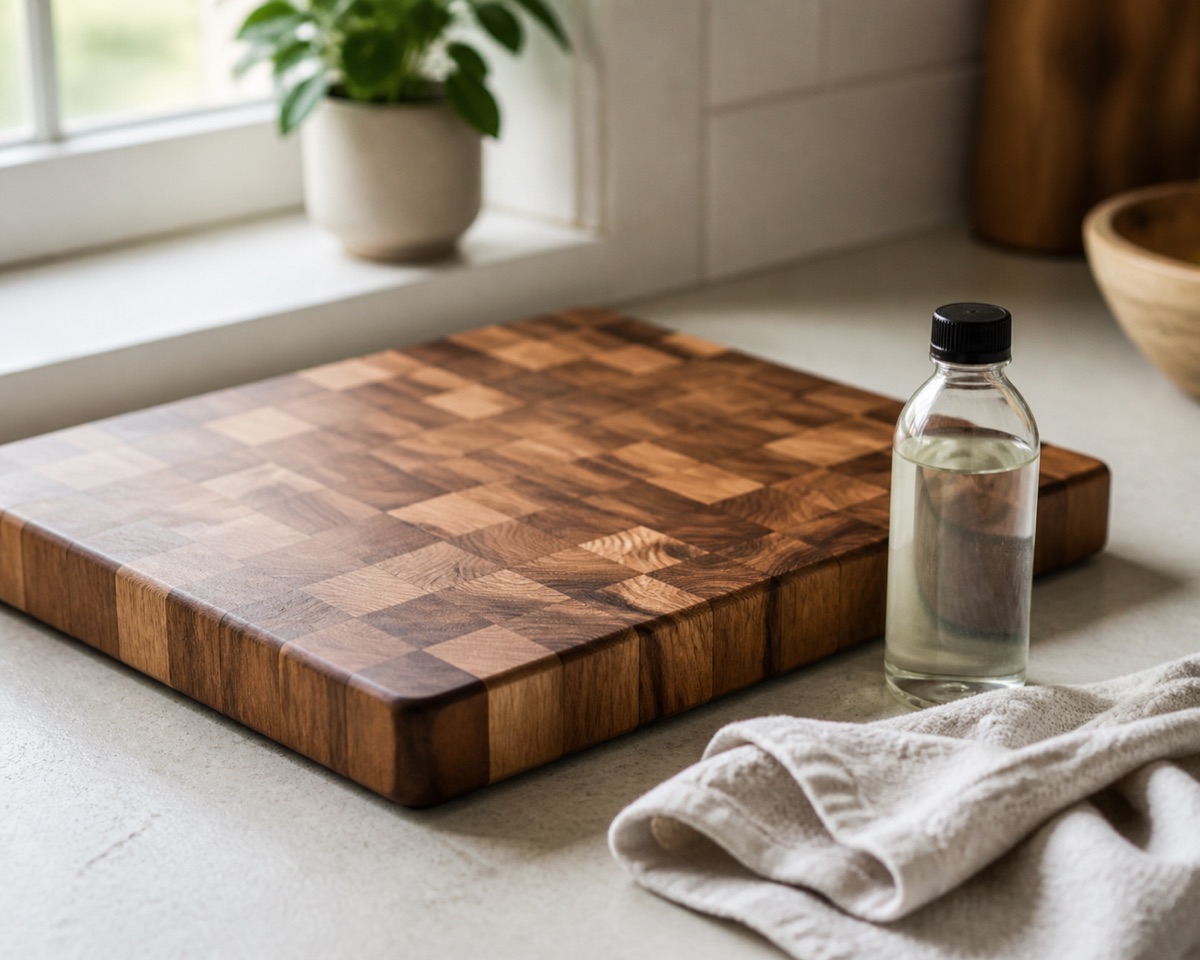
- End grain — the wood is cut so the fibre ends face up. Knife edges pass between fibres, which then close again. Gentlest on knives, self-healing, most expensive, and the heaviest.
- Edge grain — fibres run lengthwise along the surface. Knives cut across them. Durable, cheaper, and the sensible default for most kitchens.
- Face grain — the flat face of a board. Attractive, cheapest, and the least durable in use.
The hygiene question
Wood outperforms its reputation. Research at UC Davis in the 1990s found that bacteria applied to wooden boards did not survive well and did not readily transfer back to food, while the same bacteria persisted on plastic — particularly in the knife scores that plastic boards develop with use.
The mechanism appears to be that wood’s capillary structure draws bacteria below the surface where they die, and that many hardwoods contain natural antimicrobial compounds.
This is not a licence to be careless. Wash boards after every use, and keep a separate board for raw meat regardless of material.
Daily care
- Wash by hand immediately after use — hot water, dish soap, a brush or the rough side of a sponge.
- Rinse and dry both sides immediately.
- Stand it on edge to dry, so air reaches both faces. Laid flat on a worktop, the underside stays damp and the board cups.
The three things that will destroy it
- The dishwasher. Prolonged water contact plus heat plus alkaline detergent. A wooden board in a dishwasher will crack or delaminate, usually the first time
- Soaking in the sink
- Drying flat, which is the main cause of warping
Sanitising
For a board used with raw meat, or one that has developed a smell:
- Coarse salt and half a lemon — scrub the cut face of the lemon over salt spread on the board, leave 10 minutes, rinse. Deodorises and lifts surface staining
- White vinegar — wipe on, leave a few minutes, rinse
- Diluted bleach — one tablespoon per gallon of water, applied briefly, then rinsed thoroughly and dried. Effective, and not for routine use
- Hydrogen peroxide 3% — pour on, leave a few minutes, rinse
Oiling: the part that keeps it alive
Oil fills the wood’s pores so it absorbs less water. A dry board absorbs, swells, dries, shrinks — and that cycle is what splits boards.
Which oil
Food-grade mineral oil. It never goes rancid, it is cheap, and it is what board makers specify.
Do not use cooking oils. Olive, vegetable, sunflower and nut oils go rancid in the wood. The board develops a stale, sour smell over weeks that cannot be removed and it transfers to food. This is a common and irreversible mistake.
Board butter — mineral oil with beeswax — is a good finishing step. The wax slows moisture ingress further.
How
- Board clean and completely dry.
- Pour a generous amount of mineral oil on and spread it with a cloth over every surface including the edges and underside.
- Leave it to soak in for several hours, or overnight.
- Wipe off the excess.
- Optionally apply board butter and buff.
How often
| Stage | Frequency |
|---|---|
| New board | Daily for a week, then weekly for a month |
| Established, regular use | Monthly |
| Occasional use | Every 2–3 months |
| Whenever the wood looks pale, dry or feels rough | Immediately |
Fixing problems
Warping
A cupped board has absorbed water unevenly — usually from being dried flat. Lay it with the concave side down on a damp towel and weight the top, or dampen the convex side and stand it on edge. It often flattens over a day or two. Then oil it thoroughly and dry it on edge from now on.
Rough surface
Sand with 120 grit, then 220, then wipe clean and oil generously. This is a normal part of a wooden board’s life and it takes twenty minutes.
Deep knife scores
Sand them out. If they are too deep to sand, they are harbouring bacteria and it is time to replace the board.
Cracks and separated glue lines
A crack through the board, or a laminated board coming apart at a joint, is the end. Neither is reliably repairable, and both are dishwasher damage nine times out of ten.
Choosing one
- Close-grained hardwoods — maple, walnut, cherry, beech. Dense enough to resist absorption and kind to knives
- Avoid open-grained woods like oak and ash for boards; the pores hold moisture and food
- Bamboo is technically a grass and is harder than most hardwood — durable, but noticeably harder on knife edges
- Thickness of at least 3 cm for a board that will stay flat
- Feet or a groove so air circulates underneath
Common questions
Are wooden boards less hygienic than plastic?
The research suggests the opposite. Work at UC Davis found bacteria applied to wooden boards did not survive well and did not readily transfer back to food, while the same bacteria persisted on plastic — particularly in the knife scores plastic develops. Wash after every use regardless, and keep a separate board for raw meat.
Which oil should I use?
Food-grade mineral oil. Never cooking oils — olive, vegetable, sunflower and nut oils go rancid in the wood over weeks, producing a stale sour smell that cannot be removed and does transfer to food. This is a common and irreversible mistake.
My board has warped. Can I flatten it?
Often. Lay it with the concave side down on a damp towel and weight the top, or dampen the convex side and stand it on edge. It usually flattens over a day or two. Then oil it thoroughly and dry it standing on edge from now on — drying flat is what caused it.
How often does a board need oiling?
A new board daily for a week, then weekly for a month. After that, monthly with regular use, and immediately whenever the wood looks pale and dry or feels rough. Oil fills the pores so the wood absorbs less water, and it is what stops boards splitting.
When is a board finished?
When it has cracked through, when a laminated board is separating at a glue line, or when knife scores are too deep to sand out. The first two are dishwasher damage nine times out of ten. A merely rough surface is not finished — sand at 120 then 220 grit and oil it.