The short answer
The bang a sheet pan makes in a hot oven is thermal shock — one area heating faster than the rest, so the metal buckles to relieve the stress. Heavier gauge pans barely do it. Dark pans absorb more radiant heat, so reduce the oven by 10–15 °C or check earlier. Hand wash bare aluminium: dishwasher detergent is strongly alkaline and turns it permanently dull grey. Never line the oven floor with foil, which blocks airflow and can obstruct a gas burner. Sticky silicone is oxidised fat, recoverable with a very hot degreasing soak.
Bakeware fails in ways that look like damage but usually are not. Aluminium sheet pans warp with a bang in a hot oven. Dark steel pans go brown and blotchy. Silicone gets sticky. Each has a cause and most have a fix.
Aluminium sheet pans
Uncoated aluminium is what commercial kitchens use, and for good reason: it conducts heat better than steel, it is light, and it is cheap enough to be replaceable.
Warping, and the bang
The startling noise when a sheet pan flexes in the oven is thermal shock. One area of the pan is heating or cooling faster than the rest, and the metal buckles to relieve the stress. It usually flattens again as the temperature evens out.
Reducing it:
- Distribute food across the pan rather than clustering it in the middle
- Do not put a cold pan into a very hot oven if you can avoid it — let it come up with the oven
- Never run cold water onto a hot pan
- Buy heavier gauge. Thin pans warp; a proper commercial half-sheet at 18 gauge barely does. This is the real fix
Discolouration
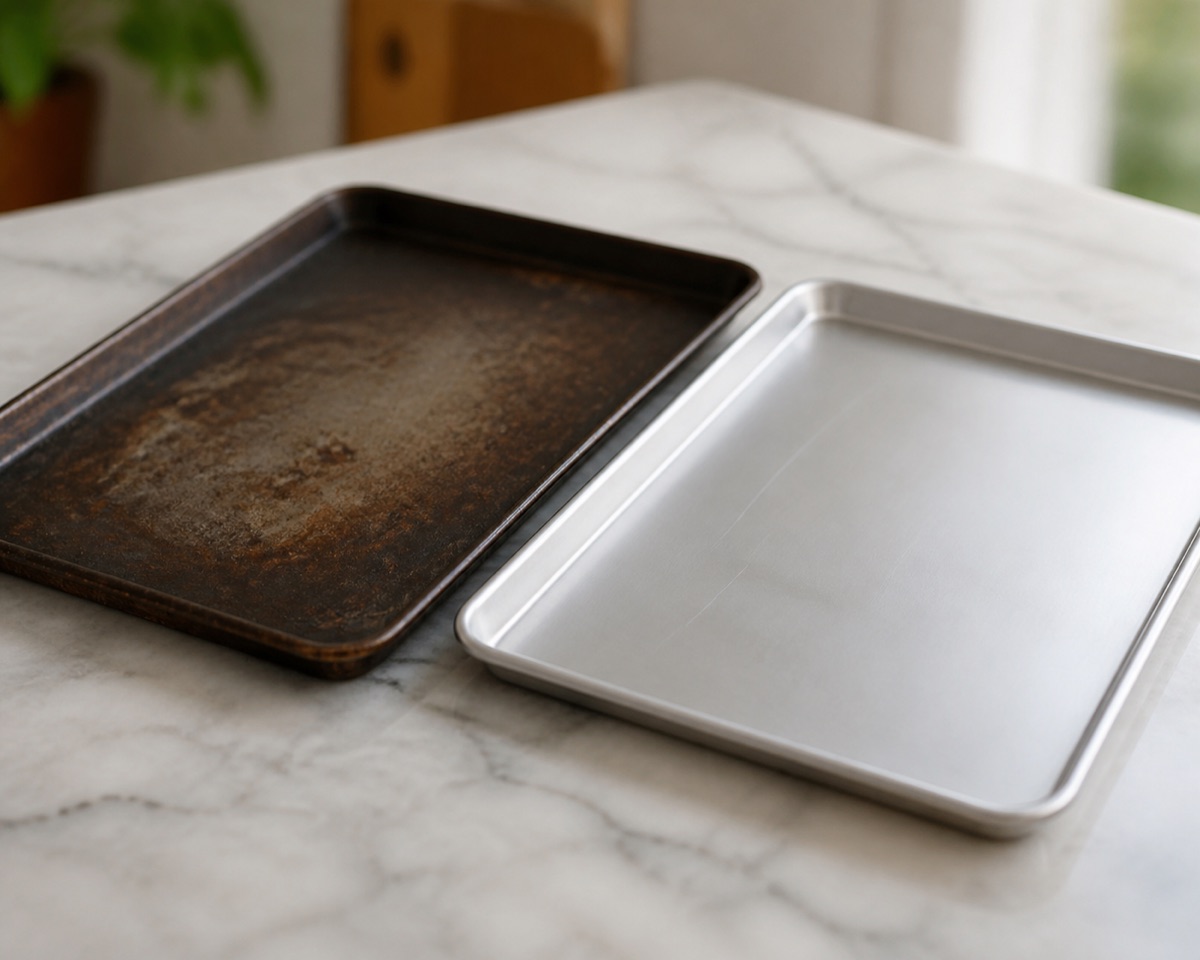
Aluminium darkens and develops a mottled patina with use. This is oxidation, it is harmless, and it does not affect performance. Do not attempt to scour it back to new — you will remove metal and thin the pan.
Care
- Hand wash. Dishwasher detergent is strongly alkaline and reacts with aluminium, leaving it dull grey and chalky. Permanent
- Bar Keepers Friend or a paste of bicarbonate for baked-on residue
- Line with parchment for anything sticky — cheaper than the effort of cleaning
- Avoid prolonged contact with acidic or salty food, which pits bare aluminium
Dark and non-stick coated steel
Dark surfaces absorb more radiant heat, which means food browns faster. Recipes are generally written for light-coloured pans, so with dark bakeware reduce the oven by about 10–15 °C (25 °F), or check earlier.
- Hand wash, soft sponge, no abrasives
- Nothing metal — no metal spatulas, no knives cutting in the pan
- Same heat limits as non-stick cookware: keep below about 230 °C and never use under a grill element
- Replace when the coating flakes
Carbon steel bakeware
Baking trays, loaf tins and pizza pans in carbon steel season exactly like a carbon steel frying pan, and a well-used baking sheet develops a genuinely non-stick surface.
- Dry immediately after washing, and heat briefly to drive off moisture
- Wipe with a trace of oil
- Do not scour off the seasoning — the dark patina is the point
Glass
Borosilicate and tempered soda-lime glass are both used for bakeware and they behave differently. The critical rule for both is avoid sudden temperature change, which causes shattering:
- Never move a dish from the fridge or freezer straight into a hot oven
- Never put a hot dish onto a cold or wet surface — use a dry cloth or a trivet
- Never add cold liquid to a hot glass dish
- Never use glass under a grill element
Glass also insulates rather than conducts, so it heats slowly and holds heat. Food continues cooking after it comes out, and edges brown less than in metal.
Silicone
Convenient, flexible, and it has one specific failure mode: it becomes permanently sticky.
The cause is fat absorbed into the silicone that has oxidised. To recover it, soak in very hot water with a strong degreasing dish soap and scrub with a brush, or bake the empty mould at 180 °C for 10 minutes and wash immediately while hot. Repeated cases mean the mould is at the end of its useful life.
Buy platinum-cured silicone if you can — it is more stable than the cheaper peroxide-cured type, which is what usually goes sticky and can retain an odour.
Getting baked-on residue off anything
- Cover the affected area with bicarbonate of soda.
- Add just enough hydrogen peroxide (3%) or hot water to make a paste.
- Leave 2 to 4 hours, or overnight for heavy carbon.
- Scrub with a nylon brush and rinse.
For pans that will take it — bare aluminium and stainless — Bar Keepers Friend is faster and more effective. Not on non-stick, and not on anodised aluminium.
Storage
- Do not nest coated pans directly. Put a sheet of kitchen paper or a pan protector between them — nesting is a common cause of scratched non-stick
- Store bakeware completely dry, particularly carbon steel
- Vertical storage in a rack is kinder than stacking
What to buy
| Item | Best material |
|---|---|
| Sheet pans | Heavy-gauge bare aluminium (commercial half-sheet) |
| Cake tins | Light anodised aluminium for even browning |
| Loaf tins | Carbon steel or heavy aluminium |
| Roasting tins | Stainless or heavy carbon steel — needs to take direct heat |
| Casserole dishes | Glass or ceramic, for slow even heat |
| Muffin and shaped moulds | Coated steel, or good silicone |
Common questions
Why does my sheet pan bang in the oven?
Thermal shock — one area heating faster than the rest, so the metal buckles to relieve the stress. It usually flattens again as temperature evens out. Distributing food across the whole pan helps, and heavier gauge pans barely do it at all.
Should I reduce the temperature for dark pans?
Yes, by roughly 10–15 °C. Dark surfaces absorb more radiant heat so food browns faster, and most recipes are written assuming a light-coloured pan. Otherwise check considerably earlier than the stated time.
Is lining the oven floor with foil a good idea?
No, and manufacturers are near-unanimous about it. Foil blocks airflow, can reflect heat back into the element, and on gas ovens can obstruct the burner. Use a tray on a lower shelf to catch drips instead.
My silicone moulds have gone sticky. Can I fix them?
Sometimes. The stickiness is absorbed fat that has oxidised. Soak in very hot water with a strong degreasing dish soap and scrub, or bake the empty mould at 180 °C for ten minutes and wash immediately while hot. Repeated cases mean it has reached the end of its life.
Why did my glass dish shatter?
Sudden temperature change, almost always. Moving a dish from fridge to hot oven, setting a hot dish on a cold or wet surface, or adding cold liquid to a hot dish will all do it. Glass also should never go under a grill element.