The short answer
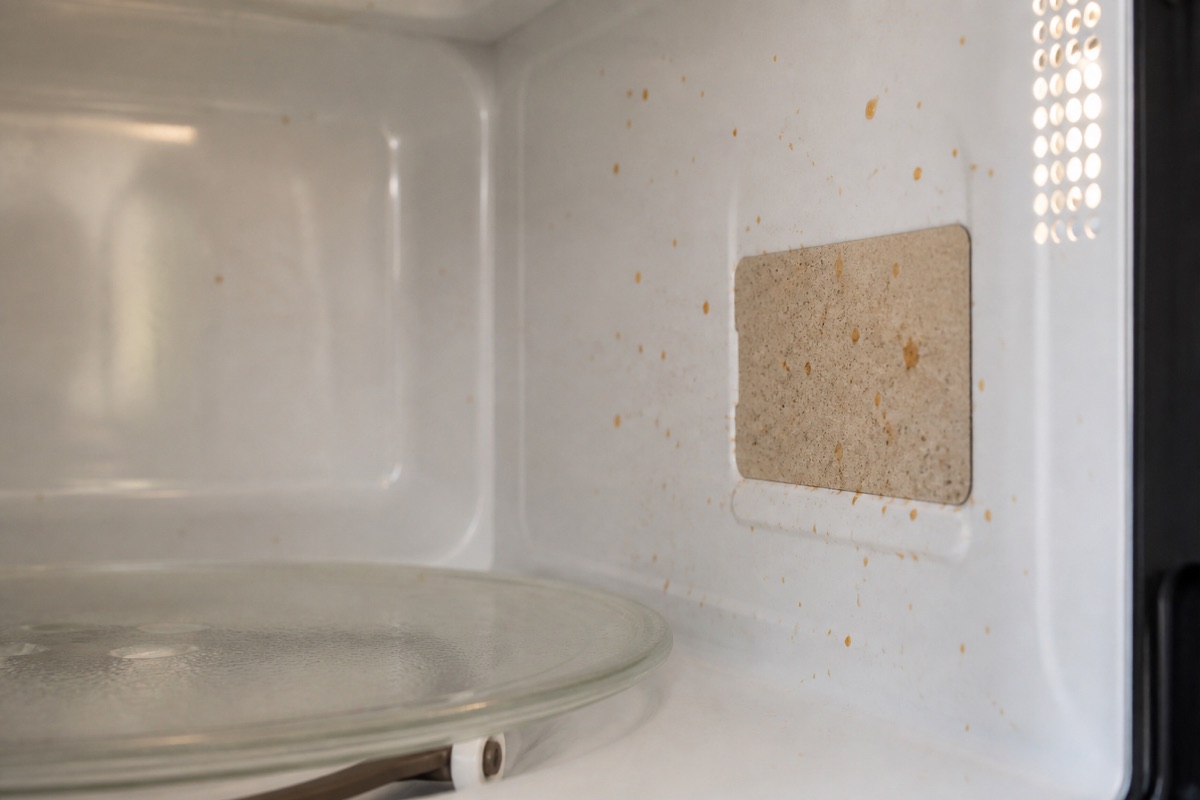
The small beige or grey rectangle on your microwave’s side wall is the waveguide cover, made of mica, and it is the part most likely to cause a fault. Splatter carbonises on it, carbon absorbs microwave energy instead of passing it, and the result is arcing that can destroy the magnetron. Clean it with a barely damp cloth — never soak it, because wet mica delaminates. Replace it when charred, blistered or holed: mica sheet costs a few pounds and cuts to size with scissors.
Most people clean the inside of a microwave and stop. There is a small panel on the side wall — usually a beige or grey rectangle about the size of a playing card — that almost nobody touches, and it is the part most likely to cause an actual fault.
What that panel is
It is the waveguide cover. Microwaves are generated by the magnetron and delivered into the cavity through a channel called the waveguide; the cover is a thin sheet that closes the mouth of that channel. It is transparent to microwaves and it keeps food and steam out of the works.
It is almost always made of mica — a mineral sheet, slightly translucent, with a laminated feel to the edges. Mica is chosen because it passes microwave energy, tolerates heat, and is cheap. It is also porous, and it does not survive being soaked or scrubbed.
Why it matters
Splatter lands on the cover and gets cooked onto it. Each subsequent use heats that carbonised residue, and carbon absorbs microwave energy rather than passing it. Get enough of it in one spot and you get local overheating, then charring, then arcing — visible as sparks or a flash in the corner of the cavity — and arcing at the waveguide mouth can take the magnetron with it.
Symptoms in escalating order:
- Brown staining on the panel
- A burnt smell during use with no food to explain it
- Visible dark scorch marks or blistering on the panel
- Sparking or arcing near the panel
- The oven runs but no longer heats
Cleaning it
Unplug the microwave first. Never remove the outer casing — the high-voltage capacitor can hold a lethal charge long after the unit is unplugged. Everything here is done from inside the cavity, which is safe.
- Wipe the cover with a cloth barely damp with warm soapy water. Not wet. Mica absorbs water and delaminates.
- For cooked-on residue, hold the damp cloth against the spot for a minute to soften it, then wipe again. Repeat rather than scrub.
- Dry it immediately and thoroughly.
What will destroy it
- Soaking, or spraying cleaner directly onto it
- Abrasive pads, scouring cream, or a scraper
- Removing it for a wash — most are held by a tab or a single screw and can be removed, but a soaked mica sheet is scrap
Replacing it
Replace when the panel is charred, blistered, cracked, soft, or has a hole burned through it. Do not run the oven with a damaged cover and do not run it with the cover removed.
Mica sheet is sold as a universal blank — a plain rectangle, typically a few pounds or dollars — that you cut to size with scissors. Take the old cover out, use it as a template, mark it with a pencil, cut, punch the mounting hole with a hole punch or a screwdriver tip, and fit. It is a ten-minute job with no tools worth the name.
If the panel behind the cover is itself scorched, or the metal at the waveguide mouth is pitted, stop and get it looked at. That is beyond a cover replacement.
Cleaning the rest of the cavity
The steam method, which needs no chemicals:
- Put a microwave-safe bowl with 250 ml of water and a few slices of lemon — or a tablespoon of white vinegar — into the oven.
- Run on full power for 3 to 5 minutes, until the window fogs and the water is boiling.
- Leave the door shut for 5 minutes. The steam does the work in this step; opening early wastes it.
- Remove the bowl carefully — superheated water can boil over suddenly. Wipe the interior with a cloth. Softened residue lifts with no pressure.
Take the turntable and its roller ring out and wash them separately; the ring track collects crumbs that the plate hides.
Wipe the door seal and the flat surface it meets. A microwave door seal is part of the containment system, and food residue holding it open is worth removing on principle.
How often
| Task | Frequency |
|---|---|
| Wipe visible splatter | As it happens |
| Steam clean the cavity | Monthly |
| Inspect and wipe the waveguide cover | Monthly |
| Wash turntable and roller ring | Monthly |
The habit that prevents all of it
Cover food. A plate, a vented lid, or a sheet of kitchen paper stops essentially all splatter, and splatter is the entire mechanism by which the waveguide cover fails. It is a five-second habit that removes a failure mode.
Common questions
Can I run the microwave with the waveguide cover removed?
No. The cover keeps food and steam out of the waveguide channel, and running without it lets residue reach the magnetron feed. If the cover is damaged, replace it before using the oven — mica sheet is inexpensive and cuts to size with scissors.
What causes the sparking in the corner of the cavity?
Usually carbonised food on the waveguide cover. Carbon absorbs microwave energy rather than passing it, which produces local overheating and then arcing. Occasionally it is metal — a foil fragment, or a plate with a metallic trim. Stop using the oven until you have found which.
Why can I not just wash the cover?
Mica is a laminated mineral sheet and it is porous. Soaking it causes delamination, after which it is scrap. Wipe it with a barely damp cloth, hold the cloth against stubborn spots to soften them, and dry it immediately.
How do I know when to replace it rather than clean it?
Replace if it is charred, blistered, cracked, soft to the touch, or holed. Brown staining alone is cosmetic and can stay. If the metal behind the cover is pitted, that is beyond a cover swap and needs looking at.
Is the steam cleaning method safe for all microwaves?
Yes — it is just water. Two cautions: superheated water can boil over suddenly when disturbed, so lift the bowl carefully, and keep the door closed for five minutes after the cycle, because that dwell time is where the softening actually happens.