The short answer
A musty smell from a front-loader is the door gasket, not the machine. Fold the rubber back, clear the channel, wipe it with a solution of 180 ml bleach per 3.8 litres of water, and leave it 10 minutes before rinsing. Then clean the drain pump filter behind the lower front panel, which holds standing water permanently and is the source people never find. Four habits stop it returning: less detergent, no fabric softener, one 60 °C wash a week, and leaving the door ajar.
If your laundry comes out of a front-load washer smelling faintly of a damp basement, the machine is almost certainly not the problem. The door gasket is.
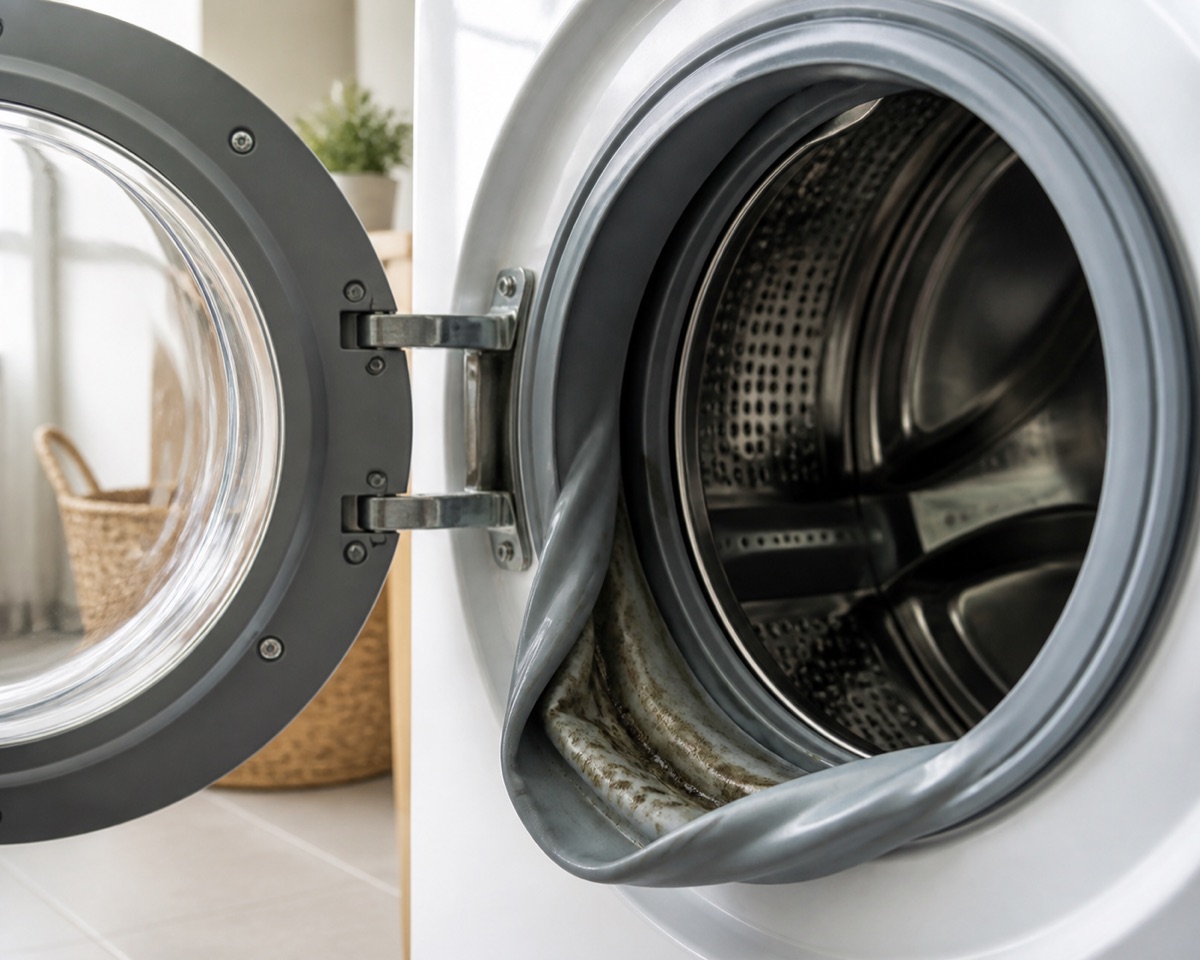
That flexible rubber boot between the door and the drum is the one part of the machine designed to hold water in — and it does the job so well that it never fully drains. Fold it back and you will usually find a shallow trough holding a film of water, lint, hair, and a grey-brown paste of detergent and fabric softener residue. That combination is a near-perfect growth medium, and what grows in it is what you are smelling.
Why it happens, specifically
Four things drive gasket growth, and three of them are habits rather than faults:
- Too much detergent. This is the single most common cause. Surplus surfactant does not rinse away; it stays behind as a sticky film that traps soil and feeds microbial growth. High-efficiency machines use a fraction of the water of a top-loader, so a dose sized by eye is almost always several times too much.
- Fabric softener. Softener works by depositing a waxy cationic coating on fibres. It deposits that same coating on the gasket, the dispenser, and the drum, and it is considerably harder to rinse off than detergent.
- Cold washes only. Washing exclusively at 30 °C / 86 °F is good for fabrics and energy bills, but it never raises the interior temperature enough to disrupt a biofilm that has established itself.
- A closed door. A sealed drum with a wet gasket stays at 100% humidity indefinitely.
Before you start
Check your manual for one thing: whether the manufacturer permits chlorine bleach. Most do for the gasket and drum. A minority — particularly some machines with certain stainless or coated components — specify oxygen bleach only. If the manual says no bleach, use the hydrogen peroxide method further down instead.
Two hard rules, regardless of machine:
- Never mix chlorine bleach with vinegar, or with any acidic descaler. It releases chlorine gas. If you have already used vinegar in the drum, run a rinse cycle and ventilate before going anywhere near bleach.
- Never mix chlorine bleach with ammonia, which is in many glass and multi-surface cleaners.
Open a window. Wear gloves — this is unpleasant to touch more than it is dangerous.
The clean, step by step
1. Empty the trough
Pull the gasket toward you and fold the outer lip back to expose the channel underneath. Work around the full circumference. Pull out the hair, lint, and the assorted coins, hair grips and plastic tabs that collect at the bottom. A dry paper towel does most of this better than a wet cloth, which just smears the residue around.
2. Wipe with a disinfecting solution
Mix roughly 3/4 cup (180 ml) of household chlorine bleach into 1 gallon (3.8 litres) of water. Soak a cloth, wring it out so it is damp rather than dripping, and wipe every surface of the folded-back gasket — top, underside, and the channel. Pay attention to the bottom third, between roughly four and eight o’clock, where water sits longest and growth is always worst.
If bleach is not permitted: use 3% hydrogen peroxide straight from the bottle, undiluted, on the same surfaces. It is slower and less aggressive on established growth but safe on effectively every gasket material.
3. Let it dwell, then rinse
Leave the solution on the rubber for 10 minutes. Contact time is what does the work; wiping and immediately drying accomplishes very little. Then wipe the whole gasket down with a cloth wrung out in clean water, and dry it with a towel.
4. Deal with the black spots that stay
If dark speckling remains after cleaning, the growth has penetrated the rubber rather than sitting on it. Cosmetically it will not come out. Functionally, this matters only if the gasket has gone hard, cracked, or started leaking — in which case it is a replaceable part, typically £40–90 / $50–120, and a job most people can do in under an hour with the manual open.
5. Clean the drain pump filter — the part everyone skips
Behind the small access panel at the bottom front of the machine sits the drain pump filter, and behind it a reservoir of standing water that never empties on its own. On a machine that has never had it cleaned, this is frequently the actual source of the smell.
Put a shallow tray and towels down first, because up to a litre of water will come out. Some machines have a small drain hose beside the filter for exactly this. Unscrew the filter counter-clockwise, rinse it under a tap, clear the housing with a cloth, and screw it back in until it is firmly seated. A filter that is not fully home will leak.
6. Pull the dispenser drawer
Most drawers release with a tab in the softener compartment. Soak it in hot water, brush out the siphon cap, and wipe the empty cavity in the machine — the roof of that cavity is usually coated in the same residue.
7. Run a hot maintenance cycle
Use the machine’s Tub Clean or Drum Clean cycle if it has one, empty, with the dose of tub cleaner or bleach the manual specifies. If it does not have one, run the longest, hottest cycle available — 90 °C / 194 °F if offered — empty.
Keeping it from coming back
The clean above takes about 40 minutes. Doing it repeatedly because nothing else changed is the avoidable part.
- Cut the detergent. Use the manufacturer’s stated dose for your load size and water hardness as a maximum, not a starting point. If your machine has an auto-dose reservoir, this is largely handled for you. If clothes feel stiff or the drum produces visible suds at the end of a wash, you are still overdosing.
- Drop the fabric softener, or use it on a fraction of loads. Wool dryer balls or a small dose of white vinegar in the rinse compartment do most of what people actually want from softener without the waxy deposit.
- Run one hot wash a week. Towels, bedding or whites at 60 °C / 140 °F is enough to keep a biofilm from establishing.
- Wipe the gasket after the last load of the day, and leave the door and the dispenser drawer ajar. This one habit does more than everything else combined.
- Do not leave wet laundry in the drum. Move it within an hour.
How often
| Task | Frequency |
|---|---|
| Wipe gasket dry | After the last load of the day |
| Full gasket clean | Monthly |
| Hot maintenance cycle | Monthly |
| Drain pump filter | Every 3 months |
| Dispenser drawer | Every 3 months |
When it is not the gasket
If you have done all of the above and the smell returns within a week, look at the drain. A washer standpipe with no trap, or a drain hose pushed too far down one, lets sewer gas back into the machine. The tell is that the smell is sulphurous rather than musty, and that it is present when you open a machine that has been sitting dry. That is a plumbing fix, not a cleaning one.
Common questions
Will the black spots ever come out?
If they remain after a proper clean with adequate dwell time, the growth has penetrated the rubber rather than sitting on it, and cosmetically it will not come out. Functionally this only matters if the gasket has hardened, cracked or started leaking — in which case it is a replaceable part and a job most people can do in under an hour.
Can I use vinegar instead of bleach?
You can, but never after bleach or in the same session — acid plus chlorine bleach releases chlorine gas. If your manual prohibits bleach, use 3% hydrogen peroxide undiluted instead. It is slower on established growth but safe on effectively every gasket material.
Why does the smell come back within weeks?
Because nothing else changed. The four drivers are excess detergent, fabric softener, cold-only washing, and a closed door. Cleaning without addressing those means doing it again every month. The single most effective habit is wiping the gasket dry after the last load and leaving the door ajar.
What is the drain pump filter and where is it?
Behind the small access panel at the bottom front. It holds a reservoir of standing water that never empties on its own, and on a machine that has never had it cleaned it is frequently the actual source of the smell. Put towels and a tray down first — up to a litre will come out.
The smell is sulphurous rather than musty. Is that still the gasket?
Probably not. A sulphurous smell present when you open a machine that has been sitting dry points to the drain — a standpipe with no trap, or a drain hose pushed too far down one, letting sewer gas back into the machine. That is a plumbing fix, not a cleaning one.