The short answer
A dryer needing two cycles has an airflow problem, not a heat problem. The lint screen catches only part of what comes off; the rest builds up in the duct. Clean the full path — screen slot, blower housing, transition duct and wall duct — annually, or every six months on a long run. Test the screen by running water onto it: if it beads rather than passing through, dryer-sheet film is blocking it. Maximum duct length is about 35 feet, minus roughly 5 feet per 90° bend.
A tumble dryer that needs two cycles to dry one load is not wearing out. It is telling you that the air cannot get out.
A dryer works by moving heated air through the drum and carrying the moisture away. Every restriction in the path from the drum to the outside wall reduces that airflow, and the machine compensates by running longer and hotter. That costs money, shortens the life of the heating element and the thermal fuse, and — in the part of this that is not merely expensive — accumulated lint in a hot duct is a genuine fire load. Dryers are a recurring cause of home fires, and failure to clean is consistently the leading contributing factor.
The lint screen is not the vent
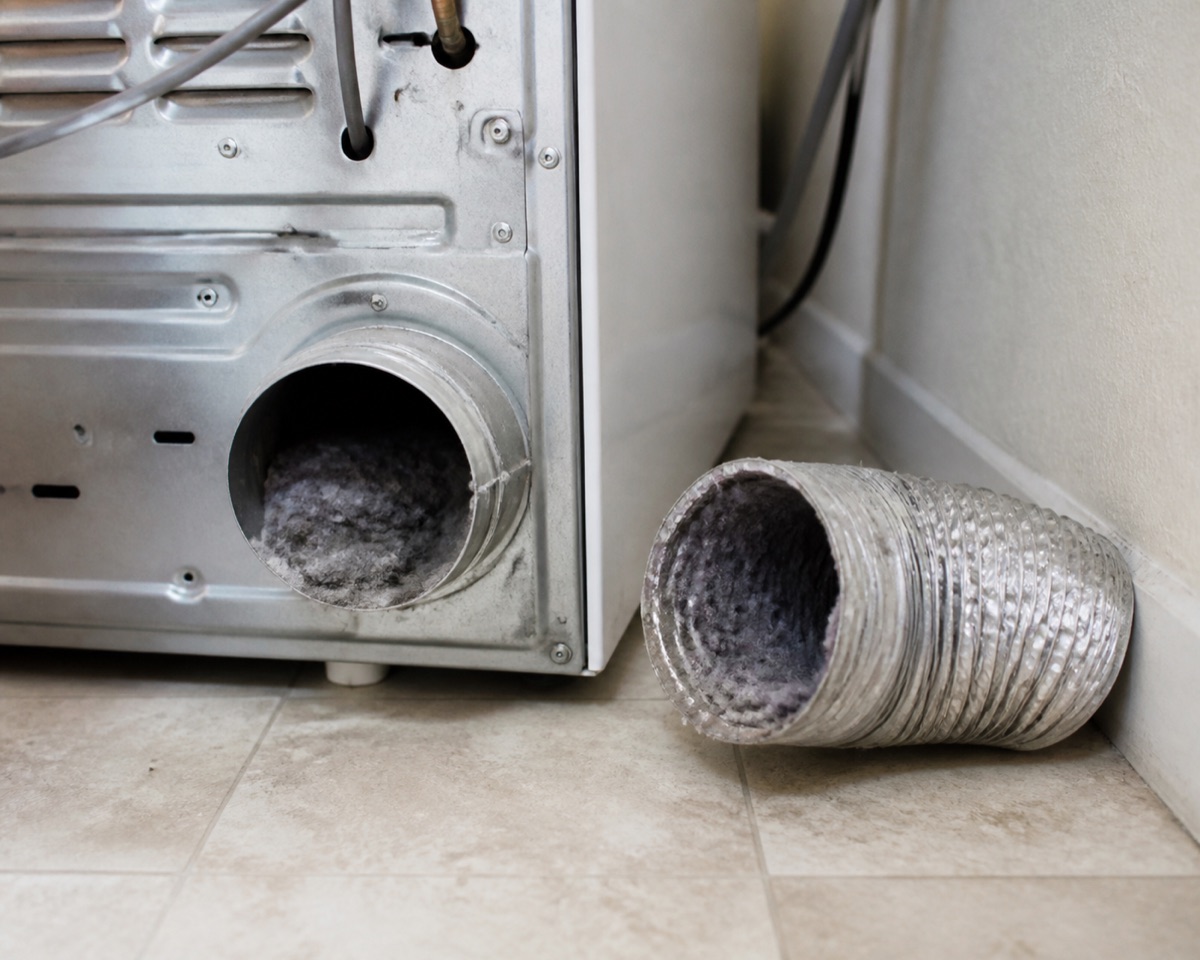
This is the core misunderstanding. The lint screen catches a large share of the lint, but a meaningful fraction goes past it every single load, and that fraction is what builds up downstream. A household that has diligently cleaned the screen after every load for eight years can still have a duct that is two-thirds blocked.
The full path has four sections, and all four need attention:
- The lint screen and the slot it sits in
- The blower housing behind the slot
- The transition duct — the flexible section from the back of the machine to the wall
- The wall duct and the exterior hood
Symptoms worth acting on
- Loads need a second cycle, or come out hot but still damp
- The top of the dryer is hot to the touch after a cycle
- The room becomes humid or noticeably warm while the dryer runs
- A faint burning or scorched smell
- The exterior vent flap does not open fully, or does not open at all
- Lint visible around the exterior hood
Two checks that take a minute each
The water test on the lint screen
Take the screen out — with no lint on it — and run water onto it from a tap. It should pass straight through. If the water beads or pools, the mesh is glazed with a film left by dryer sheets and liquid softener. That film blocks airflow while looking perfectly clean.
Fix: scrub both sides with warm water, a drop of dish soap and a soft brush, rinse thoroughly, dry fully before refitting. Then repeat this test every six months.
The exterior hood test
Start the dryer on a heat setting and go outside. The flap should be pushed open by a strong, warm airflow. A flap that barely lifts, or one held permanently open by packed lint, tells you the blockage without any disassembly.
Cleaning the duct
Unplug the dryer. If it is a gas dryer, turn off the gas supply valve and do not disconnect the gas line — that is a job for a qualified fitter. Everything below applies to the air path only.
1. Pull the machine out and disconnect
Ease it away from the wall. Release the clamp on the transition duct at both the dryer and the wall, and set the duct aside.
2. Clean the transition duct
If it is flexible foil, it is often easier to inspect by holding it up to a light. Pull the lint out by hand and shake it out. If the duct is crushed, torn, or so compressed that it has lost its round section, replace it rather than reusing it.
3. Clean the wall duct
A dryer vent brush kit — a nylon brush head on flexible rods, joined as you push — is the right tool and costs little. Feed it in from the wall opening, rotating clockwise as you push so the sections do not unscrew inside the duct. Work it in and out several times. If your run is short and straight, you can often do the whole thing from outside instead, which drops the debris on the ground rather than in the room.
4. Vacuum the blower housing
With the lint screen out, use a narrow vacuum crevice tool or a dryer lint wand down the screen slot. On many machines the lower front panel comes off with two screws and gives much better access to the blower housing, which is where the heaviest accumulation sits.
5. Reconnect properly
Clamp both ends. Push the dryer back without crushing the duct — leaving the machine a few extra centimetres from the wall is better than a kinked duct.
What the duct should be made of
| Material | Verdict |
|---|---|
| Rigid metal (galvanised or aluminium) | Best. Smooth bore, minimal lint capture |
| Semi-rigid aluminium | Acceptable for short transition runs |
| Flexible foil | Common, tolerable if short and not crushed |
| Flexible plastic or vinyl | Never. Combustible, and prohibited by code in most jurisdictions |
Do not seal duct joints with screws that project into the airflow — every protrusion becomes a lint anchor. Foil tape on the outside of the joint is the correct method.
Length and bends
The residential rule of thumb, and the code requirement in much of North America, is a maximum 35 feet (about 10.7 m) of duct, with an equivalent-length deduction for each bend — commonly 5 feet per 90° elbow and 2.5 feet per 45°. Two right-angle bends therefore cut a permitted run to about 25 feet. If your installation exceeds this, no amount of cleaning will make it perform, and a booster fan or a rerouted duct is the actual fix.
How often
| Task | Frequency |
|---|---|
| Lint screen | Every load |
| Lint screen water test | Every 6 months |
| Full duct clean | Annually |
| Full duct clean — long run, many bends, or heavy use | Every 6 months |
The one that is not airflow
If the duct is clear and the dryer still runs cold, the heating element or the thermal cut-out has likely failed — and on many machines the cut-out fails because of a blocked duct. Clearing the vent is still the first thing to do; it is just no longer the last.
Common questions
I clean the lint screen every load. Is that not enough?
No, and this is the core misunderstanding. A meaningful fraction of lint passes the screen every single load and accumulates downstream. A household that has cleaned the screen diligently for eight years can still have a duct that is two-thirds blocked.
What is the water test on the lint screen?
Take the screen out with no lint on it and run water onto it. It should pass straight through. If it beads or pools, the mesh is glazed with a film from dryer sheets and liquid softener — invisible, and it blocks airflow while looking perfectly clean. Scrub both sides and repeat the test every six months.
Is flexible foil duct acceptable?
Tolerable if short and not crushed, though rigid metal is substantially better because its smooth bore captures far less lint. What is never acceptable is flexible plastic or vinyl — it is combustible and prohibited by code in most jurisdictions.
How long can a dryer duct be?
The common residential limit is 35 feet (about 10.7 m), with an equivalent-length deduction for bends — typically 5 feet per 90° elbow. Two right-angle bends therefore cut a permitted run to about 25 feet. Beyond that, no amount of cleaning will make it perform.
The duct is clear but the dryer still runs cold. What now?
Likely the heating element or the thermal cut-out — and on many machines the cut-out failed because of a blocked duct. Clearing the vent is still the first thing to do; it is just no longer the last.