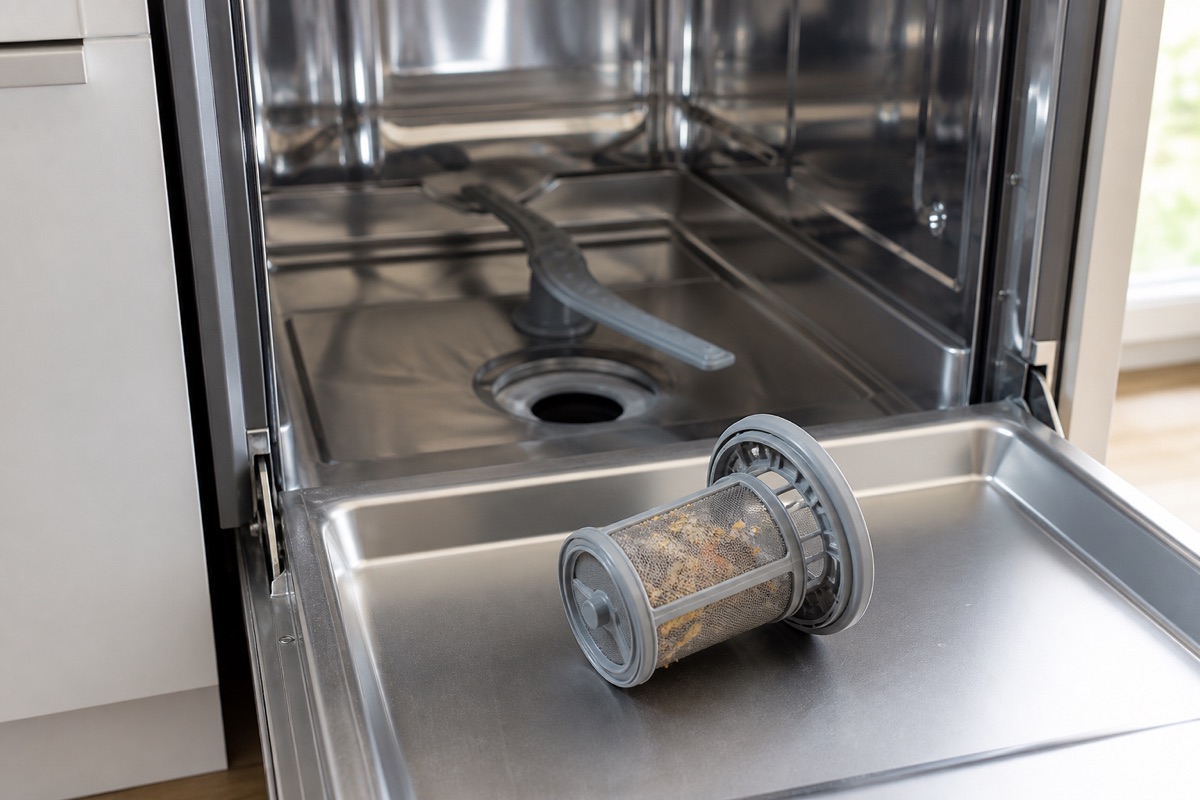
The short answer
Gritty glasses and standing water almost always mean the filter has never been cleaned. It sits in the tub floor: twist the cylinder counter-clockwise, lift it and the flat mesh out, rinse under warm water and brush with an old toothbrush — never a wire brush, which opens the mesh. Refit mesh first, then twist the cylinder clockwise until it locks. Clean it every two to six weeks depending on use. Scrape solids off plates, but do not rinse them clean: enzyme detergents need soil to work on.
If your dishwasher has started leaving a fine grit on the inside of glasses, or the bottom of the tub smells before you have even opened the door, the filter is the first place to look — and on most machines it has never been touched.
This catches people out because of a design change. Dishwashers built before roughly 2010 mostly had a hard food disposer: a small grinder that pulverised debris and flushed it down the drain. It worked, and it was loud. Manufacturers dropped it almost universally in favour of a manual filter, which is quieter and more efficient but has one requirement the grinder did not — somebody has to clean it.
How to tell yours needs it
- A gritty or sandy film on glassware and the inside of cups
- Standing water in the bottom of the tub after a completed cycle
- A stale smell from the machine between uses
- Dishes coming out with debris redeposited on them — often on upward-facing surfaces
- Cycles running noticeably longer than they used to
Finding it
Pull the lower rack right out. In the centre or rear of the tub floor you will see a cylindrical filter, usually with an arrow and a padlock icon on top, sitting inside a flat circular mesh plate. That is a two-part assembly: the cylinder is the coarse filter, the flat plate is the fine mesh.
A small number of machines — mostly older or entry-level models — instead have a single non-removable flat screen. If nothing twists out, that is what you have, and you clean it in place.
Cleaning it
1. Remove the assembly
Twist the cylinder counter-clockwise about a quarter turn until it releases, and lift it straight out. The flat fine mesh underneath usually then lifts free as well, sometimes after a slight sideways nudge. Do not force it; on most designs it simply sits in place once the cylinder is out.
2. Rinse under warm running water
Hold the parts at an angle and let the water push debris out the way it came in, rather than driving it deeper into the mesh. Most of what is in there — softened food, grease, paper fibres from labels — comes away in seconds.
3. Brush what is left
Use a soft brush: an old toothbrush is ideal. A little dish soap helps with the greasy film on the fine mesh.
Do not use a wire brush or anything abrasive. The fine mesh is thin stainless, and a wire brush will open the weave. Once it is holed, debris passes straight through to the pump and you are into a repair rather than a clean.
4. Clear the sump
With the filter out, look into the recess it came from. Glass fragments, fruit stickers, olive stones and the occasional screw collect here. Wipe it out with a cloth, and be careful — broken glass in a dishwasher sump is common.
5. Refit properly
Fine mesh in first, seated flat. Then the cylinder, dropped in and twisted clockwise until it locks. This matters: a filter that is not locked can lift during a cycle and let debris bypass it entirely. If the cylinder spins freely without ever stopping, it is not engaged.
While you are in there
Spray arms
Both arms should spin freely by hand. Hold each one up to the light and check the jets — the small holes clog with limescale and food. A cocktail stick or a straightened paper clip clears them. Most arms unclip or unscrew for a proper rinse.
The door edge and seal
The narrow ledge at the bottom of the door, below the seal, is not reached by the spray. It collects a black film that is the source of a lot of dishwasher smells. Wipe it with a damp cloth.
How often
| Household | Filter clean |
|---|---|
| 1–2 people, dishes scraped well | Every 4–6 weeks |
| Family use, daily cycles | Every 2 weeks |
| Heavy soil, no scraping, or a machine that has never been done | Weekly until it stays clean |
The pre-rinsing question
Two things are true at once, and conflating them causes most of the confusion:
Scrape solids off. Do not rinse dishes clean.
Bones, peel, rice, pasta and anything fibrous should go in the bin — those are what clog a filter. But modern dishwasher detergents are enzymatic, and the enzymes need protein and starch to act on. Loading spotless dishes means the enzymes have nothing to bind to, and some detergents will then be more aggressive toward glassware. Machines with a soil sensor will also read a clean load and select a shorter, weaker cycle.
If cleaning the filter does not fix it
Standing water that persists after a filter clean points past the filter. In rough order of likelihood: a kinked or blocked drain hose, a blocked air gap or sink waste connection where the hose ties in, a clogged drain pump impeller, or a failed pump. The first two are worth checking yourself; the last two usually are not.
Persistent grit on glassware after a clean filter is usually hard water rather than debris. That is a different fix — dishwasher salt if your machine has a softener reservoir, a rinse aid if it does not, and a periodic descale either way.
Common questions
Why did older dishwashers not need this?
They had a hard food disposer — a small grinder that pulverised debris and flushed it away. It worked and it was loud. Manufacturers dropped it almost universally around 2010 in favour of a manual filter, which is quieter and more efficient but requires somebody to clean it.
Should I rinse dishes before loading?
Scrape solids, do not rinse clean. Bones, peel, rice and pasta clog filters and belong in the bin. But modern detergents are enzymatic and need protein and starch to act on, and machines with a soil sensor read a rinsed load as clean and select a weaker cycle.
Can I use a wire brush on the fine mesh?
No. The mesh is thin stainless and a wire brush opens the weave. Once holed, debris passes straight through to the pump and you are into a repair. An old toothbrush and a little dish soap does the job.
How do I know the filter is seated properly?
The cylinder should twist clockwise and come to a definite stop. If it spins freely without ever locking, it is not engaged — and an unlocked filter can lift during a cycle and let debris bypass it entirely.
The filter is clean but water still stands in the bottom. What now?
The problem is past the filter. In rough order of likelihood: a kinked or blocked drain hose, a blocked air gap or sink waste connection, a clogged drain pump impeller, or a failed pump. The first two are worth checking yourself; the last two usually are not.