The short answer
Coffee is roughly 15% oil by weight, and that oil coats every internal surface of a grinder and then goes rancid. Brush the hopper, burrs and chute weekly; run cleaning tablets monthly; strip and brush the burrs fully every three to six months. Everything must stay dry — burrs are steel and washing them causes rust. Do not use rice as a substitute for tablets: it is far harder than coffee and manufacturers routinely exclude the damage. Worn burrs show up as drifting several settings finer over a year.
A grinder has more effect on coffee than the brewer does, and it is the component most people never clean. Coffee is roughly 15% oil by weight, and that oil coats every internal surface, goes rancid, and taints every subsequent grind.
Burr or blade
Worth settling first. A blade grinder is a spinning blade that smashes beans into a random distribution of fragments. A burr grinder crushes beans between two abrasive surfaces at a set distance, producing a consistent particle size.
Consistency is what determines even extraction. If you are trying to improve your coffee and you have a blade grinder, replacing it does more than any cleaning routine.
Conical and flat burrs
- Conical — a cone rotating inside a ring. Less heat, lower power draw, slightly wider particle distribution. Common in home grinders
- Flat — two parallel discs. Tighter distribution, more heat, more retention. Common in commercial and high-end grinders
Weekly: brush out what you can reach
- Unplug it.
- Remove the hopper and wipe it out with a dry cloth. Oil accumulates here and it is the easiest fix.
- Brush the exposed burrs and the exit chute with a stiff brush.
- Vacuum the grounds bin and any accessible cavity.
Everything must stay dry. Burrs are steel and they rust. Never wash a burr, never wipe one with a damp cloth, never put any part of the grind path in a dishwasher.
Monthly: grinder cleaning tablets
Cleaning tablets — Grindz, Full Circle and similar — are food-safe pellets that run through the grinder like beans, absorbing oils and scouring the burrs.
- Empty the hopper of beans.
- Run the stated quantity of tablets through at a medium setting.
- Follow with a small dose of cheap beans to purge tablet residue.
- Discard both.
Rice is often suggested as a substitute. It is not a good one: rice is much harder than coffee, it can damage burrs, and grinder manufacturers routinely void warranties for it. The tablets are not expensive.
Every three to six months: full strip
- Unplug. Photograph the assembly as you go — the reassembly order matters and grinder manuals are often unhelpful.
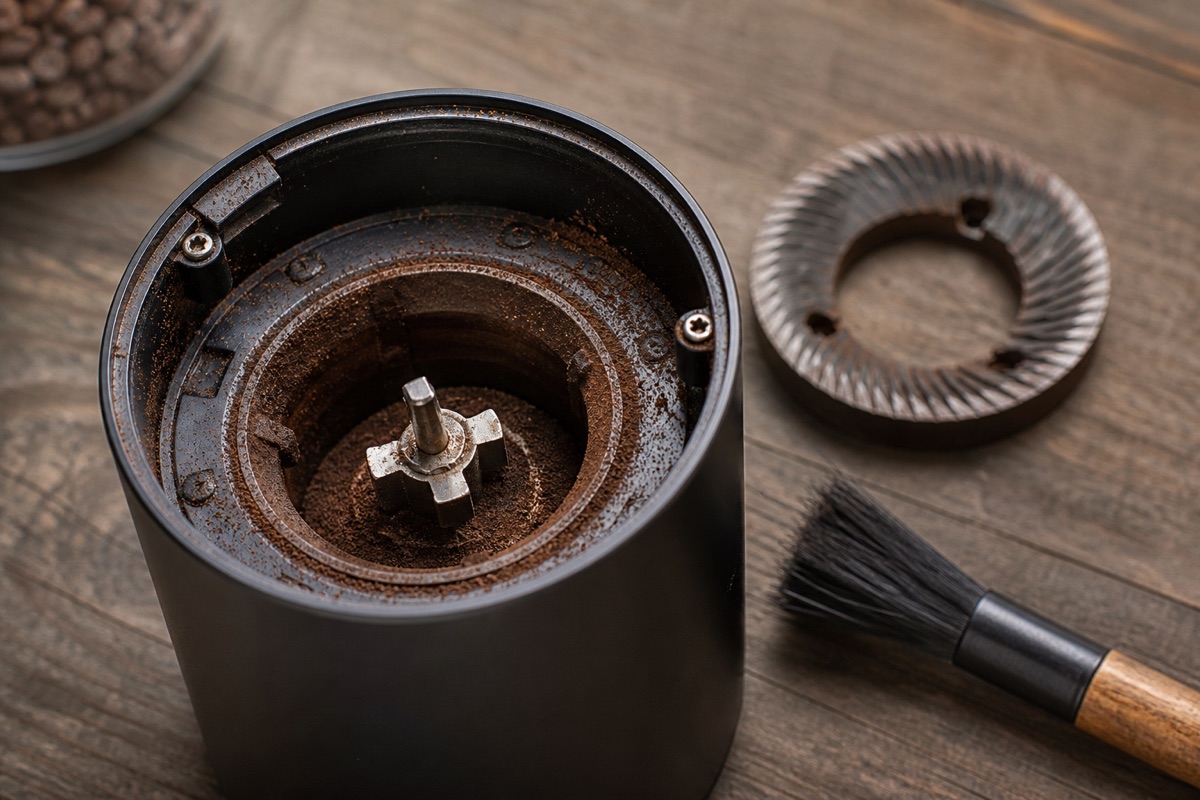
- Remove the hopper and the upper burr carrier. On most home grinders this unscrews or lifts out after releasing a retaining ring.
- Note the position of any adjustment collar before you disturb it, or you will lose your grind setting.
- Brush both burrs thoroughly with a stiff dry brush. A vacuum helps. Compressed air works, but it drives fines further into the housing — brush first.
- Wipe the housing with a dry cloth, or one very slightly dampened with alcohol, which evaporates.
- Reassemble and reset the grind.
When to replace burrs
Burrs are consumables. As they wear, particle distribution widens, grind time increases, and you find yourself moving to progressively finer settings to get the same result.
| Burr type | Approximate life |
|---|---|
| Steel, home use | 500–1000 kg of coffee — effectively many years |
| Steel, commercial | Replace annually or by weight |
| Ceramic | Longer life, more brittle — a stone will chip them |
Signs: inconsistent grind at every setting, noticeably longer grind times, more fines than before, or having drifted several settings finer over a year with no other change.
Retention
Retention is coffee left inside the grinder between uses — commonly a gram or two, sometimes far more. Those grounds are stale by the next session and they come out in your next dose.
Reducing it:
- Single dose — weigh beans per brew rather than keeping a full hopper
- Bellows, or a puff of air into the hopper after grinding, to push out what has settled
- Tap the body firmly while grinding finishes
- Purge a gram before an important brew if you have changed beans
Beans, hoppers and oil
Dark roast and oily beans coat a grinder far faster than light roast. If you drink dark roasts, clean more often and do not store beans in the hopper — the oil migrates onto the walls and goes rancid, and a hopper that smells stale is contaminating everything that passes through it.
Store beans in an airtight container away from light and heat, and keep the hopper empty between sessions.
Schedule
| Task | Home use |
|---|---|
| Wipe hopper, brush chute | Weekly |
| Cleaning tablets | Monthly |
| Full disassembly and brush | Every 3–6 months |
| Inspect burrs for wear | Annually |
Common questions
Can I wash burrs if I dry them straight away?
No. Burrs are hardened steel and they will develop surface rust from a single wash, even dried immediately — the water reaches seams and the shaft where a cloth cannot. Everything in the grind path is cleaned dry, with brushes and a vacuum.
Is rice really that bad for a grinder?
It is considerably harder than roasted coffee, and grinder manufacturers routinely exclude damage from it. It does absorb oils, which is why the advice persists. Purpose-made cleaning tablets are formulated to be softer than burr steel and cost little enough that the risk is not worth taking.
How do I know if my burrs are worn rather than dirty?
The tell is drift. If you have moved several settings finer over a year to get the same extraction, and a full clean does not bring the setting back, the burrs are worn. Dirty burrs produce sluggish grinding and inconsistency that a clean resolves; worn burrs do not respond to cleaning at all.
Does retention actually affect taste?
It affects the first dose after a gap, and it matters most when you change beans. Two grams of yesterday’s grounds in a 18 g dose is a measurable fraction of stale coffee. For a single daily brew it is a small effect; for a session where you switch between roasts it is obvious.
Should I store beans in the hopper?
Not if you can avoid it. Beans in an open hopper stale faster from air exposure, and their oils migrate onto the hopper walls, where they go rancid and taint everything that passes through. Weigh out per session and keep the beans in an airtight container.