The short answer
Two things decide how long a water heater lasts, and almost nobody checks either. Sediment settles on the tank floor and insulates it from the burner — the popping and rumbling noise is water flashing to steam beneath that layer. Flush annually, or every six months in hard water. The anode rod is a magnesium or aluminium rod that corrodes instead of the steel tank; replacing it every two to three years can roughly double the heater’s life for the cost of one part. Keep storage at 60 °C and fit mixing valves at the taps.
A storage water heater is a steel tank full of hot water, and two things determine how long it lasts: how much sediment accumulates in the bottom, and whether the sacrificial anode rod is still doing its job. Both are maintainable, and both are almost universally ignored until the tank leaks.
Before anything else: this covers flushing and the anode rod. If your heater is gas-fired, do not touch the gas supply, the burner, the flue or the thermocouple — that is qualified-fitter work. Everything below can be done with the gas control set to Pilot or Vacation, or with the electricity isolated.
Sediment: what it does
Minerals precipitate out of heated water and settle in the bottom of the tank. In a gas heater, the burner is underneath, so that layer sits between the flame and the water — it insulates, and the steel of the tank floor runs hotter than designed. In an electric heater it buries the lower element.
Symptoms:
- Popping, rumbling or kettling noises — water flashing to steam under the sediment layer. This is the classic tell
- Less hot water than there used to be
- Longer recovery between showers
- Higher energy use
- Discoloured or gritty hot water
Flushing the tank
- Turn off the heat. Gas: set the control to Pilot or Vacation. Electric: switch the breaker off. Never run an electric heater dry — the element burns out in seconds.
- Shut the cold water inlet valve at the top of the tank.
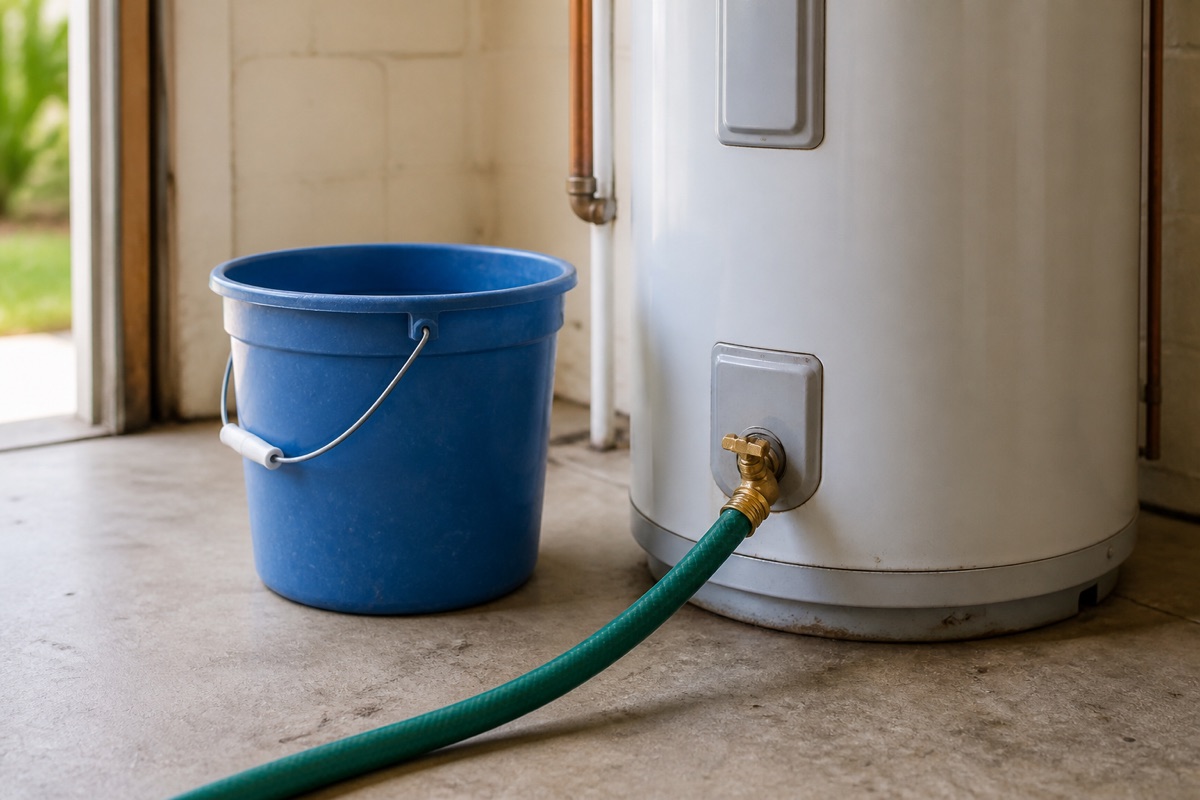
- Attach a hose to the drain valve at the base and run it to a drain or outside. The water will be scalding.
- Open a hot tap somewhere in the house to break the vacuum, or the tank will drain very slowly.
- Open the drain valve and let the tank empty.
- Briefly open the cold inlet in bursts to stir up and flush out settled sediment. Repeat until the water runs clear.
- Close the drain valve, remove the hose, open the cold inlet and let the tank fill completely. Leave the hot tap open until water flows steadily with no air.
- Restore the heat only once you are certain the tank is full.
Two things that commonly go wrong. Old plastic drain valves often will not reseal after being opened, so have a hose cap or a replacement brass valve on hand. And on a tank that has never been flushed, sediment can block the drain valve entirely — a shop vacuum at the valve, or a short length of stiff wire, usually clears it.
The anode rod: the part that decides the tank’s lifespan
The tank is glass-lined steel, and the lining always has imperfections. The anode rod is a length of magnesium or aluminium suspended in the tank that corrodes instead of the steel — galvanic protection, the same principle as a zinc block on a boat hull.
When the rod is used up, the tank starts corroding. Replacing a £25 rod every few years can double the life of the heater, and virtually nobody does it.
Checking it
- Turn off the heat and the cold inlet. Drain a few litres so the water level is below the rod fitting.
- Find the hex head on top of the heater — sometimes under a plastic cap, sometimes combined with the hot outlet.
- Undo it with a 27 mm socket and a breaker bar. It will be tight; this is the hardest part of the job.
- Withdraw the rod and look at it. Replace it if it is under about 12 mm thick, heavily pitted, or if the steel core wire is exposed.
- Wrap the threads with PTFE tape and refit.
Low headroom is common — a segmented or flexible anode rod solves it.
Which type
- Magnesium — best protection, standard in soft water
- Aluminium — longer-lasting in hard water
- Powered / impressed current — no consumable rod, useful where a magnesium rod produces a sulphur smell
That rotten-egg smell in hot water is usually sulphate-reducing bacteria reacting with a magnesium anode. Switching to aluminium or a powered anode is the fix.
Temperature
60 °C (140 °F) in the tank is the usual recommendation. High enough to suppress Legionella, which multiplies between roughly 20 and 45 °C.
That temperature will scald. The correct solution is not to turn the tank down, but to fit thermostatic mixing valves at the taps so stored water stays hot while delivered water is safe — particularly with children or elderly occupants in the house.
The pressure relief valve
The T&P valve is the safety device that prevents the tank rupturing. Test it annually: lift the lever briefly and let water discharge into the drain pipe, then release. It should stop cleanly.
If it weeps continuously afterwards it needs replacing. Never plug or cap a T&P discharge pipe under any circumstances.
Schedule
| Task | Frequency |
|---|---|
| Flush the tank | Annually — every 6 months in hard water |
| Inspect the anode rod | Every 2–3 years |
| Test the T&P valve | Annually |
| Check for leaks and corrosion at fittings | Every 6 months |
When it is finished
Water leaking from the body of the tank means the tank has corroded through, and it is not repairable. Replace it promptly — tank failures tend to progress from a weep to a flood.
Typical life is 8 to 12 years, or considerably longer with anode replacement. If yours is past 10 and you have never touched the anode, plan the replacement rather than waiting for the floor to tell you.
Common questions
What is the anode rod and why have I never heard of it?
It is a magnesium or aluminium rod suspended in the tank that corrodes instead of the steel — the same principle as a zinc block on a boat hull. Once it is used up the tank starts corroding. Replacing an inexpensive rod every few years can roughly double a heater’s life, and almost nobody does it.
My hot water smells of rotten eggs. What is that?
Usually sulphate-reducing bacteria reacting with a magnesium anode. The fix is switching to an aluminium rod or a powered anode rather than treating the water. It is a nuisance rather than a hazard.
Why does my heater rumble and pop?
Sediment on the tank floor. Water flashes to steam underneath the deposit layer, which produces the noise — and in a gas heater that layer sits between the burner and the water, so the steel runs hotter than designed. It is the clearest signal that a flush is overdue.
Should I turn the thermostat down to save energy?
Not below 60 °C. That temperature suppresses Legionella, which multiplies between roughly 20 and 45 °C. The correct way to handle scald risk is thermostatic mixing valves at the taps, so stored water stays hot while delivered water is safe.
The tank is leaking. Can it be repaired?
No. Water from the body of the tank means the steel has corroded through, and replacement is the only option. Do it promptly — tank failures tend to progress from a weep to a flood rather than staying stable.