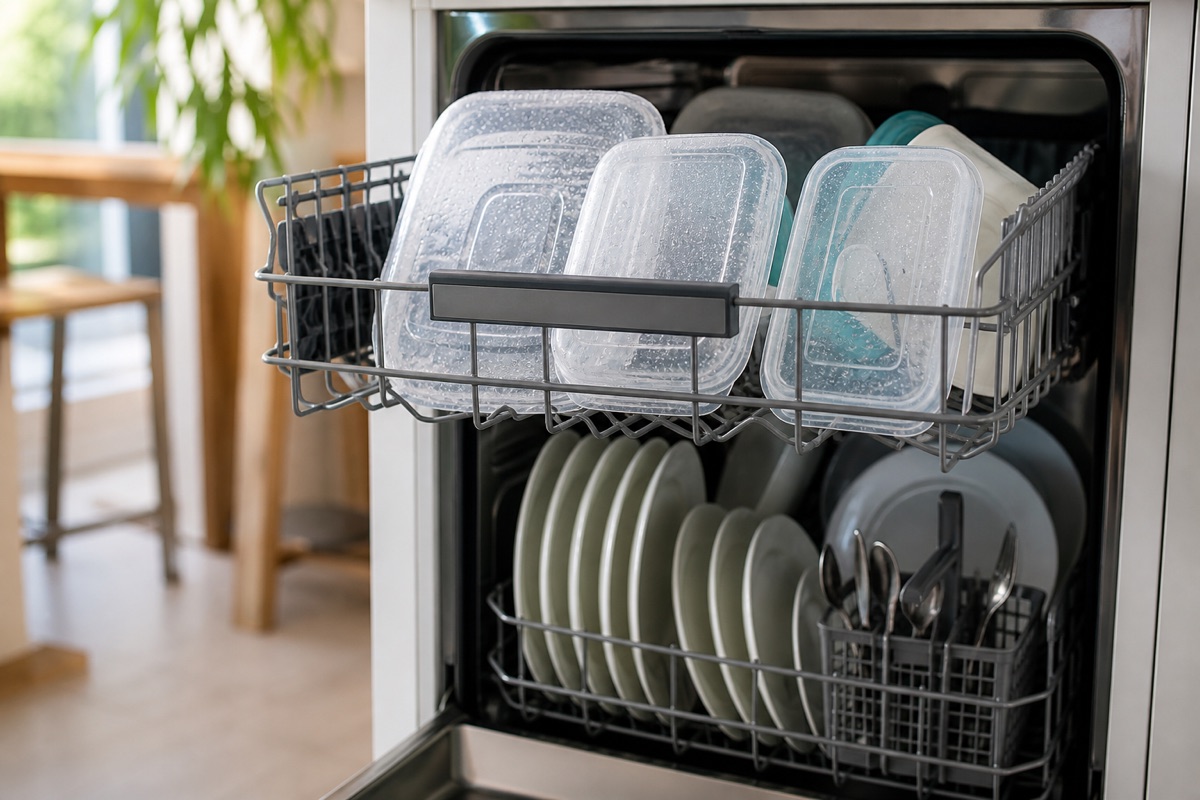
The short answer
Modern dishwashers dry by condensation rather than a heating element, which is why plastics come out wet while ceramics are dry: glass and ceramic hold residual heat that evaporates the water film, and plastic sheds heat instantly. No setting fully fixes that. What you can fix is rinse aid, which is doing structural work rather than adding polish — it makes water sheet off instead of beading. Fill the separate reservoir even if you use all-in-one tablets, and crack the door open 20 to 30 minutes after the cycle ends.
A dishwasher that cleans perfectly but leaves everything wet is usually working exactly as designed. The drying stage is the part that changed most in the last fifteen years, and the reason your plastics come out soaked while the plates are dry is physics rather than a fault.
How modern dishwashers actually dry
Older machines dried with a heating element in the base — simple, effective, and energy-hungry. Efficiency regulations pushed manufacturers away from that toward two quieter methods:
- Condensation drying. The final rinse is hot, the stainless tub walls cool faster than the dishes, and moisture migrates to the walls and runs down the drain. No heater involved. This is standard on most European machines.
- Zeolite drying. A mineral that releases heat as it absorbs moisture, packed in a cartridge that the machine vents air through. Effective and expensive; found on higher-end models.
Condensation drying explains the single most common complaint: plastics stay wet while glass and ceramic dry. Glass and ceramic hold heat, so residual warmth evaporates the film on them. Plastic has low thermal mass — it cools almost instantly and the water just sits there.
That is not a fault, and no setting fixes it completely. Put plastics on the top rack, angled, and expect to towel them.
Rinse aid is not optional any more
On a condensation-drying machine, rinse aid is doing structural work rather than adding polish. It lowers the surface tension of water so it sheets off in a film instead of beading. Beads sit and dry into spots; sheets run off and leave the surface dry.
If you have switched to all-in-one tablets and stopped filling the rinse aid reservoir, that is very often the whole problem. Tablets contain a rinse aid component, but at a fixed and usually inadequate dose.
| Symptom | Rinse aid setting |
|---|---|
| Water spots and streaks on glass | Increase |
| Cloudy film that wipes off | Increase |
| Sticky or greasy feel on glassware | Decrease |
| Foam visible at the end of a cycle | Decrease |
Most machines have a rinse aid dosage setting from 1 to 6, usually buried in the control panel menu. In hard water areas the factory setting is often too low.
The other things that stop a machine drying
Cycle choice
Eco cycles run at lower temperatures for longer. They clean well and use less energy, but a cooler final rinse means less residual heat for condensation drying. If drying matters more than the energy saving, use a normal or intensive cycle, or an Extra Dry option if your machine has one.
Opening the door too early — or too late
Condensation drying continues for a while after the cycle ends. Opening the door immediately releases the warm humid air before it has condensed on the walls.
Conversely, leaving it sealed for hours traps humidity and everything stays damp. The optimum is to crack the door open about 10 cm roughly 20 to 30 minutes after the cycle finishes, then leave it ajar.
Loading
- Anything that can hold a pool of water will. Angle cups, bowls and mug bases so they drain.
- Do not overload. Items pressed together shield each other from both spray and warm air.
- Keep tall items out of the top spray arm’s path — a blocked arm means a cold, badly rinsed top rack.
Water temperature at the tap
Most machines take cold water and heat it, but a few take a hot feed. If yours is hot-fed and the water arriving is lukewarm, every stage runs cooler than intended. Run the kitchen hot tap until it is properly hot before starting a cycle.
When it is an actual fault
| Sign | Likely cause |
|---|---|
| Everything cold at the end, including ceramics | Heating element or thermostat |
| Drying suddenly got worse with no other change | Rinse aid reservoir empty or dispenser blocked |
| Cloudy film that does not wipe off | Etching from soft water — not a drying problem |
| Machine also cleaning poorly | Blocked filter or spray arms — fix that first |
| Vent flap on the door not opening | Vent motor or linkage |
The filter is worth ruling out before anything else, because a machine that is not rinsing properly will not dry properly either. If you have never cleaned it, start with How to Clean a Dishwasher Filter.
A working routine
- Keep the rinse aid reservoir filled, and raise the dose if you see spotting.
- Fill the salt reservoir if your machine has one and your water is hard.
- Load plastics on the top rack, angled to drain.
- Use a normal cycle, or add Extra Dry, when drying matters.
- Crack the door 20 to 30 minutes after the cycle ends.
- Clean the filter monthly.
Common questions
Why do plastics never dry?
Low thermal mass. Condensation drying relies on residual heat in the items themselves, and plastic sheds that heat almost immediately, so there is nothing left to evaporate the water film. Glass and ceramic hold heat and dry themselves. No setting fully fixes this — put plastics on top and towel them.
Do all-in-one tablets remove the need for rinse aid?
They contain a rinse aid component at a fixed dose, which is often inadequate in hard water. If drying got worse when you switched to tablets, fill the separate reservoir as well and see whether it changes.
Should I open the door straight away?
No. Give it 20 to 30 minutes for condensation to finish, then crack the door about 10 cm and leave it ajar. Opening immediately releases the warm humid air; leaving it sealed for hours keeps everything damp.
Why did drying get worse after I started using Eco?
Eco cycles use a lower final rinse temperature, and condensation drying depends on residual heat. It is a genuine trade-off, not a fault. Use a normal cycle or an Extra Dry option when you need dry dishes.
My glasses are cloudy and it will not wipe off. Is that drying?
No — that is etching, permanent corrosion of the glass caused by soft water plus alkaline detergent plus heat. Reduce detergent, lower the temperature, and hand wash anything you care about. Mineral film, by contrast, clears in a vinegar soak.