The short answer
Cold at the top with a hot bottom means trapped air and bleeding fixes it in two minutes. Cold at the bottom with a hot top means sludge, which bleeding will not touch. Cold all over while others are hot means a flow problem, fixed by balancing. Bleed with the heating off and cooled for an hour, then check boiler pressure, which should sit at 1.0–1.5 bar cold. To balance, adjust the lockshield valve — the one under a plastic cap — opening it least on the radiator that heats first and fully on the one that heats last.
A radiator that is hot at the bottom and cold at the top has air in it. A radiator that is cold all over while others in the house are hot has a flow problem. They look like the same complaint and they need opposite fixes — one takes two minutes, the other takes an afternoon.
Everything here is on the water side of a wet central heating system. Nothing below involves the boiler, the gas supply or any electrical work. Leave all three to a qualified engineer.
Diagnose by where the cold is
| Symptom | Cause | Fix |
|---|---|---|
| Cold at the top, hot at the bottom | Trapped air | Bleed it |
| Cold at the bottom, hot at the top | Sludge build-up | Power flush or radiator removal and rinse |
| Cold all over, others hot | Valve closed, or poor flow | Check valves, then balance |
| Cold only at the far end of the house | System out of balance | Balance the system |
| Whole system lukewarm | Boiler or pump | Engineer |
Bleeding a radiator
Air rises to the top of a radiator and stops water circulating through that section. Bleeding lets it out.
- Turn the heating off and let the system cool for at least an hour. Bleeding a hot system risks scalding and draws more air in.
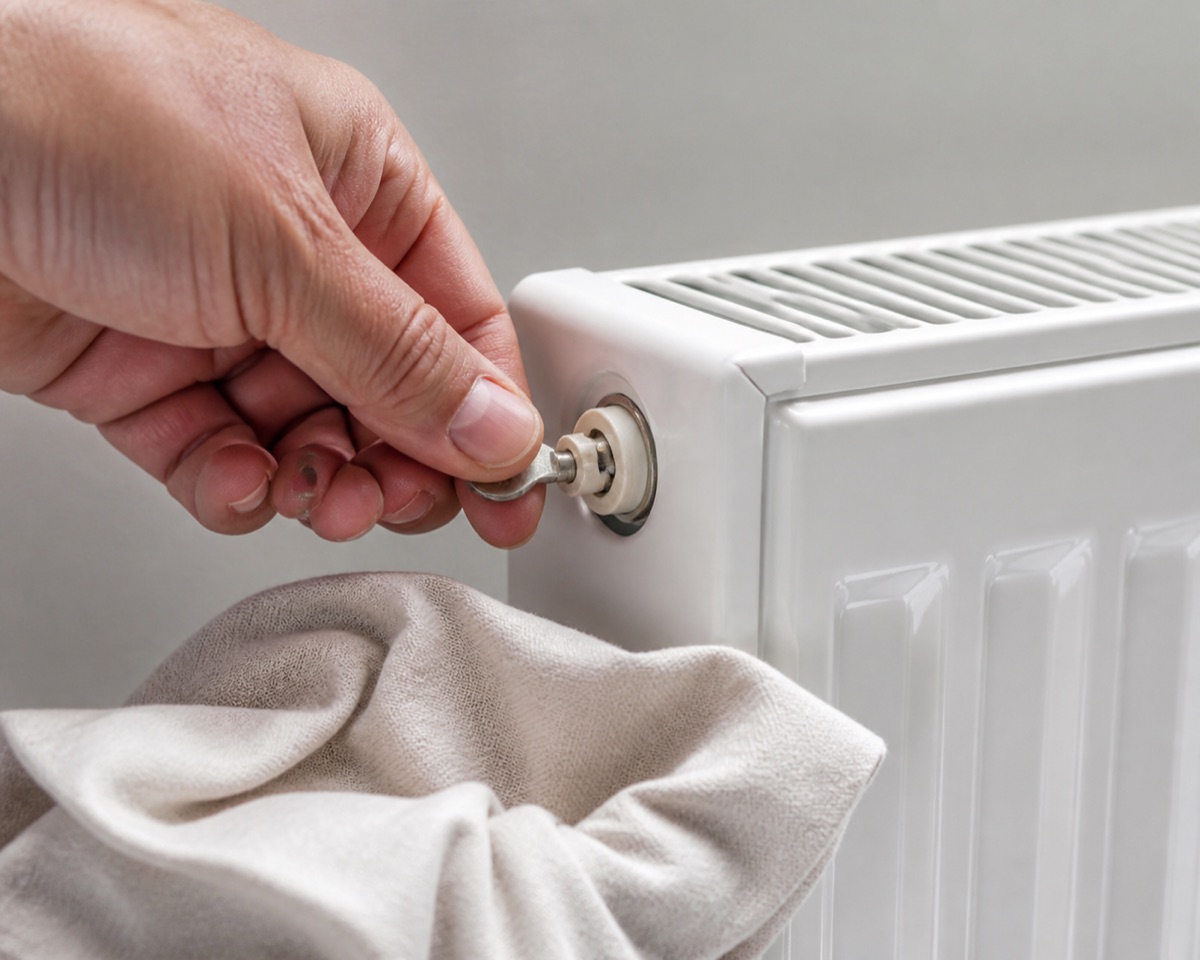
- Find the bleed valve — a small square nipple at one top corner.
- Hold a cloth and a small container underneath.
- Turn the key anticlockwise a quarter to half turn. You will hear a hiss.
- Close it as soon as water appears in a steady dribble rather than spitting. Do not open it further than needed.
- Work through the house — downstairs first, then upstairs, and from the radiator nearest the boiler outward.
- Check the boiler pressure afterwards. Bleeding releases pressure, and a combi boiler needs roughly 1.0–1.5 bar cold. Top up via the filling loop if it has dropped below.
If it keeps needing bleeding
Air that returns every few weeks is not normal. It usually means air is being drawn in through a small leak, a failing automatic air vent, or — more seriously — that corrosion inside the system is generating hydrogen. A radiator producing gas that smells of rotten eggs, or black water when bled, points to internal corrosion and needs an inhibitor added and probably a flush.
Balancing the system
Water takes the path of least resistance, so radiators nearest the pump get more flow than the ones at the end of the run. Balancing restricts the easy ones so the far ones get their share. It is the fix for “the back bedroom is never warm”.
Each radiator has two valves: a control valve (a wheel head or a thermostatic head) at one end, and a lockshield valve at the other, usually under a plastic cap. The lockshield is the one you adjust.
- Bleed everything first. Balancing an airlocked system tells you nothing.
- Open every valve fully, run the heating from cold, and note the order in which radiators warm up. That order is your problem list — first to heat is over-supplied, last is starved.
- Turn the heating off and let it cool.
- Close every lockshield valve fully, then open each one by a set amount, starting with the radiator that heated first: give that one about a quarter turn, and progressively more as you work down the list, with the last-to-heat radiator opened fully.
- Run the system and reassess. Adjust in small increments over a few days.
Done precisely, this is measured with two clip-on pipe thermometers, aiming for roughly an 11–12 °C drop between the flow and return pipes at each radiator. Done approximately, by feel and timing, it still fixes most cold-room complaints.
Thermostatic valves
- The numbers are temperature targets, not flow settings. Turning it to 5 does not heat the room faster; it just stops later.
- A TRV stuck open or closed is usually a seized pin under the head. Pull the head off and press the pin — it should spring back. Free it with penetrating oil and gentle taps, or replace the head.
- Do not fit a TRV in the room with the main thermostat — the two fight each other.
- Open TRVs fully in summer, or the pins seize over the months the heating is off.
Common questions
Cold at the top or cold at the bottom — does it matter?
Completely different problems. Cold at the top is trapped air and bleeding fixes it in two minutes. Cold at the bottom is sludge settled in the base, which bleeding will not touch — that needs the radiator flushed or the system power flushed.
Should the heating be on or off when bleeding?
Off, and cooled for at least an hour. A hot system sprays scalding water when the valve opens, and bleeding under pressure tends to pull more air in as it cools.
Why does the boiler pressure drop after bleeding?
Because you have let water and air out of a sealed system. Top up through the filling loop to about 1.0–1.5 bar cold. If pressure keeps falling week after week without bleeding, you have a leak somewhere and that needs finding.
Which valve do I adjust to balance a radiator?
The lockshield — the one under a plastic cap, at the opposite end from the control or thermostatic head. The control valve is for the room; the lockshield sets how much flow that radiator takes from the system.
Does turning a TRV to 5 heat the room faster?
No. The number is a target temperature, not a speed. At 5 the valve simply stays open longer before shutting off. Setting every TRV to maximum is a common reason a house feels unevenly heated and expensive to run.