The short answer
The number that governs everything is 27 °C at the floor surface — not the thermostat, not the water temperature. Exceeding it is what causes the damage people blame on the flooring, and a floor sensor rather than a room thermostat is what keeps you under it. Tile and stone are ideal; engineered wood is the right way to have wood over underfloor heating; solid hardwood is the risky choice because it cups and gaps. Keep humidity between 35% and 55%, and remember a thick rug plus a dense pad creates a local hot spot.
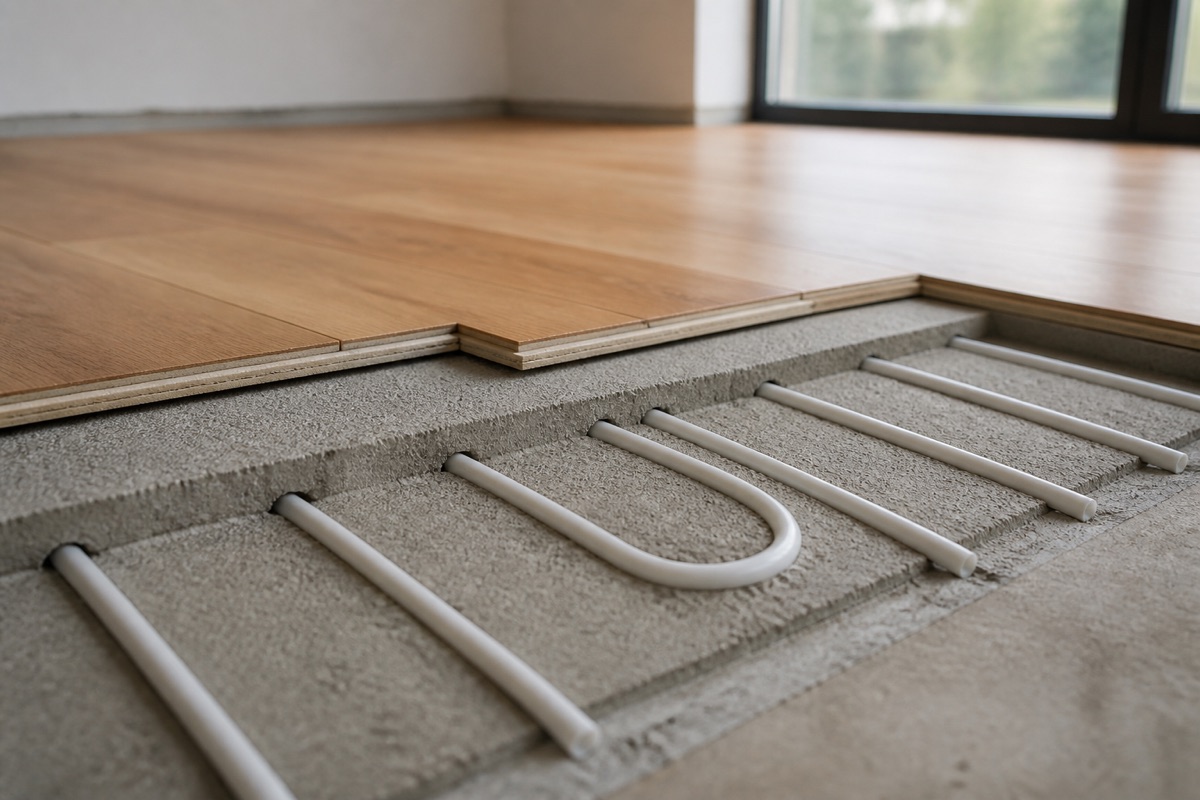
Underfloor heating changes what a floor covering has to tolerate. The heat is gentle but it is constant, it comes from underneath, and it moves through the covering rather than around it. Some materials handle that indefinitely; others cup, gap or void their warranty.
The number that governs everything
Almost every flooring manufacturer sets a maximum floor surface temperature of 27 °C. Not the water temperature in the pipes, not the thermostat setting — the temperature of the floor surface itself.
Exceeding it is what causes the damage people blame on the flooring. It is also easy to exceed without realising, because a floor probe reading and a room thermostat reading are different things, and rugs and furniture create hot spots by trapping heat.
A floor sensor is not optional on a system under a temperature-sensitive covering. A room thermostat alone will happily drive the floor past its limit trying to warm a draughty room.
By covering
| Covering | Suitability | Notes |
|---|---|---|
| Tile and stone | Excellent | Best conductivity, no movement issues. The default choice |
| Engineered wood | Good | The right way to have wood over UFH. Stable plywood core |
| LVP / LVT | Good | Check the rating; SPC handles it better than WPC |
| Laminate | Acceptable | Only if rated. Thin underlay required |
| Solid hardwood | Poor | Moves too much. Cupping and gapping are likely |
| Carpet | Conditional | Total tog of carpet plus underlay must stay under about 2.5 |
| Thick natural fibre | Poor | Insulates the floor from the room |
Why solid wood is the problem child
Solid timber moves across the grain with moisture content, and heating from below drives moisture out of the underside faster than the top. The board cups, and in winter the drier air widens the gaps. Engineered board solves this with a cross-laminated core that restrains movement — which is why it is the recommended wood product over UFH almost universally.
Commissioning: the step people skip
A new screed and a new floor need a controlled heat-up before normal use, and skipping it is a common cause of failure blamed on the covering.
- Let the screed cure fully — typically 21 to 28 days for a sand-cement screed, less for liquid screeds. Check the specification.
- Start the system at about 20 °C and hold it for three days.
- Raise by roughly 5 °C per day to the maximum design temperature, and hold for several days.
- Bring it back down gradually, then lay the floor covering.
- Acclimatise the covering in the room for the period the manufacturer specifies, with the heating running at normal temperature.
Living with it
- Run it low and constant. Underfloor heating has enormous thermal mass and responds over hours, not minutes. Cycling it hard is both inefficient and hard on the floor covering.
- Change the temperature seasonally in small steps, not sharply.
- Keep humidity between 35% and 55%. This matters more with UFH than without, because the heating is actively drying the covering from below. A humidifier in winter is often necessary with a wood floor.
- Watch what you put on it. A thick rug, a dense pad, or a large piece of furniture with a solid base traps heat and creates a local hot spot that can exceed the limit even when the average is fine. Use thin, UFH-rated rug pads and leave airflow under large furniture.
- Do not block floor sensors with furniture.
Diagnosing problems
| Symptom | Likely cause |
|---|---|
| Boards cupped, edges higher than centres | Too much heat, or moisture from below |
| Gaps opening between boards in winter | Humidity too low |
| Localised discolouration or a raised patch | Hot spot under a rug or furniture |
| Tiles lifting or grout cracking | Missing movement joints, or heated before curing |
| Room never warm despite the floor being warm | Covering too insulating, or heat loss elsewhere |
Common questions
Can I put solid hardwood over underfloor heating?
It is possible with narrow, quarter-sawn, well-acclimatised boards and careful humidity control, but it is the highest-risk option and most manufacturers advise against it. Engineered wood gives the same appearance with a cross-laminated core that restrains movement, and is the standard recommendation.
What is the maximum temperature?
27 °C at the floor surface for most coverings — and it is the surface that matters, not the thermostat or the water temperature. A floor sensor is essential; a room thermostat alone will push past the limit trying to heat a draughty room.
Can I put a rug on it?
A thin one, with a UFH-rated pad or none. A thick rug plus a dense pad insulates that patch, and the floor beneath can exceed the limit even when the rest of the room is fine. That is a common cause of a single discoloured or raised area.
Why do gaps open between my boards in winter?
Low humidity. Heating dries the air and the heating under the floor dries the boards from below as well. Keep relative humidity between 35% and 55% — a humidifier is often needed in winter with wood over UFH.
Should I turn it off when I go out?
No. Underfloor heating has hours of thermal lag, so switching it off and on wastes more than it saves and subjects the covering to repeated temperature swings. Run it low and constant, and set back by a couple of degrees rather than off.