The short answer
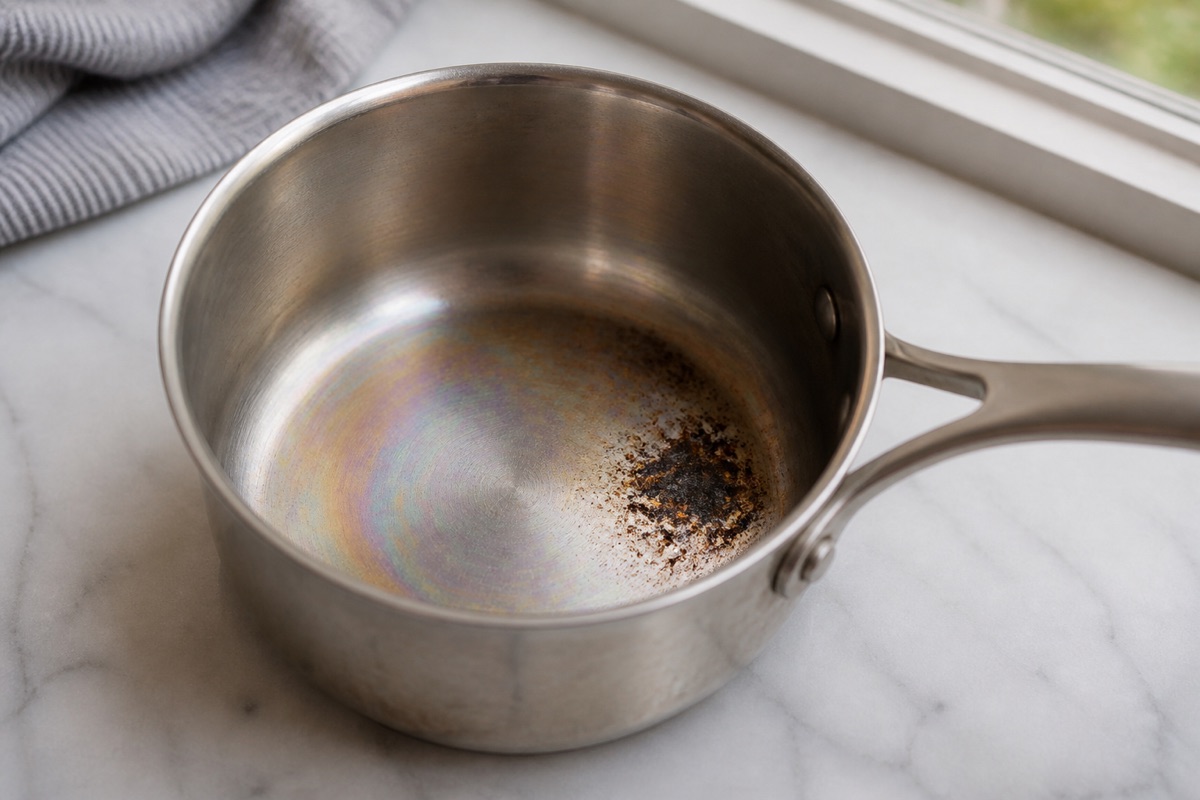
For burnt-on food, deglaze rather than scrub: pour a centimetre of water into the still-warm pan, simmer, and scrape gently with a wooden spoon. It removes in three minutes what twenty minutes of scrubbing will not. Rainbow discolouration is heat tint, a harmless oxide layer that vinegar removes in seconds. To stop food sticking, heat the dry pan on medium for two to three minutes until a water droplet balls up and skates, then add oil, then food — and leave it alone until it releases by itself.
Stainless steel is the most forgiving pan material in a kitchen — it takes metal utensils, high heat, acid, the dishwasher and abrasives. Its two complaints, burnt-on food and discolouration, both have straightforward fixes, and neither indicates damage.
Burnt-on food: deglaze, do not scrub
The fastest method for a pan with food welded to the base is also the least effort.
- Pour a centimetre of water into the still-warm pan.
- Bring it to a simmer on the hob.
- Scrape gently with a wooden spoon as it simmers. The residue lifts on its own within a few minutes.
- Pour off, wash normally.
This is deglazing, and it works because water dissolves the soluble bonds holding the fond to the metal. It removes in three minutes what twenty minutes of scrubbing will not.
If it is worse than that
- Bicarbonate and water: cover the base, add water to make a slurry, simmer 15 minutes, then scrub.
- Overnight soak in hot water with dish soap for severely carbonised deposits.
- Bar Keepers Friend or an oxalic acid cleaner: a paste with a little water, worked in with a soft cloth. This is the most effective product for stainless and it also removes discolouration. Rinse thoroughly.
Avoid steel wool and heavy abrasive pads. Stainless tolerates them, but they leave a scratched surface that then holds food more readily. A nylon scrubber and the right chemistry beat brute force.
The rainbow stain
Iridescent blue, purple and gold patches on a stainless pan are heat tint — a thin oxide layer that forms on the chromium at high temperature. It is purely cosmetic, it is not damage, and the pan is entirely safe to use.
To remove it: wipe with white vinegar, or a paste of Bar Keepers Friend. Both dissolve the oxide layer in seconds.
The white chalky spots
Small white or cloudy marks, usually in the base, are calcium deposits from hard water — often accelerated by adding salt to water before it boils, which lets salt sit undissolved on hot metal.
Remove with white vinegar: cover the base, bring to a simmer, then wash. To prevent, add salt after the water is boiling and dry the pan rather than letting it air-dry.
Making food stop sticking
Stainless is not non-stick, but it can be made largely non-stick through temperature control. The mechanism is the Leidenfrost effect.
- Heat the dry pan over medium heat for two to three minutes.
- Test with a droplet of water. If it sizzles and evaporates, the pan is not hot enough. When the droplet forms a ball and skates across the surface, it is ready.
- Add the oil then — it should shimmer almost immediately.
- Add the food, and leave it alone.
The last point matters. Protein sticks to hot metal initially and releases by itself once a crust forms. If a steak or a fish fillet will not move, it is not ready to move. Wait thirty seconds and try again rather than forcing it, which tears the surface and leaves half of it in the pan.
Restoring the shine
For a pan that has gone dull overall:
- Wash and dry.
- Make a paste of Bar Keepers Friend or a stainless cleaner with a little water.
- Work it over the surface with a soft cloth, following the grain of the metal where there is a visible grain.
- Rinse thoroughly — oxalic acid residue is not something to leave on cookware.
- Dry with a clean cloth.
Care that keeps it going
- Let it cool before washing. Cold water into a very hot pan can warp the base — and a warped base never sits flat on an induction hob again
- Dry rather than air-dry in hard water areas
- Dishwasher-safe, but hand washing keeps it brighter. Dishwasher detergent dulls the finish over time
- Do not store food in it. Prolonged contact with salt and acid can pit the surface
- Avoid chlorine bleach, which pits stainless
What the construction tells you
Stainless steel is a poor conductor of heat on its own. Every decent stainless pan is therefore a sandwich with aluminium or copper inside.
- Disc-bottom: a conductive disc bonded to the base only. Cheaper, and the walls stay relatively cool — fine for boiling, poor for sauces where you want even heat up the sides.
- Fully clad: the conductive layer runs through the base and the walls. More expensive, and noticeably better for anything that needs even heating.
If a pan has a hot spot in the middle that scorches while the edges do nothing, it is disc-bottom construction on a burner that is too small — not a fault.
Common questions
Is the rainbow discolouration harmful?
No. It is heat tint — a thin oxide layer on the chromium in the steel, formed at high temperature. It is purely cosmetic and the pan is entirely safe. White vinegar or a paste of oxalic-acid cleaner removes it in seconds if it bothers you.
Why does food always stick to my stainless pan?
Almost always insufficient preheat. Heat the dry pan on medium for two to three minutes and test with a water droplet — it should bead and skate rather than sizzle. Then add oil, then food, and leave it alone. Protein releases by itself once a crust forms.
What are the white chalky spots in the base?
Calcium deposits from hard water, often worsened by adding salt before the water boils so it sits undissolved on hot metal. Simmer white vinegar in the pan and wash. Adding salt after the water is boiling prevents it.
Can I use steel wool on stainless?
It will not destroy the pan, but it leaves a scratched surface that then holds food more readily and dulls permanently. A nylon scrubber with the right chemistry — deglazing, bicarbonate, or an oxalic-acid cleaner — works better with no damage.
Why does the middle of my pan burn while the edges do nothing?
Disc-bottom construction on a burner that is too small. The conductive layer covers only the base, so heat does not travel up the walls, and a narrow flame concentrates it centrally. It is a design characteristic, not a fault. Fully clad pans do not do this.