The short answer
Carbon steel seasons like cast iron but responds like stainless — it heats fast and changes temperature in seconds, which is why professional kitchens use it. New pans ship with a beeswax or lacquer coating that must be scrubbed off before seasoning, or the layer flakes later. Season on the hob: heat, add a few drops of high smoke point oil, wipe it off, heat until it stops smoking, repeat three or four times. It is thinner than cast iron so it rusts faster — dry it on the hob every time.
Carbon steel sits between cast iron and stainless, and it is the pan most professional kitchens reach for. It seasons like cast iron, heats and responds like stainless, and weighs about a third less than a cast iron skillet of the same diameter.
The care is close to cast iron but not identical, and the differences are the ones worth knowing.
Carbon steel versus cast iron
| Carbon steel | Cast iron | |
|---|---|---|
| Composition | ~99% iron, ~1% carbon | ~97% iron, ~2–3% carbon |
| Weight | Light — thin, forged | Heavy — thick, cast |
| Heat-up | Fast | Slow |
| Responsiveness | Quick to change temperature | Very slow to change |
| Heat retention | Moderate | Excellent |
| Surface | Smooth | Slightly textured |
| Best for | Sautéing, eggs, stir-fry, anything needing control | Searing, cornbread, anything needing thermal mass |
The practical difference is responsiveness. Turn the heat down under carbon steel and it responds in seconds. Cast iron carries on doing whatever it was doing for another two minutes.
Stripping a new pan
New carbon steel arrives with a protective coating — usually beeswax or a food-safe lacquer — that must be removed before seasoning. Seasoning over it produces a patchy, flaking mess.
- Scrub with hot water, dish soap and a scouring pad. Be thorough; the coating is tenacious.
- If it resists, simmer water in the pan for 10 minutes and scrub again while hot.
- Dry completely.
The pan will look dull grey and slightly blotchy. That is bare steel and it is correct.
Seasoning
The stovetop method suits carbon steel better than the oven method, because carbon steel warps if heated unevenly and a hob lets you keep the heat on the base.
- Heat the dry pan on medium until it darkens slightly — you may see a blue or bronze tint appear.
- Add a few drops of high smoke point oil — grapeseed, rapeseed or sunflower.
- Wipe it around and then wipe it off with a folded paper towel held in tongs. The pan should look almost dry.
- Keep heating until the oil stops smoking, around 5 minutes.
- Cool slightly and repeat three or four times.
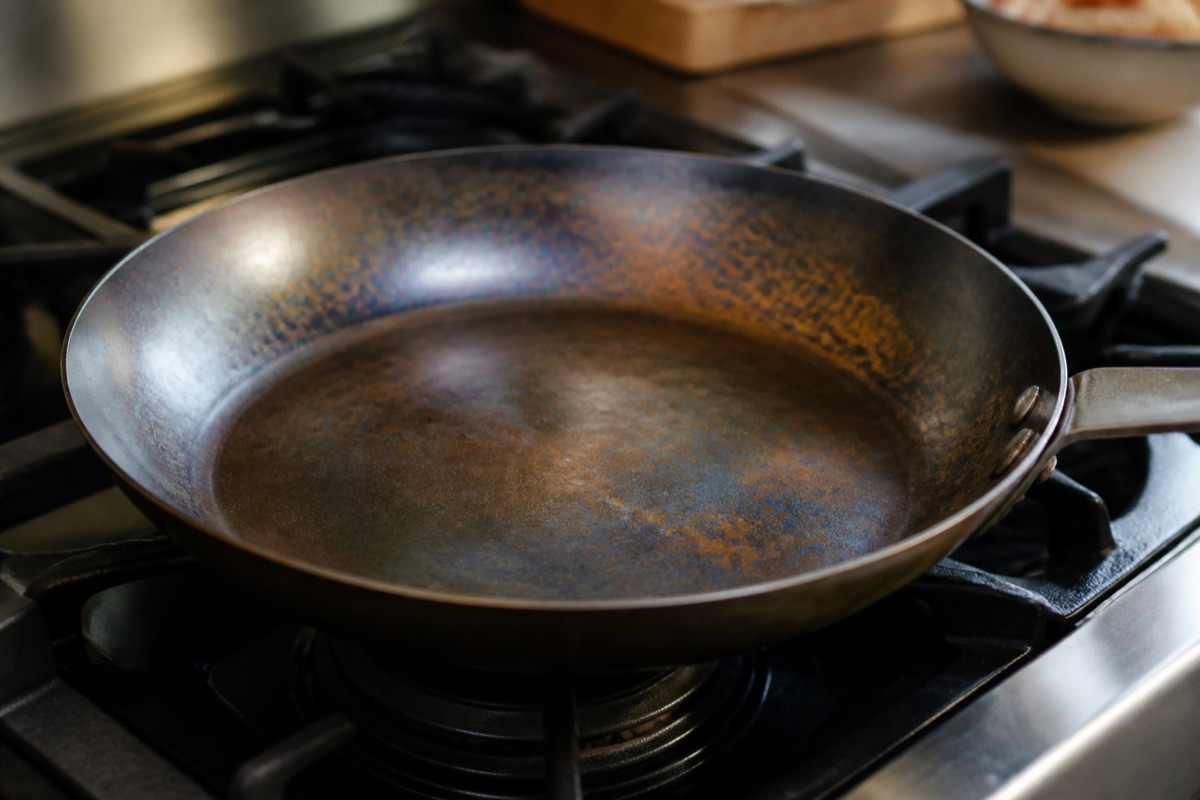
The pan will end up bronze, then brown, then approaching black over the following weeks of cooking. Uneven colour is normal and it evens out with use.
Everyday care
- Clean while warm with hot water and a brush.
- Deglaze stuck-on residue with a splash of water in the hot pan rather than scrubbing.
- Dry immediately, then heat on the hob for a minute to drive off every trace of moisture.
- Wipe with a trace of oil while warm and buff most of it back off.
Carbon steel is thinner than cast iron and rusts faster. The drying step is not optional; a pan left wet for a few hours will show orange spots.
Acid
This is the main constraint. Tomatoes, wine, vinegar and lemon strip seasoning from carbon steel more readily than from cast iron because the layer is thinner.
- Brief acid contact on a mature pan is fine — deglazing with wine will not undo it
- Do not simmer an acidic sauce in it, and do not leave one standing in the pan
- A young pan should stay away from acid entirely until the seasoning has built up
Warping
Carbon steel is thin, and thin metal warps under uneven or sudden heat. The rules:
- Preheat gradually. Medium heat, give it two or three minutes
- Never put a hot pan under cold water. This is the most common cause of a warped pan and it happens in one second
- Match the pan to the burner. A small intense flame under a large pan heats the centre and not the edges
A slightly warped pan usually settles back with gentle even heating. A badly warped one will never sit flat on an induction hob again.
Woks
Traditional woks are carbon steel, and everything above applies with two additions. Season the whole interior including the upper walls, since stir-frying uses the entire surface. And a round-bottomed wok needs a gas hob with a wok ring; on a flat electric or induction hob, a flat-bottomed wok is the only version that works.
What to cook in it
Carbon steel excels at anything needing responsiveness and a clean release: eggs, fish, crêpes, stir-fry, sautéed vegetables, steak. Once seasoning is established an omelette slides out of a carbon steel pan as readily as from non-stick, and unlike non-stick it will still do so in ten years.
What it is less good at: long acidic braises, and anything wanting the sheer thermal mass of cast iron.
Common questions
My new pan is blotchy after seasoning. Did I do it wrong?
Almost certainly not. Carbon steel seasons unevenly at first — bronze in places, brown in others, occasionally blue where the metal ran hottest. It evens out over weeks of cooking. Patchiness only matters if the surface is sticky, which means the oil layer was too thick.
Can I cook tomatoes in carbon steel?
Briefly, on a mature pan. Deglazing with wine or a quick tomato sauce will not undo established seasoning. What strips it is a long simmer — an hour of acidic braising will take a young seasoning back to bare metal. Use stainless or enamelled cast iron for those.
Why did my pan warp?
Sudden or uneven heat. The two usual causes are running cold water into a hot pan and using a small intense burner under a large pan. Carbon steel is thin, which is what makes it responsive and also what makes it warp. Preheat gradually on medium and let it cool before washing.
Is carbon steel better than cast iron?
Different, not better. Carbon steel is lighter and responds quickly to heat changes, which suits eggs, fish and stir-frying. Cast iron holds heat, which suits searing and anything wanting thermal mass. Most kitchens benefit from one of each.
Do I need to strip a new pan before seasoning?
Yes, and thoroughly. New carbon steel ships with a protective beeswax or lacquer coating that must come off, or the seasoning bonds to the coating instead of the steel and later flakes off in sheets. Hot water, dish soap and a scouring pad, repeated until the surface is uniform dull grey.