The short answer
Drag a fingernail across the mark: if it glides over, the scratch is in the finish and is very repairable; if it catches, it has reached the material below. Wood is the most repairable — wax sticks for surface scratches, filler and blending markers for deeper ones, and a screen-and-recoat when scratching is general rather than local. Laminate and vinyl cannot be refinished at all, so repairs are cosmetic concealment or plank replacement. Colour-match with two markers, one base tone and one darker drawn along the grain.
What you can do about a scratch depends entirely on how deep it goes and what the floor is made of. The useful first question is not “how do I fix this” but “has it gone through the finish”.
Depth test
Drag a fingernail lightly across the scratch.
- Your nail glides over it — the mark is in or on the finish only. Very repairable.
- Your nail catches — it has gone into the material below. Repairable, but the repair will be a fill, not a restoration.
Second test: wipe the mark with a damp cloth. If it disappears while wet, it is a scratch in the finish that will respond to a refresher or a recoat. If it stays dark, the substrate is exposed.
Hardwood
Wood is the most repairable of the three, because there is material to work with.
Surface scratches in the finish
- Clean the area first — repairing over dirt seals it in.
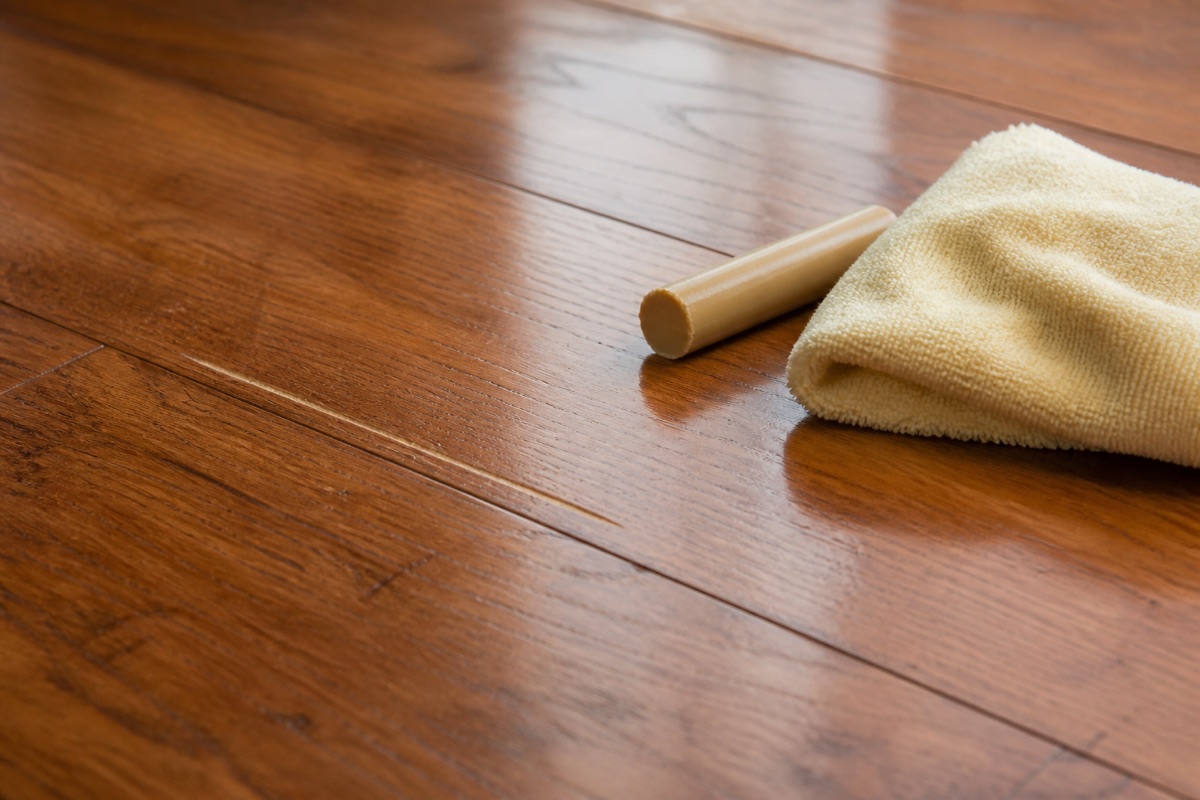
- A wax repair stick in a matching shade, rubbed in and buffed level with a cloth, hides most light scratches.
- For an area with many fine scratches, a screen-and-recoat is the right answer: the whole floor is lightly abraded and given a fresh coat. It takes a day and costs a fraction of full refinishing.
Deeper scratches into the wood
- Wood filler in a matching colour, pressed in, levelled with a plastic scraper, and finished with a compatible topcoat once cured.
- Blending markers or touch-up pens work well on dark stains. Test on an offcut — colour is much easier to get wrong than to get right.
- On an oiled floor, light scratches often disappear entirely with a maintenance oil applied to the area, because the finish is in the wood rather than on it. This is oiled flooring’s real advantage.
Dents rather than scratches
A dent is compressed fibre, not removed material, and it can often be raised. Lay a damp cloth over the dent and apply a warm iron for a few seconds at a time, checking frequently. The steam swells the crushed fibres back up.
This works on bare or oiled wood. On a polyurethane-finished floor it will damage the finish, so the technique is only useful if you intend to recoat afterwards.
Laminate
Laminate cannot be sanded or refinished — the decorative layer is a printed film, and once you are through it, it is gone. Every repair is cosmetic concealment.
- Light scuffs: a pencil eraser, or a cloth with a little bicarbonate paste, rubbed gently.
- Visible scratches: laminate repair filler or a wax stick in a matching shade. Press it in, scrape level with a plastic card, buff.
- Deep damage: replace the plank. On a floating floor that means unclipping back from the nearest wall, which is tedious rather than difficult.
The argument for keeping a spare pack from the original batch is exactly this — laminate decors are discontinued constantly, and a later production run rarely matches.
Luxury vinyl
- Scuffs: isopropyl alcohol on a cloth, or a pencil eraser.
- Light scratches: often improve on their own; vinyl has some memory. A vinyl repair kit handles the rest.
- Deep gouges: replace the plank. On glue-down LVT, an individual tile can be warmed, lifted and replaced, which is genuinely easier than on a floating floor.
- Rubber staining is not a scratch and cannot be repaired — the discolouration goes through the wear layer.
Matching colour
This is where most home repairs become obvious. Three things help:
- Test on an offcut or a hidden area first. Under the fridge, inside a wardrobe, behind a door.
- Start lighter than you think. Darkening a repair is easy; lightening one is not.
- Look at it in daylight and in artificial light. A repair that matches under a warm bulb can look completely wrong in the morning.
Wood has grain, and a solid block of filler colour reads as a repair even when the shade is right. Two markers — one for the base tone, one slightly darker drawn as fine lines along the grain direction — is what makes a fill disappear.
When to stop repairing and refinish
Individual repairs stop being worth it once scratching is general rather than local — when the traffic lane has lost its sheen across its whole width, for example. At that point:
- Hardwood: screen-and-recoat while the finish is still intact, or a full sand and refinish once bare wood is exposed. The recoat window closes when dirt reaches the grain, so this is a decision with a deadline.
- Laminate and vinyl: there is no refinishing. Widespread wear means replacement, or a rug.
Preventing the next one
- Felt pads on everything that touches the floor, and inspect them twice a year — a pad with grit embedded in it is an abrasive disc
- Lift furniture, never drag
- Mats at every door, because grit tracked in causes most fine scratching
- Trim pet claws
- Non-marking castors on chairs, and a chair mat under a desk
- Vacuum with the beater bar off on hard floors
Common questions
How do I tell how deep a scratch is?
Drag a fingernail across it. If your nail glides over, the mark is in the finish only and is very repairable. If it catches, it has reached the material below. Second test: wipe with a damp cloth — a mark that disappears while wet is in the finish; one that stays dark means the substrate is exposed.
Why does my repair look obvious even though the colour matched?
Because wood has grain and a solid block of filler colour reads as a patch. Use two markers — one for the base tone, one slightly darker drawn as fine lines along the grain — and the fill disappears. Also check it in daylight and artificial light, since a repair that matches under a warm bulb can look wrong in the morning.
Can I steam a dent out of a finished floor?
Only if you intend to recoat afterwards. The damp cloth and warm iron method swells crushed fibres back up, which works on bare or oiled wood but will damage a polyurethane finish. On a sealed floor, use filler instead.
When does it stop being worth repairing individually?
When wear is general rather than local — when a traffic lane has lost its sheen across its whole width. On hardwood that is the moment to screen-and-recoat, while the finish is still intact. On laminate and vinyl there is no refinishing, so it means replacement or a rug.
Why do felt pads need checking?
Because they collect grit and become abrasive discs. A pad you fitted two years ago and never looked at is likely doing damage rather than preventing it. Inspect them twice a year and replace any that feel gritty.