The short answer
Test by pouring water in until the float rises, not by lifting the float by hand — the float switch is the most common failure point and lifting it bypasses exactly what you need to test. Check quarterly, service annually, and clean the pit of silt and gravel. The most common cause of a flooded basement is not a broken pump but a working pump with no electricity, because storms bring the water and the outage together: a battery backup pump and a high-water alarm matter more than the pump itself. Replace on age at 7 to 10 years.
A sump pump is a single point of failure protecting the lowest part of a building. It sits idle for months, and it is called on precisely when conditions are worst — a heavy storm, often with the power off. Testing it after the water is rising is too late.
How it works
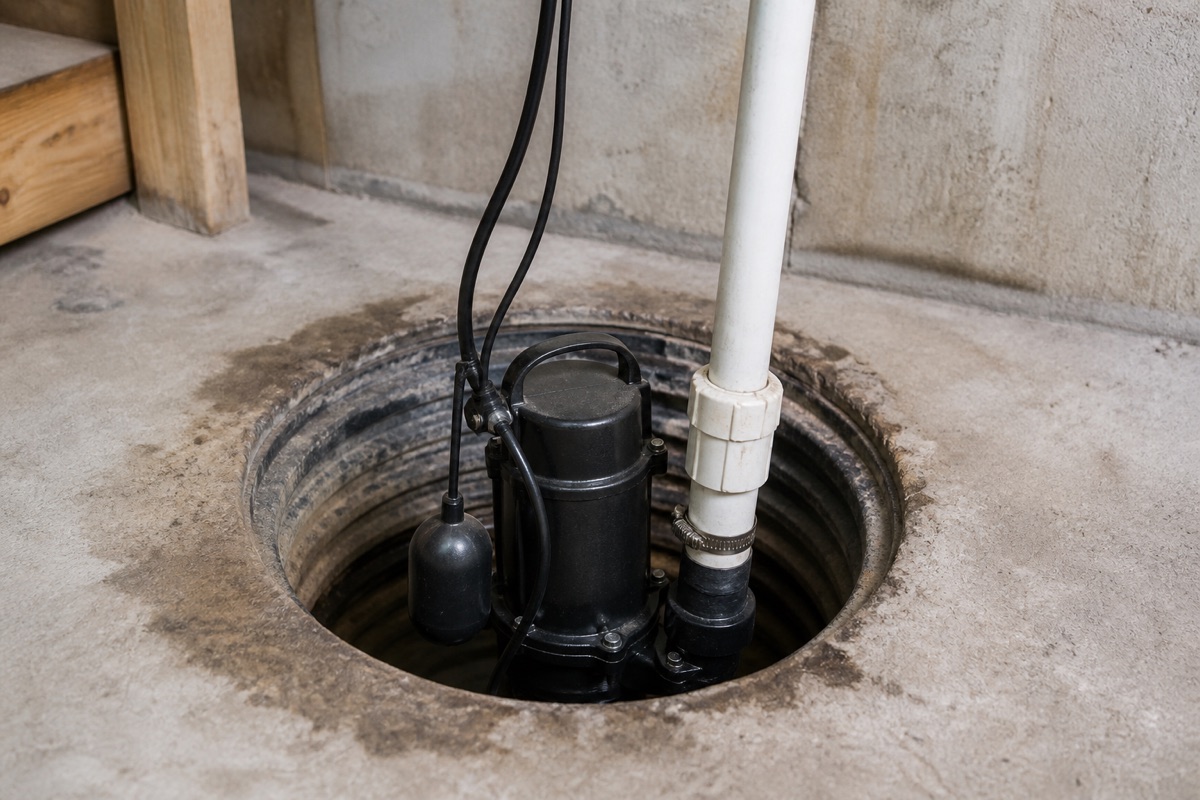
Groundwater collects in a pit — the sump — below the floor slab. A float rises with the water level and switches the pump on; the pump discharges through a pipe to somewhere outside, and a non-return valve stops that water flowing back into the pit when the pump stops.
Four components, and each has its own failure mode.
The quarterly test
Ten minutes, four times a year, and it catches nearly everything.
- Lift the lid and look. The pit should be free of gravel, silt and debris. Anything solid in there will eventually reach the impeller.
- Pour water in — a bucket at a time until the float rises.
- Confirm it starts automatically, pumps the pit down, and shuts off cleanly.
- Go outside and check the discharge. Water should be leaving the outlet at full flow.
- Listen. Grinding, rattling or a laboured hum means a problem. A pump that hums without pumping usually has a jammed impeller or a failed capacitor.
Testing by lifting the float by hand confirms the pump runs but does not test the float switch, which is the most common failure point. Use water.
Annual service
- Unplug it.
- Lift the pump out of the pit.
- Clean the inlet screen and the impeller — silt, gravel and grit collect there and reduce flow long before they stop it.
- Clean the pit itself. Scoop out silt and debris; a wet vacuum makes this easy.
- Check the non-return valve. A failed valve lets discharged water run straight back into the pit, so the pump cycles repeatedly and burns out. The tell is a distinct clunk and the pump restarting shortly after it stops.
- Check the discharge pipe for blockages, and the outdoor end for debris, ice or a crushed section.
- Refit, ensuring the pump sits flat and the float can move through its full travel without touching the pit wall or the pipe.
- Test with water.
The failure modes, in order of likelihood
| Failure | Sign |
|---|---|
| Float switch stuck | Pump does not start, or does not stop. Usually debris or the float fouling the pit wall |
| Power failure | Nothing runs — and storms cause both the water and the outage |
| Blocked discharge | Pump runs, level does not drop |
| Failed non-return valve | Rapid short-cycling |
| Frozen discharge line | Winter. Pump runs against a solid plug |
| Motor or capacitor failure | Humming with no pumping, or nothing at all |
| Undersized pump | Runs continuously and still loses ground in heavy rain |
Backup, because power and water arrive together
The most common cause of a flooded basement is not a broken pump. It is a working pump with no electricity. If the space being protected matters, a backup is not optional.
- Battery backup pump — a second pump on its own battery, mounted slightly higher in the pit. The standard solution. Test the battery twice a year and replace it every three to five years
- Water-powered backup — driven by mains water pressure, so it needs no electricity at all. Excellent where mains pressure is reliable; it does consume potable water while running, and it is prohibited in some jurisdictions
- Generator — covers the pump and everything else, but requires someone present to start it
Whichever you choose, a high-water alarm is the cheapest useful device in this whole list. It tells you the level is rising while there is still time to do something.
The discharge line
Where the water goes matters as much as whether it leaves.
- Discharge well away from the building — at least 3 metres, and further on clay. Water dumped beside the foundation returns to the sump, and the pump cycles indefinitely
- Never discharge into a foul sewer. Prohibited in most jurisdictions
- Slope it away so it drains and cannot hold water to freeze
- Fit a freeze-relief opening in cold climates — a gap or air-gap fitting near the house that lets water escape if the outdoor section freezes
Before heavy rain
- Test the pump with water
- Check the discharge outlet is clear
- Confirm the backup battery is charged
- Clear gutters and downspouts — most groundwater arriving at a sump got there from a roof
- Move anything valuable off the basement floor
Replacement
Sump pumps typically last 7 to 10 years, less with frequent cycling. Replace on age rather than on failure: a pump that dies during a storm costs vastly more than a planned replacement.
If yours runs constantly even in dry weather, the pump is not the problem — that is a groundwater or drainage issue, and the fix is outside: gutters, downspout extensions, ground falls, and in some cases a French drain.
Common questions
How should I test it — lifting the float or pouring water?
Pour water. Lifting the float by hand confirms the pump runs but does not test the float switch itself, which is the most common failure point. Fill the pit until the float rises on its own, and confirm the pump starts, empties the pit and shuts off cleanly.
Why does my pump start again a few seconds after it stops?
A failed non-return valve. Water in the discharge pipe is running straight back into the pit when the pump stops, so it cycles repeatedly and eventually burns out. The tell is a distinct clunk followed by a restart.
Is a backup pump really necessary?
If the space matters, yes — because the most common cause of a flooded basement is a working pump with no electricity. Storms bring the water and the power cut together. A battery backup pump mounted slightly higher in the pit is the standard solution.
My pump runs constantly even in dry weather. What is wrong?
Usually not the pump. Either the discharge is dumping water too close to the building and it is returning to the sump, or you have a groundwater or drainage problem. Check that the outlet is at least three metres from the wall, and look at gutters and downspouts before blaming the pump.
How long do sump pumps last?
Seven to ten years typically, less with frequent cycling. Replace on age rather than waiting for failure — a pump that dies during a storm costs vastly more than a planned replacement, and a high-water alarm is the cheapest useful insurance in the meantime.