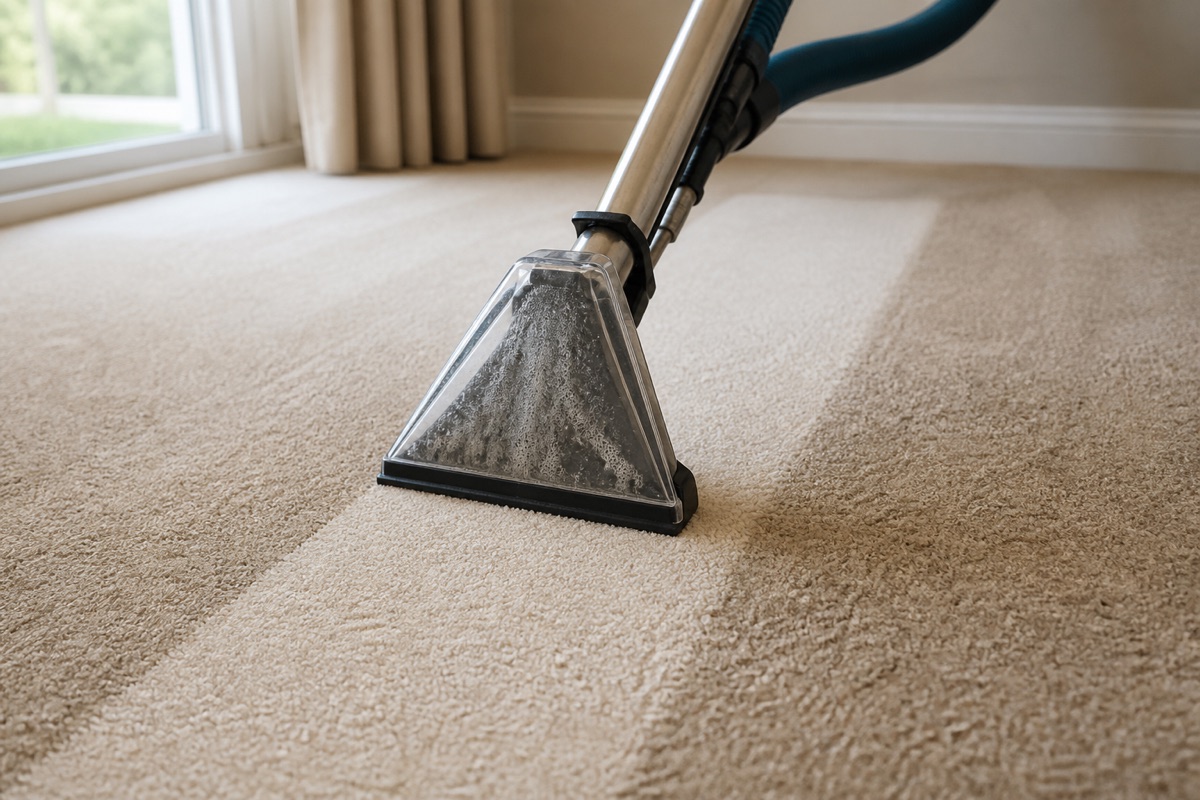
The short answer
Deep clean carpet every 12 months for a typical family, every 6 with pets or allergies, and every 18–24 for a low-traffic household. Hot water extraction is the method most manufacturers specify and some require for warranty. The dominant DIY mistake is detergent residue, which makes carpet resoil faster than before — use half what you think, and do two dry passes for every wet pass. Target under 12 hours drying; beyond 24 you risk odour and mould in the underlay. Wool needs cooler water and pH-neutral products.
Vacuuming removes loose soil. It does nothing about the oily film that builds up in the fibres over years, and that film is what makes a carpet look tired even when it is not stained. Removing it needs water, heat and extraction — and doing it badly leaves carpet worse than not doing it at all.
Vacuuming, done properly
Before any discussion of deep cleaning: most carpets are under-vacuumed, and no deep clean compensates for that. Grit works its way to the base of the pile and cuts the fibres every time someone walks on it. That damage is what actually wears a carpet out.
- Traffic lanes: two or three times a week. Bedrooms and low-use rooms: weekly.
- Slow passes. A single slow pass removes far more than three fast ones — the airflow needs time to lift soil out of the pile.
- Cross-hatch. Go over each area in two directions; pile lies in one direction and traps soil against it.
- Set the height correctly. Too high and the brush does nothing; too low and it fuzzes the pile and strains the motor.
- Empty the bin or change the bag at two-thirds full. Suction falls off a cliff after that.
The deep cleaning methods
| Method | How it works | Best for |
|---|---|---|
| Hot water extraction (often called steam cleaning) | Hot solution injected under pressure, immediately vacuumed back out with the soil | The most thorough option. The standard most carpet manufacturers specify |
| Encapsulation | A polymer solution crystallises around soil; the crystals are vacuumed out next day | Low moisture, fast drying, good for maintenance between deep cleans |
| Bonnet cleaning | An absorbent pad spun over a damp carpet surface | Commercial appearance cleaning. Surface only, and it can distort pile |
| Dry compound | Absorbent granules brushed in and vacuumed out | Wool, and anywhere that cannot be taken out of service |
Note the warranty angle: many carpet manufacturers require periodic hot water extraction and will refuse a claim without evidence of it. Check yours before choosing a method on convenience alone.
Doing it yourself
Rental and domestic extraction machines are considerably less powerful than truck-mounted units — lower heat, lower vacuum lift — which means the main risk is leaving the carpet too wet. Work around that rather than ignoring it.
- Vacuum thoroughly first. Extraction turns dry soil into mud. This step is not optional.
- Pre-treat traffic lanes and stains and give the pre-spray five to ten minutes to work.
- Use half the detergent you think you need. Residue is the single most common DIY failure — carpet that resoils within weeks is carpet with soap still in it.
- Overlap passes, and do two dry passes for every wet pass. The dry passes are what actually get the water out.
- Work backwards out of the room so you are not treading on wet carpet.
- Dry aggressively. Fans, open windows, and a dehumidifier if you have one. Target under 12 hours; beyond 24 hours you risk odour, and beyond that, mould in the underlay.
- Keep off it until dry, and put foil or plastic under furniture legs before moving anything back — wooden legs and metal castors will stain damp carpet permanently.
Wool needs different handling
Wool carpet is protein, and it is damaged by exactly what damages hair:
- Keep water temperature moderate — high heat causes shrinkage and felting
- pH-neutral or slightly acidic cleaners only. No alkaline detergent, no oxygen bleach
- Do not over-wet. Wool absorbs a great deal and takes far longer to dry
- Dry compound cleaning is often the safer choice
How often
| Household | Deep clean |
|---|---|
| One or two adults, no pets, shoes off | Every 18–24 months |
| Typical family | Every 12 months |
| Pets, children, or allergies | Every 6 months |
| Heavy traffic or smoking indoors | Every 3–6 months |
When a professional is the better call
- Wool, silk or any natural-fibre carpet of value
- Carpet that has not been deep cleaned in five years or more
- Pet contamination that has reached the underlay
- Anywhere flooding or a leak has occurred — that is a remediation job with a drying protocol, not a cleaning job
- Warranty situations requiring documented extraction
Making the result last
- Apply a fluorochemical protector after cleaning — it is what makes spills sit on top long enough to blot
- Shoes off, and mats at every entrance
- Runners in the worst traffic lanes
- Rotate furniture occasionally so the pile does not permanently crush in the same places
- Blot spills immediately — response time still matters more than any product
Common questions
Why did my carpet get dirtier a few weeks after cleaning it?
Detergent residue. Surfactant left in the fibres is sticky and attracts soil, so the cleaned area resoils faster than the rest. It is the most common DIY extraction mistake and the cause is nearly always using more detergent than the machine needs. Re-extract with plain water to strip it.
Is a rental machine as good as a professional one?
No — rental and domestic units run lower heat and much lower vacuum lift, which means less soil removed and far more water left behind. That is workable if you compensate: pre-treat properly, use half the detergent, and do two dry passes for every wet pass.
How long should carpet take to dry?
Under 12 hours is the target. Beyond 24 hours you risk odour, and beyond that mould in the underlay. Fans, open windows and a dehumidifier all help, and the single biggest factor is how much water you left in it during extraction.
Can I use a carpet cleaner on wool?
With restrictions. Keep the water temperature moderate, use a pH-neutral or slightly acidic wool-safe product, and do not over-wet — wool absorbs heavily and dries slowly. Alkaline detergent and oxygen bleach will damage it. Dry compound cleaning is often the safer route.
Does deep cleaning wear carpet out faster?
Done properly, no — the opposite. The abrasive grit at the base of the pile is what wears carpet, and extraction removes it. Done badly, over-wetting and residue cause more problems than the soil did.