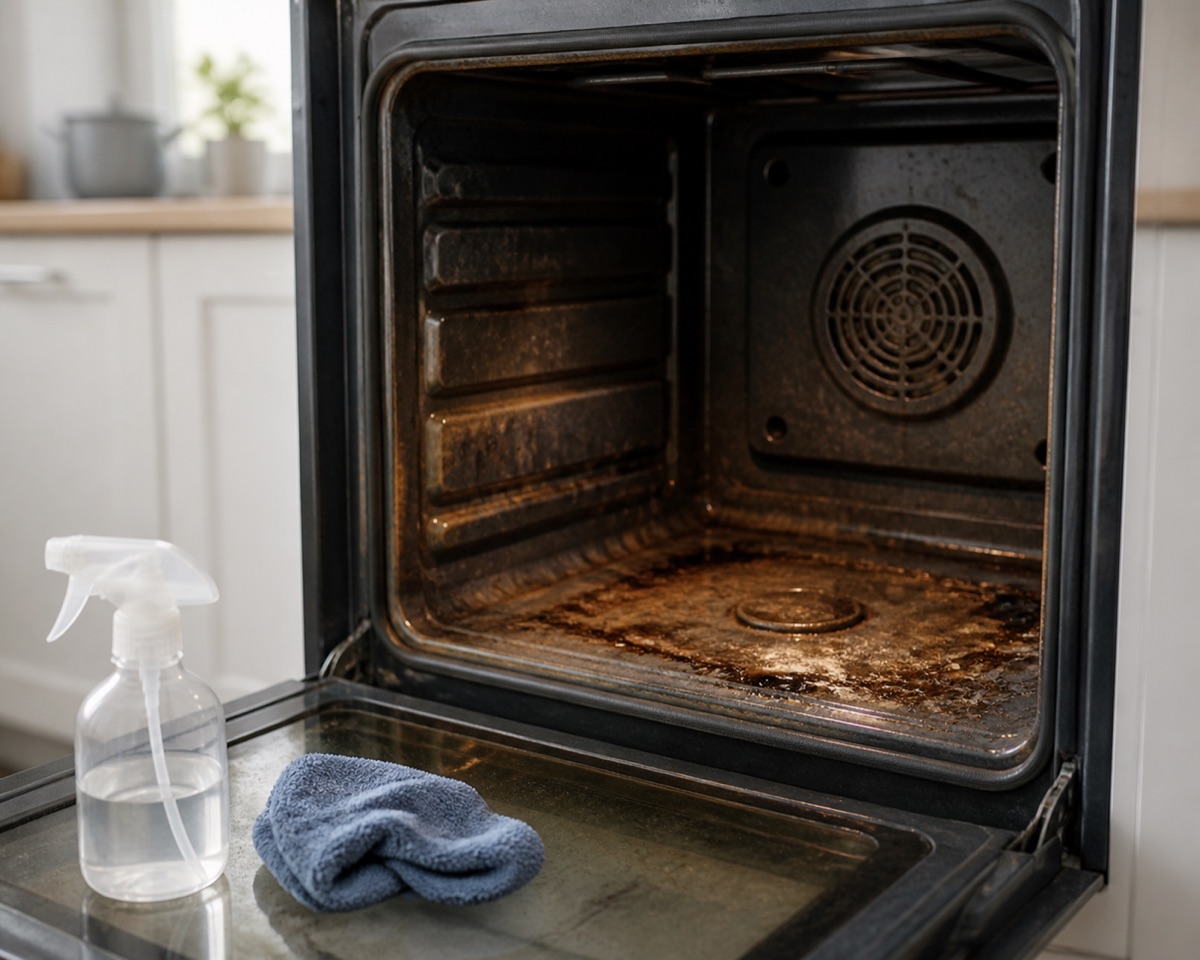
The short answer
The right method depends on what your oven interior is made of. Rough, matt, sandy-textured walls are catalytic liners: never use chemicals or scrubbing on them — they self-clean at 200–250 °C. Smooth enamel takes either a pyrolytic cycle at 425–485 °C or manual cleaning. For manual, coat the cavity with a paste of half a cup of bicarbonate and three tablespoons of water, leave overnight, scrape and wipe. Take racks out before any self-clean cycle, and move birds out of the house entirely.
There are three ways to clean an oven, and choosing the wrong one for your oven is how people end up with a dead heating element, a ruined liner, or a cavity that looks worse than when they started.
Before anything else, find out which type of interior you have. It determines everything that follows.
Identify your oven interior first
| Type | How to recognise it | Clean with |
|---|---|---|
| Standard enamel | Smooth, glossy, usually dark grey or black | Manual cleaning, or a self-clean cycle if fitted |
| Pyrolytic (self-clean) | Smooth enamel plus a dedicated high-temperature cleaning programme and a door that locks | Its own cycle, or gentle manual cleaning |
| Catalytic liners | Rough, matt, slightly sandy panels on the side and rear walls | Heat only. Never chemicals, never scrubbing |
The catalytic case is the one that matters most. Those rough panels are impregnated with a catalyst that oxidises grease at around 200–250 °C. Scrubbing them or spraying oven cleaner on them destroys the coating permanently, and the panels are an expensive replacement part. If your oven has textured walls, everything in the “manual cleaning” section below applies only to the door, the floor and the racks.
The self-clean cycle: what it does and what it costs
A pyrolytic cycle heats the empty cavity to roughly 425–485 °C (800–900 °F) for two to four hours, reducing residue to a fine ash you wipe out afterwards. It works extremely well. It also puts more thermal stress on the oven in one cycle than months of ordinary cooking.
What people find out the hard way: the failures that follow a self-clean cycle — a blown thermal fuse, a failed element, a control board that will not wake up — are common enough to be a known pattern. The cycle is not damaging the oven arbitrarily; it is finding components that were already near the end of their life.
Rules for running one
- Take the racks out unless the manual explicitly says they can stay. Chrome racks discolour and lose their smooth slide permanently.
- Scrape out loose debris first. A pool of spilled fat will produce a great deal of smoke rather than ash.
- Ventilate hard. Open windows and run the extractor.
- Move birds out of the house entirely. Birds have respiratory systems acutely sensitive to fumes from overheated cookware coatings and pyrolysis products. This is a well-documented risk and it is not a small one.
- Do not run it the day before you need the oven. If something is going to fail, this is when.
Steam clean, if your oven offers it
A lower-temperature programme — typically around 90 °C with a measured amount of water in the cavity floor — that softens light soil in 20 to 30 minutes. It will not touch carbonised deposits, but for regular upkeep between deep cleans it is gentle and effective, and it carries none of the risk of a pyrolytic cycle.
Manual cleaning
The baking soda method
Slow, cheap, and effective on all but the most carbonised deposits.
- Remove the racks. Mix about half a cup of bicarbonate of soda with three tablespoons of water into a spreadable paste.
- Coat the interior surfaces — floor, walls, inside of the door glass. Avoid the heating elements, the fan, and any catalytic panels entirely.
- Leave it overnight, or at least eight hours. The dwell time is the active ingredient here.
- Scrape the dried paste off with a plastic scraper and wipe out with a damp cloth.
- Spray any stubborn residue lightly with white vinegar — it will foam against the remaining bicarbonate — and wipe again.
Commercial oven cleaner
Most are strongly alkaline, typically sodium hydroxide. They work quickly on heavy carbon and they will burn skin and damage eyes.
- Nitrile gloves, eye protection, and good ventilation. Not optional.
- Never on catalytic liners, heating elements, the fan, the door seal, or exposed aluminium.
- Rinse thoroughly and repeatedly. Residual caustic bakes into a haze on the next use and produces fumes.
Racks
The bath is the easiest route: lay the racks on an old towel in the bath to protect the enamel, cover with hot water, add a generous scoop of washing soda or a couple of dishwasher tablets, and leave them for several hours. Most of the deposit will then come off with a nylon brush.
The door glass
The inner face cleans with the same bicarbonate paste. Discolouration you can see but cannot reach is between the panes — grease that has wicked in through the vent gap at the bottom of the door. Reaching it means removing the door and separating the glass, which on most ovens is a documented procedure in the manual and takes about half an hour. It is not a job to improvise; the panes are toughened and the retaining clips are specific to the model.
Keeping it clean
- Wipe spills once the oven has cooled but before it is used again. Every reheat cycle carbonises a spill further.
- Use a tray under anything likely to bubble over. A sheet of foil on the oven floor is not the way to do this — it blocks airflow, can reflect heat back into the element, and on gas ovens can obstruct the burner. Manufacturers are near-unanimous about this.
- Cover roasting dishes for the first part of a long cook to cut the fat that sprays onto the walls.
How often
| Task | Frequency |
|---|---|
| Wipe spills | After each cook, once cool |
| Light clean or steam programme | Monthly |
| Deep clean or pyrolytic cycle | Every 3–6 months |
| Racks | Every 3 months |
Common questions
How do I know if I have catalytic liners?
Feel the side and rear walls. Catalytic liners are rough, matt and slightly sandy rather than smooth enamel. If yours are textured, never use chemicals or scrubbing on them — the catalyst coating is destroyed permanently and the panels are an expensive replacement part.
Is the self-clean cycle bad for the oven?
It puts more thermal stress on the oven in one cycle than months of ordinary cooking, and failures afterwards — thermal fuse, element, control board — are a known pattern. It is not damaging the oven arbitrarily; it is finding components already near the end of their life. Do not run one the day before you need the oven.
Why do people say to move birds out of the house?
Birds have respiratory systems acutely sensitive to fumes from overheated cookware coatings and pyrolysis products, and the exposure kills quickly. It is well documented and it is not a small risk. Ventilate hard regardless.
Can I leave the racks in during a self-clean cycle?
Only if the manual explicitly says so. Chrome racks discolour at pyrolytic temperatures and lose their smooth slide permanently. Take them out and clean them separately in a bath with washing soda.
How do I clean between the door glass?
Grease wicks in through the vent gap at the bottom of the door, so it cannot be reached from either face. Removing the door and separating the panes is a documented procedure in most manuals and takes about half an hour. It is not a job to improvise — the panes are toughened and the clips are model-specific.