The short answer
A machine that walks is out of level, or still has its transit bolts fitted. Remove those first — two to four bolts across the back panel, which must come out before first use. Then level with a spirit level side to side and front to back, and finish with the rock test: push each top corner in turn, and there should be no movement at all. Tighten the lock nuts against the cabinet, or vibration walks the feet round within a month. Recheck annually.
A washing machine that bangs, shuffles across the floor, or vibrates hard enough to rattle things off a shelf is almost never broken. It is out of level, or it is still bolted for transit, and both are fixable in under half an hour.
The reason it matters more on a washing machine than on any other appliance is the spin cycle. A modern front-loader spins at 1200 to 1600 rpm. A load of wet laundry never distributes perfectly, so there is always some imbalance, and the suspension is designed to absorb it — provided all four feet are carrying load. Lift one foot off the floor and the drum has a pivot to work against, which turns a small imbalance into a machine walking across the room.
First: are the transit bolts out?
If the machine is newly installed and violently loud, check this before anything else. Transit bolts are long bolts through the back panel that clamp the drum to the casing so it cannot move in shipping. They must be removed before first use. Running a machine with them in place will damage the suspension, and it is not covered by warranty.
Look at the back: two to four bolt heads, often with plastic collars, usually in a row or a square. Unscrew them fully, withdraw them, and fit the blanking caps that came in the accessory bag. Keep the bolts — you need them if the machine is ever moved.
Levelling it
You need a spirit level and usually an open-ended spanner. A phone level app is accurate enough for this job.
1. Check the floor first
Feet compensate for a floor that is out of level by a few millimetres. They cannot fix a floor that flexes. A suspended timber floor that bounces when you walk on it will let a spinning machine build up movement no matter how well levelled it is — the fix there is a sheet of thick plywood spanning several joists, or relocating the machine.
2. Level side to side, then front to back
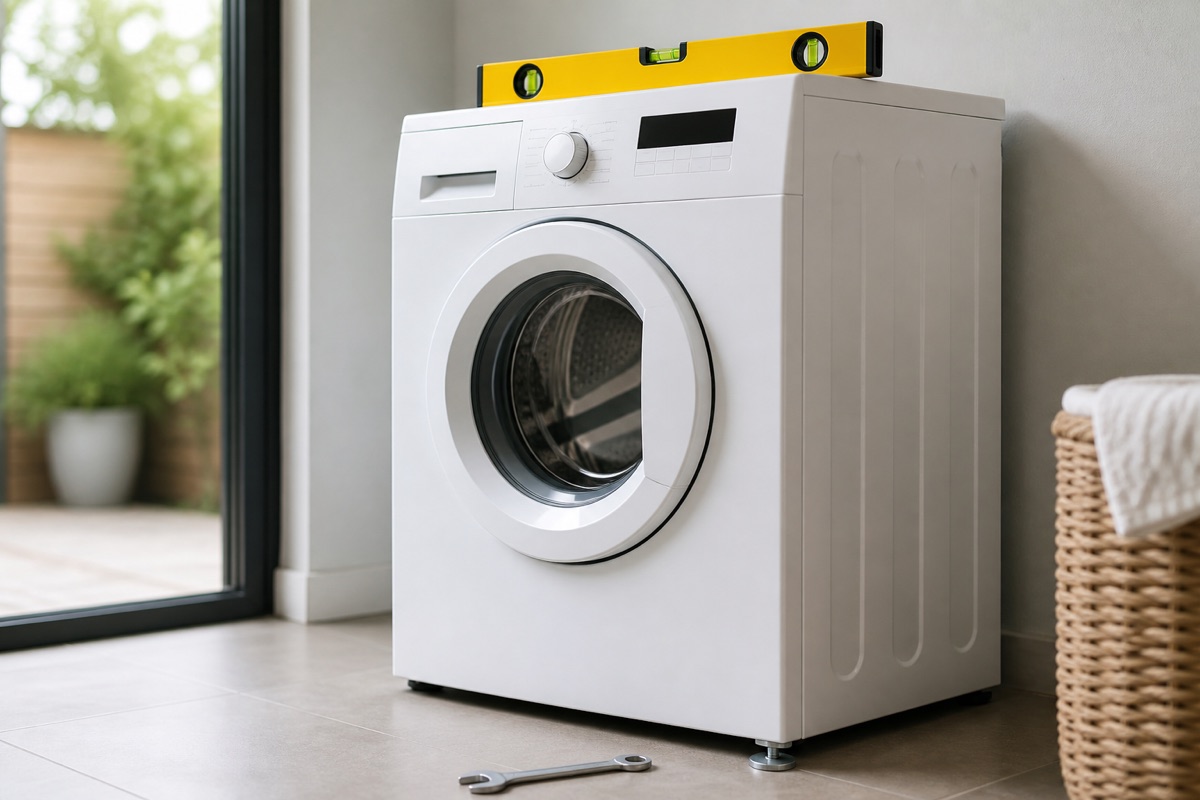
Put the level across the top of the machine, left to right. Adjust the front feet by turning them — clockwise to lower, counter-clockwise to raise, on almost all machines — until the bubble is centred. Then turn the level ninety degrees and repeat front to back.
Rear feet on many machines are self-levelling: you tilt the machine forward, the feet drop to meet the floor, and they lock when you set it down. If yours are adjustable instead, set them the same way as the front.
3. The rock test — the one that actually matters
Push down firmly on each of the four top corners in turn. There should be no movement at all. If a corner drops, the diagonally opposite foot is too long, or the one below that corner is too short.
Work in small increments: a quarter turn changes more than you expect. Recheck the level after every adjustment, because raising one foot tilts the whole machine.
4. Lock the feet
Most feet have a lock nut. Once the position is right, hold the foot still and tighten the nut up against the underside of the cabinet. Skipping this is the most common reason a machine that was levelled correctly goes out of level again within a month — vibration walks an unlocked foot round over time.
5. Test with a real load
Run a small load — three or four towels — on the fastest spin. Small loads are the hardest case for balance, so if it holds steady with those it will be fine with a full drum.
If it is level and still moves
| Symptom | Likely cause |
|---|---|
| Loud banging only at high spin, machine stays put | Worn suspension dampers or shock absorbers |
| Grinding or rumbling that changes with drum speed | Drum bearings |
| Machine slides on a hard floor but is stable otherwise | Feet slipping — anti-vibration pads will fix it |
| Only certain loads misbehave | Load distribution — see below |
Suspension dampers are a moderately accessible repair on many machines. Bearings usually are not; on most current designs the drum is a sealed assembly and replacing bearings means replacing the tub, at a cost that often exceeds the machine’s value.
Load habits that cause imbalance
- A single heavy item. One bath sheet, one pair of jeans, or a rug on its own cannot distribute. Add a few smaller items to give it something to balance against.
- Anything waterproof. Mattress protectors, raincoats and pram covers trap water in a pocket and become a lump. Wash them alone on a low spin.
- Overloading. A drum packed solid cannot tumble, so the load stays as one mass. The manufacturer’s stated capacity assumes clothes can move.
- Duvets and pillows in a machine too small for them. They wrap the drum wall and stay there.
Anti-vibration pads
Rubber pads under the feet cut transmitted noise and stop a machine sliding on tile or vinyl. They are cheap and they work. What they do not do is substitute for levelling — a machine on pads that is still rocking will still rock, just more quietly at first.
How often to check
Re-check level and the rock test annually, and any time the machine has been moved — including being pulled out to clean behind it. Floors settle, feet drift, and it takes two minutes.
Common questions
My new machine is violently loud. What should I check first?
Transit bolts. They clamp the drum to the casing for shipping and must be removed before first use — two to four bolt heads across the back panel, often with plastic collars. Running with them in place damages the suspension and is not covered by warranty.
What is the rock test and why does it matter more than the spirit level?
Push down firmly on each of the four top corners in turn. There should be no movement at all. A machine can read perfectly level and still rock if one foot is not carrying load, and that free pivot is what turns a small imbalance into a machine walking across the room.
I levelled it and a month later it is loud again. Why?
The lock nuts. Most feet have one, and if it is not tightened up against the underside of the cabinet, vibration walks the foot round over weeks. This is the most common reason a correctly levelled machine goes out of level again.
Do anti-vibration pads replace levelling?
No. They cut transmitted noise and stop a machine sliding on tile or vinyl, which is genuinely useful. A machine that is still rocking will keep rocking on pads — just more quietly at first.
Which loads cause the worst imbalance?
A single heavy item with nothing to balance against — one bath sheet, one pair of jeans, a rug. Also anything waterproof, which traps water in a pocket and becomes a lump, and an overloaded drum where clothes cannot tumble and stay as one mass.