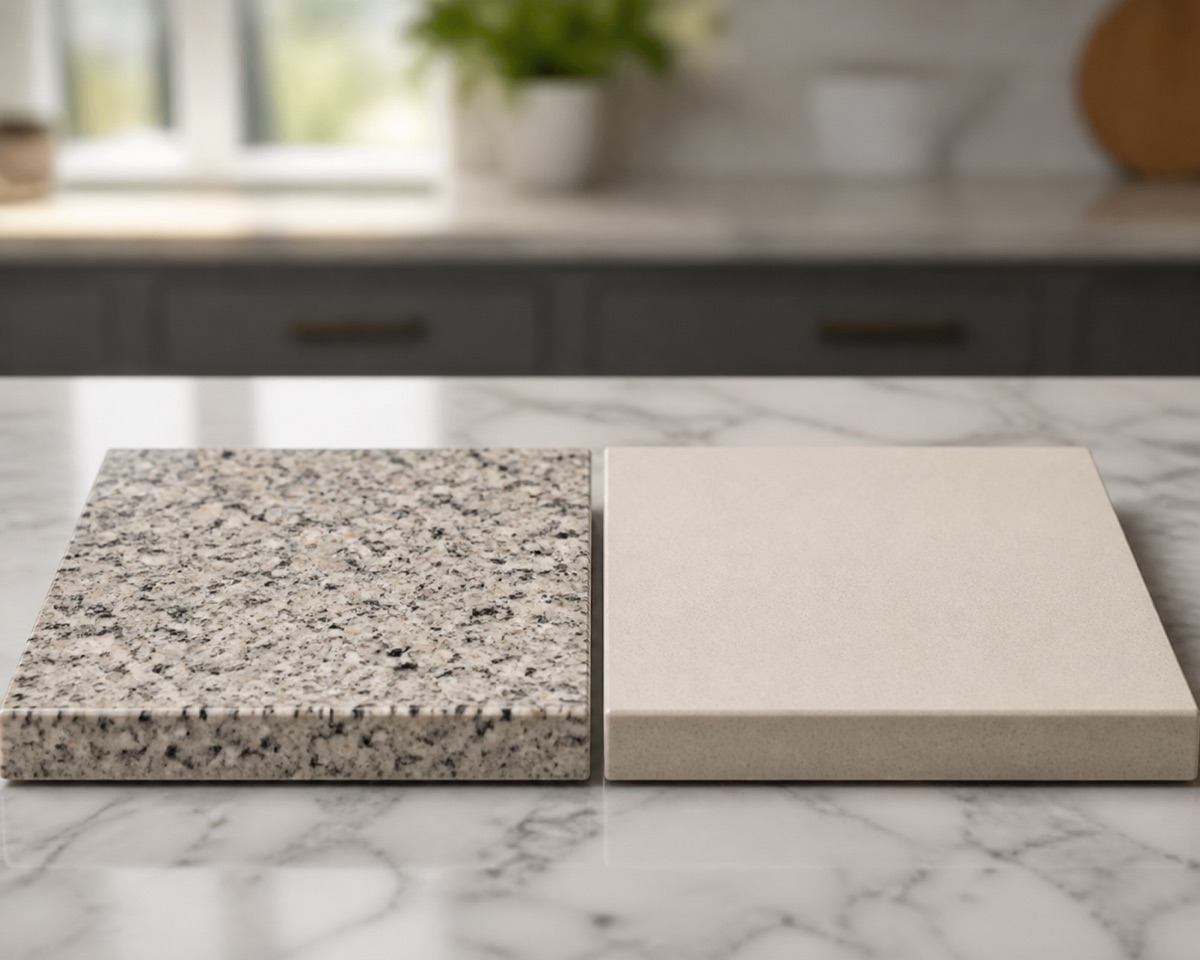
The short answer
Quartz is non-porous and never needs sealing, but its resin binder is damaged above roughly 150 °C — so a pan straight off the hob can leave a permanent mark, and it yellows under UV. Granite tolerates heat and sunlight but is porous and needs sealing every one to three years. Test the seal by leaving a tablespoon of water 15 minutes: if the stone darkens, reseal. Both need pH-neutral cleaning; neither tolerates abrasive pads. Choose granite next to a hob, quartz away from one.
Engineered quartz and granite look similar in a showroom and behave very differently in a kitchen. Choosing between them, or looking after one you already have, comes down to three properties: porosity, heat tolerance, and UV stability.
What they actually are
Granite is quarried igneous rock, cut and polished. Every slab is different, it is naturally porous to varying degrees, and its performance depends on the specific stone.
Engineered quartz — Caesarstone, Silestone, Cambria and others — is roughly 90–93% ground natural quartz bound in about 7–10% polymer resin, with pigments. That resin is the source of every difference between the two.
The three that matter
Porosity
Quartz is non-porous. The resin fills the voids, so it never needs sealing and it does not absorb liquids. This is its main practical advantage.
Granite is porous, though how porous varies enormously — a dense black granite may absorb almost nothing, while a coarse-grained light granite absorbs readily. It needs sealing, and the interval depends on the stone.
Heat
This reverses the ranking. Granite tolerates heat well; it is rock, and it was formed hot. Quartz does not. The resin binder typically begins to suffer somewhere around 150 °C (300 °F), and a pan straight off the hob can scorch it, leave a permanent white or yellow mark, or cause thermal-shock cracking.
Quartz heat damage is not repairable in any practical sense. Trivets are not optional on a quartz worktop.
UV
The resin in quartz yellows and can discolour under prolonged direct sunlight. Most manufacturers explicitly exclude outdoor installations from warranty, and a quartz worktop under a large south-facing window will change colour over years. Granite is UV-stable.
Side by side
| Engineered quartz | Granite | |
|---|---|---|
| Sealing | Never | Every 1–3 years |
| Stain resistance | Excellent | Good when sealed |
| Heat resistance | Poor — always use trivets | Very good |
| Scratch resistance | Very good | Very good |
| UV stability | Poor — indoor only | Excellent |
| Acid resistance | Good | Good (granite is siliceous) |
| Consistency of appearance | Uniform, predictable | Every slab unique |
| Repairability | Difficult | Chips fillable, can be re-polished |
Daily care — quartz
- Warm water, a soft cloth, and a little pH-neutral dish soap
- Wipe spills as they happen — non-porous is not the same as indestructible, and some dyes will mark the resin if left
- For dried-on residue: a plastic scraper, then a non-abrasive cleaner
Avoid entirely: bleach, oven cleaner, drain cleaner, paint stripper, and any high-pH product — all attack the resin. Abrasive pads dull the finish permanently. Do not use a melamine sponge; it is abrasive.
Daily care — granite
- The same warm water and pH-neutral soap routine
- Rinse well and dry, or you build a soap film
- Test the seal annually with the water test: a tablespoon of water left 15 minutes should not darken the stone
Avoid: acidic cleaners (they will not etch granite, but they degrade the sealer), bleach and ammonia, and abrasives.
Common damage and what can be done
| Problem | Quartz | Granite |
|---|---|---|
| Heat mark | Permanent | Rare; usually sealer damage, resealable |
| Stain | Usually surface, cleans off | Poultice draws it out |
| Chip at the edge | Colour-matched epoxy, hard to hide | Colour-matched epoxy, blends well |
| Dull patch from abrasives | Not repairable at home | Re-polishable |
| Crack across a cut-out | Professional repair or replacement | Professional repair or replacement |
The chalk mark that is not a stain
A common quartz complaint is a whitish haze that appears on a dark worktop. It is almost always limescale or soap residue, not damage. A soft cloth with a little household descaler diluted well, or a purpose-made quartz cleaner, followed by a thorough rinse, removes it. Do not attack it with an abrasive — that turns a removable film into permanent dulling.
Choosing between them
Neither is better. They fail differently:
- Choose quartz if you want zero maintenance, a consistent look across a large run, and you are disciplined about trivets. Best for a bathroom, a utility room, or a kitchen away from a hob.
- Choose granite if the worktop sits next to a hob, receives strong direct sun, or you want a natural material and do not mind resealing occasionally.
One practical note when buying granite: ask to see the actual slab, not a sample. Variation within a single stone type can be dramatic, and the piece that gets cut is the piece you live with.
Common questions
Can I put a hot pan on quartz for just a moment?
Do not risk it. The resin binder starts to suffer around 150 °C and a pan straight off a burner is well above that. Damage can be instant, it takes the form of a permanent white or yellow mark or a thermal-shock crack, and there is no home repair for either.
How do I tell quartz from granite if I did not choose it?
Look for repetition. Engineered quartz has a designed pattern that recurs across a slab and matches perfectly across a seam. Granite is geologically random, and the pattern changes visibly across a large run. Quartz also has a more uniform, slightly plastic-feeling polish.
Does granite need sealing every year without fail?
No — test rather than assume. Leave a tablespoon of water on the surface for 15 minutes and wipe it. If the stone darkens, reseal. A dense black granite may go three years or more; a coarse light one may need it annually.
Why has my dark quartz developed a white haze near the sink?
It is nearly always limescale or dried soap film, not damage. A diluted descaler or a purpose-made quartz cleaner with a thorough rinse removes it. Do not attack it with an abrasive pad, which turns a removable film into permanent dulling.
Is quartz suitable for an outdoor kitchen?
No. The resin yellows and degrades under UV, and most manufacturers exclude outdoor installation from warranty entirely. Granite, quartzite and porcelain are the outdoor options.