The short answer
Frost is water vapour that got in and froze on a cold surface, so the job is finding where the moisture enters. Visible frost in a frost-free freezer means something is wrong — either too much moisture is entering or the defrost heater has failed. Diagnose by location: frost around the door means a seal problem, an even coating means frequent openings, heavy frost on the back wall means a defrost fault, and a clear ice sheet on the floor means a blocked drain. When defrosting, never chip ice with a knife — puncturing the evaporator writes the freezer off.
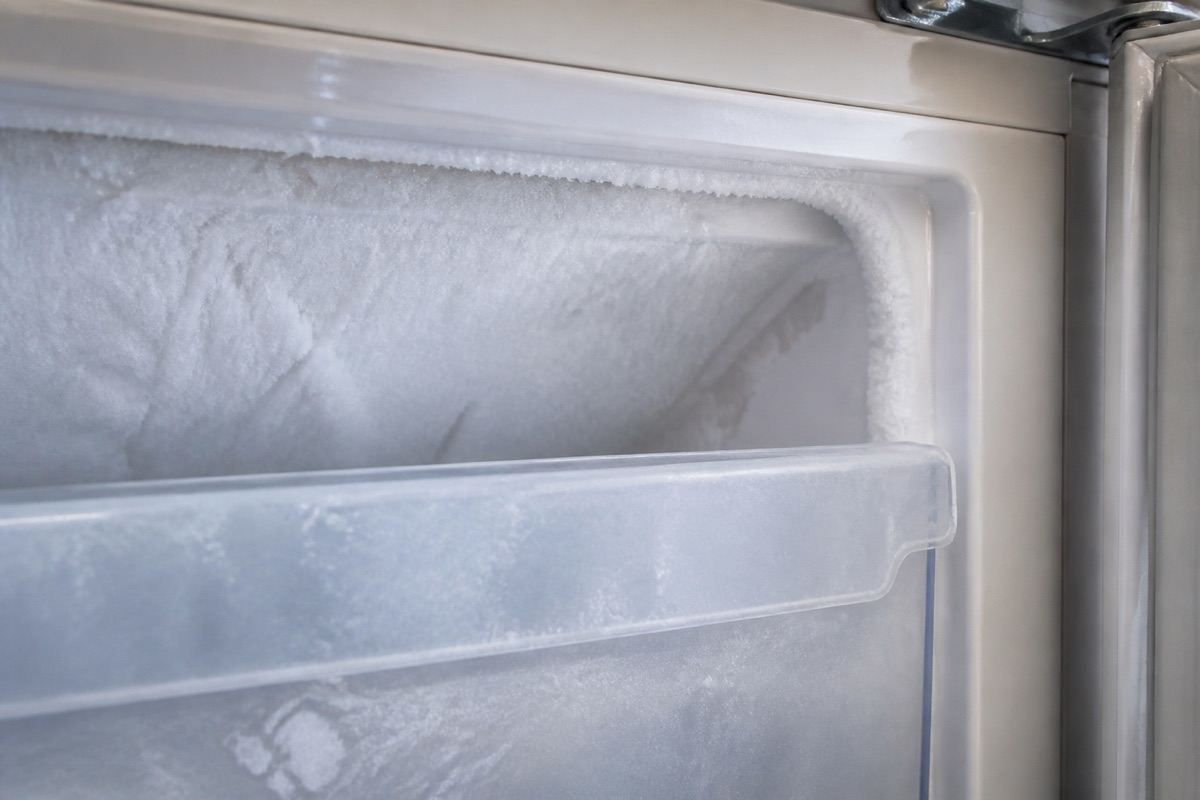
Frost in a freezer is not the freezer failing. It is water vapour that got inside, met a surface below freezing, and turned straight to ice without ever being liquid. Every gram of frost on the walls arrived as humid air, and the job is working out where it is getting in.
Frost-free is not the same as no frost
A frost-free freezer has a heating element wrapped around the evaporator coil that melts accumulated ice on a cycle, typically every six to twelve hours, and drains the meltwater away. The compartment stays clear because the ice is being removed continuously, not because it never forms.
Visible frost inside a frost-free freezer therefore means something is wrong — either too much moisture is entering for the defrost cycle to keep up, or the defrost system itself has failed.
A manual-defrost freezer, by contrast, accumulates frost as a matter of course and needs emptying and defrosting periodically. On those, frost is expected; the question is only how fast it builds.
Where the moisture comes from
- Door openings. Every opening exchanges cold dry air for warm humid room air. A chest freezer loses far less because cold air sinks and stays put.
- A door left ajar. The single biggest cause, and often not noticed — a drawer not pushed fully home, or a package holding the door open by a few millimetres.
- A failing door seal. Slow, invisible, and continuous.
- Warm or uncovered food. Food put in warm releases moisture as it cools. Uncovered food loses moisture continuously, which is also what causes freezer burn.
- High room humidity. A freezer in an unheated garage or a damp utility room takes in far more moisture per opening.
Diagnosing by where the frost is
| Frost location | What it points to |
|---|---|
| Around the door opening and seal | Seal failure or door not closing fully |
| Even coating on all surfaces | Frequent openings, or high room humidity |
| Heavy on the back wall only | Defrost system fault — heater, thermostat or timer |
| Ice sheet on the floor of the compartment | Blocked defrost drain |
| Frost inside sealed packaging | Freezer burn — packaging not airtight |
The seal test
Close the door on a sheet of paper and pull. You should feel clear drag. Test at eight or ten points around all four sides. Anywhere it slides out freely is leaking. The same paper test used on fridge gaskets applies, and so do the cleaning and reshaping fixes.
The blocked drain
If meltwater cannot leave, it refreezes on the compartment floor as a growing sheet of clear ice — quite different in appearance from the soft white frost of ordinary accumulation. The drain hole is usually at the base of the rear wall. Clearing it means defrosting fully and flushing the channel with warm water, sometimes with a length of soft tubing.
Defrosting properly
- Move the food. Cool boxes, insulated bags, or a neighbour’s freezer. Well-packed frozen food in a closed cool box holds for several hours.
- Switch off at the socket. Not just the thermostat.
- Put towels down along the base and on the floor in front. There will be more water than you expect.
- Leave the door open and let it melt. A bowl of hot water inside speeds it up considerably, refreshed every twenty minutes.
- Never use a knife, screwdriver or ice pick. Puncturing the evaporator releases the refrigerant and the freezer is finished. This is the one genuinely irreversible mistake here.
- Wipe out and dry thoroughly, including the seal and its channel.
- Restart empty and let it reach temperature before reloading.
A hairdryer on low will speed things up but keep it well away from plastic surfaces and never let it near standing water.
Preventing it coming back
- Know what is in there. Time with the door open is the main cause, and a list on the door beats rummaging.
- Cover and seal everything. Airtight packaging prevents both moisture release and freezer burn.
- Cool food before freezing it.
- Keep it reasonably full. Frozen mass holds cold and reduces the volume of humid air exchanged on opening. Bottles of water fill empty space effectively.
- Check the seal twice a year and clean it monthly.
- Set the temperature to −18 °C. Colder does not preserve food better and increases frost formation.
Common questions
My freezer is frost-free but there is frost. Is it broken?
Probably. Frost-free machines run a defrost heater on a cycle, so visible frost means either too much moisture is entering — usually a door or seal problem — or the defrost heater, thermostat or timer has failed. Check the seal first; it is the cheap answer.
How often should a manual freezer be defrosted?
When frost reaches about 5–6 mm thick. Beyond that it insulates the walls, the compressor runs longer, and you lose usable space. In a normal household that is typically once or twice a year.
Is it safe to chip ice off with a knife?
No — this is the one mistake that writes off a freezer. The evaporator tubing runs just behind the surface, and puncturing it releases the refrigerant with no practical repair. Use warm water and patience.
Why is there a solid sheet of ice on the floor of the compartment?
A blocked defrost drain. Meltwater from the defrost cycle cannot escape so it refreezes in place. It looks like clear ice rather than soft white frost. Defrost fully and flush the drain channel at the base of the rear wall.
Does a full freezer really use less energy?
Yes, modestly. Frozen mass holds cold, so the compressor cycles less after each opening, and there is less air volume to exchange. Filling empty space with bottles of water works and costs nothing.