The short answer
MERV runs 1 to 20 and a higher number is not automatically better. For most domestic systems MERV 8 to 11 is correct: denser filters raise static pressure, cut airflow across the coil, and can freeze an evaporator or strain a blower motor. If you want higher filtration, fit a deeper 100 mm media filter, which has more surface area at the same rating and therefore lower resistance. Change a 25 mm filter every 1 to 3 months. The test that beats any schedule: if you cannot see light through it, replace it.
The air filter is the cheapest component in a heating and cooling system and the one most likely to cause an expensive failure. A blocked filter starves the system of airflow, and low airflow is the root cause of a long list of faults that get diagnosed as something else.
What the filter is actually for
Most people assume it is there to clean the air they breathe. Its primary job is to protect the equipment — keeping dust off the evaporator coil and the blower wheel. Air quality is a secondary benefit, and a real one, but the design intent is equipment protection.
That explains why a filter that is too restrictive is a problem rather than an upgrade.
MERV ratings
MERV — Minimum Efficiency Reporting Value — runs from 1 to 20 and describes what proportion of particles of given sizes a filter captures.
| MERV | Captures | Suits |
|---|---|---|
| 1–4 | Large dust, lint, carpet fibre | Equipment protection only. Minimal air quality benefit |
| 5–8 | Mould spores, dust mite debris, pet dander | The standard domestic range. Good balance |
| 9–12 | Fine dust, some bacteria, auto emissions | Allergy sufferers, if the system can take it |
| 13–16 | Bacteria, smoke, most respiratory droplets | Hospital-grade. Check your system can handle it |
| 17–20 | HEPA range | Cleanrooms. Not for domestic HVAC |
Higher is not automatically better
A denser filter creates more resistance. Domestic systems are designed around a specific static pressure, and exceeding it causes real damage:
- Reduced airflow across the coil
- Frozen evaporator coil in cooling — a classic symptom of an over-restrictive filter
- Overheating and short-cycling in heating
- Higher energy use
- Blower motor strain and premature failure
For most domestic systems, MERV 8 to 11 is the sensible range. Going higher is worth it only if the ductwork and blower were specified for it, or if you fit a deeper filter — a 100 mm media filter at MERV 13 has far more surface area and therefore lower resistance than a 25 mm filter at the same rating.
The other rating systems
MPR is 3M’s own scale, FPR is Home Depot’s. Both correlate loosely with MERV. Roughly: MPR 600 ≈ MERV 8; MPR 1500 ≈ MERV 12; FPR 7 ≈ MERV 11.
Changing it
- Turn the system off at the thermostat.
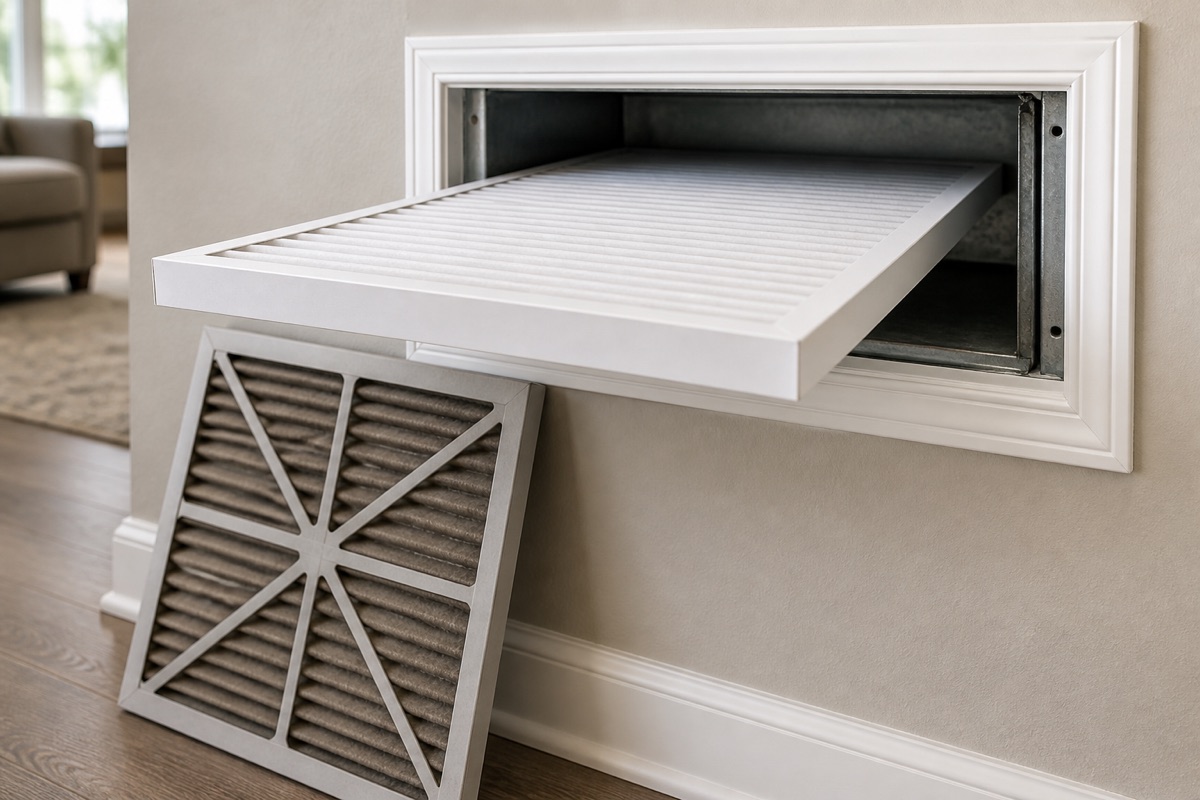
- Find the filter — in the return air grille, or in a slot at the air handler.
- Note the airflow arrow on the old filter’s frame before removing it.
- Slide the old one out, avoiding shaking the dust off into the room.
- Fit the new one with the arrow pointing toward the air handler — the direction air travels. Fitting one backwards reduces its effectiveness and can collapse the media.
- Write the date on the frame edge in marker.
- Turn the system back on.
Sizing: the printed nominal size (e.g. 20×25×1) is not the actual size, which is typically half an inch smaller each way. Buy by the nominal size printed on the old filter.
How often
| Situation | 25 mm filter | 100 mm media filter |
|---|---|---|
| No pets, low dust | Every 3 months | Every 9–12 months |
| Typical household | Every 2 months | Every 6–9 months |
| Pets | Monthly | Every 6 months |
| Multiple pets, allergies, or heavy use | Every 3–4 weeks | Every 3–4 months |
| Building work nearby | Weekly while it lasts | Monthly |
The check that beats any schedule: hold the filter up to a light. If you cannot see light through it, it is done, whatever the calendar says.
Symptoms of a blocked filter
- Weak airflow from the vents
- The system running much longer than it used to for the same result
- Ice on the refrigerant line or the coil in cooling mode
- Short-cycling — the system starting and stopping repeatedly
- Rising energy bills with no change in use
- Dust settling faster than usual
Washable filters
Reusable electrostatic filters exist and they reduce waste. Two caveats: they are typically MERV 4 or lower, so filtration is basic, and they must be completely dry before refitting. A damp filter in an air handler grows mould and distributes it through the house.
What a filter cannot do
A filter only treats air passing through the system, and only while the system is running. For continuous air quality improvement you need the fan running continuously — which most thermostats allow — or a separate room air purifier.
Filters also do nothing for gases and odours. That needs activated carbon, and for carbon monoxide specifically, it needs a detector, not a filter.
Common questions
Will a higher MERV filter make my air noticeably cleaner?
Only if the system can move air through it. A MERV 13 filter that halves your airflow filters a smaller volume of air more thoroughly, which can be a net loss. If you want high filtration, fit a deeper media filter — more surface area at the same rating means lower resistance.
My evaporator coil keeps freezing. Is that the filter?
It is the first thing to check. Low airflow across the coil drops its temperature below freezing and condensation turns to ice. Replace the filter, let the ice melt fully before restarting, and if it recurs with a clean filter the cause is elsewhere — a blocked return, a failing blower, or low refrigerant charge.
Does the airflow arrow really matter?
Yes. The media is built with a coarse face and a fine face, and running it backwards reduces its dust-holding capacity and can collapse the pleats into the frame. The arrow points in the direction air travels, toward the air handler.
Why does my filter look clean but the system still struggles?
Surface appearance is a poor guide — a filter loads from the inside. Hold it up to a light: if you cannot see light through the media, it is finished regardless of how it looks. Also check for a blocked return grille, closed supply registers, or a crushed flexible duct.
Are washable filters worth it?
They reduce waste and cost nothing to run, but they are typically MERV 4 or below, so filtration is basic. The bigger risk is refitting one that is not bone dry, which puts moisture into the air handler and can grow mould that is then distributed through the house.