The short answer
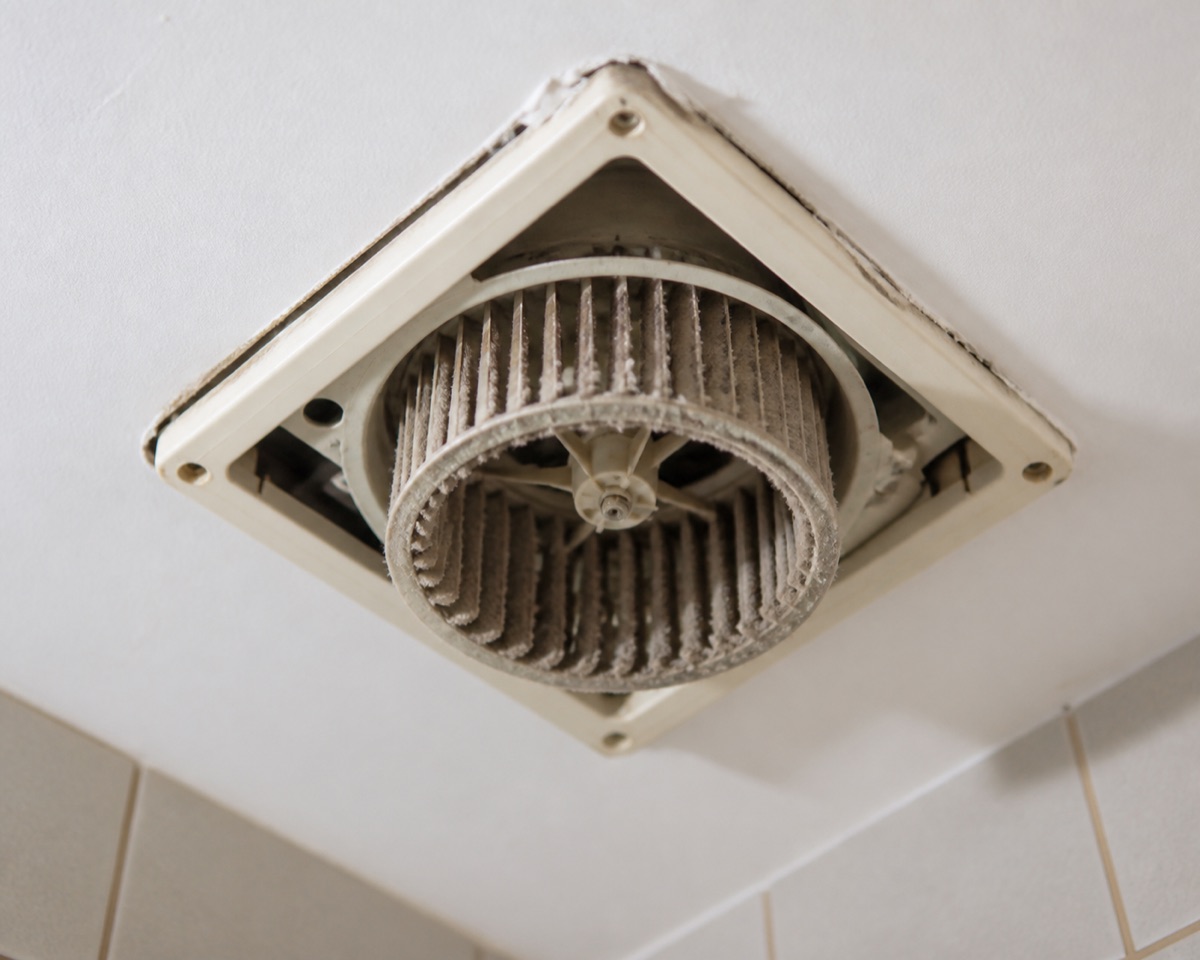
Hold a single sheet of toilet tissue against the grille with the fan running: it should stay there unaided. If it falls, the fan is moving almost nothing — and a fan that has never been cleaned still sounds exactly like a working one. Isolate the circuit at the consumer unit, then vacuum the impeller, which collects a felt of dust that destroys airflow. Run the fan during and for at least 15 to 20 minutes after a shower. A duct that terminates in the loft rather than outside is a serious defect and a common one.
A bathroom extractor fan that runs but does not extract is extremely common, and the symptom is not silence — it is mould. Black spotting on a ceiling, around a window reveal, or along a silicone joint is almost always a ventilation problem wearing a cleaning problem’s clothes.
Test whether yours works
The tissue test. Switch the fan on and hold a single sheet of toilet tissue against the grille. It should hold there unaided. If it falls, or needs to be pressed, the fan is moving very little air.
Do this before assuming the fan is fine because it makes a noise. A fan with a dust-clogged impeller and a blocked duct still sounds exactly like a working fan.
Cleaning it
Isolate the circuit at the consumer unit first. Many bathroom fans are wired to the lighting circuit and are live even with the light switch off. Turning the light off is not isolation.
- Remove the cover — usually two clips, or a central screw under a cap.
- Wash the cover in warm soapy water and dry it fully.
- Vacuum the impeller and housing. The impeller blades collect a felt of dust and hair that unbalances them and destroys airflow. A soft brush attachment plus a dry paintbrush gets most of it.
- Wipe the housing with a barely damp cloth. Nothing wet near the motor.
- Refit the cover.
- Restore power and repeat the tissue test.
Do this every six months. On a fan that has never been cleaned, the improvement is usually dramatic.
If cleaning does not fix it, check the duct
The duct is where most fan problems actually live.
- Crushed or kinked flexible duct in a loft — extremely common, and it can halve airflow on its own
- A duct that stops in the loft rather than terminating outside. This is a serious defect: you are pumping bathroom moisture into the roof space, and the result is condensation, rot and mould in the loft. It must terminate at a wall or roof vent
- A stuck external flap. Go outside with the fan running and check the grille flap opens
- Long runs and bends. Every bend costs airflow. Rigid duct outperforms flexible substantially; if you are replacing, use rigid
- Insulation piled on top of a flexible duct, crushing it
Is the fan big enough?
Extraction is rated in litres per second or cubic metres per hour. Typical requirements:
| Room | Minimum extract rate |
|---|---|
| Bathroom or shower room | 15 l/s (54 m³/h) |
| Toilet only | 6 l/s (22 m³/h) |
| Kitchen (not over hob) | 30 l/s (108 m³/h) |
| Utility room | 30 l/s (108 m³/h) |
These are the figures used in UK Building Regulations Part F; other jurisdictions differ in detail but not much in magnitude. Note that the rated figure assumes ideal ducting — a fan rated at 15 l/s on the end of five metres of crushed flexible duct with two bends is delivering far less.
Run it for long enough
This is the single biggest behavioural factor. A fan that runs only while the light is on removes almost none of the moisture from a shower, because the moisture is still evaporating off wet surfaces for a long time afterwards.
- Run it during the shower and for at least 15–20 minutes afterwards. A timer overrun model does this automatically and is worth fitting
- Leave the door closed while it runs, with the gap under the door providing make-up air. An open door lets the fan pull air from the landing instead of from the wet room
- A humidity-sensing fan handles this on its own and is the best option in a bathroom that has had mould problems
Make-up air
A fan cannot extract air it cannot replace. In a tightly sealed bathroom with a well-fitted door, the fan pulls against a vacuum and moves very little.
The gap under the door — normally around 10 mm — is the intended path. If a thick carpet or a draught excluder has closed it, the fan’s performance drops sharply. This is a common unintended consequence of draught-proofing.
Dealing with mould that is already there
- Fix the ventilation first, or it will simply come back.
- Clean surface mould with a proprietary mould remover, or a dilute chlorine solution — ventilate, wear gloves, and never mix with any other cleaner.
- Black mould in silicone joints usually cannot be cleaned out — it has grown into the sealant. Cut the old silicone out, dry the joint completely, and reseal with a sanitary-grade silicone containing a fungicide.
- Consider an anti-mould additive or paint on the ceiling.
When to replace the fan
- It is noisy, rattling, or the motor sounds laboured
- It fails the tissue test after a thorough clean and with a clear duct
- It is undersized for the room
- It has no timer overrun and nobody remembers to leave it running
Replacement fans are inexpensive. Fitting a like-for-like unit is straightforward, but bathroom electrical work is zone-regulated in most jurisdictions — if you are not certain of the requirements where you live, have an electrician do it.
Common questions
How do I know if my fan is actually working?
Hold a single sheet of toilet tissue against the grille with the fan running. It should hold there unaided. A fan with a dust-clogged impeller and a blocked duct still sounds exactly like a working fan, so noise tells you nothing.
How long should the fan run after a shower?
At least 15 to 20 minutes, because moisture continues evaporating off wet surfaces long after you get out. A fan wired to the light switch removes almost none of it. A timer overrun or humidity-sensing model handles this automatically and is worth fitting.
Why does my fan seem weaker since I draught-proofed?
A fan cannot extract air it cannot replace. The gap under the door — normally around 10 mm — is the intended make-up air path, and a thick carpet or a draught excluder closing it will drop performance sharply. This is a common unintended consequence.
My duct ends in the loft. Is that a problem?
A serious one. You are pumping bathroom moisture into the roof space, which causes condensation, rot and mould in the loft. The duct must terminate at a wall or roof vent outside. This is a defect worth fixing before anything else.
The mould keeps coming back in the silicone. Why?
Because it has grown into the sealant rather than sitting on it, so cleaning is only cosmetic. Cut the old silicone out, dry the joint completely, and reseal with a sanitary-grade silicone containing a fungicide — after fixing the ventilation, or it will simply happen again.