The short answer
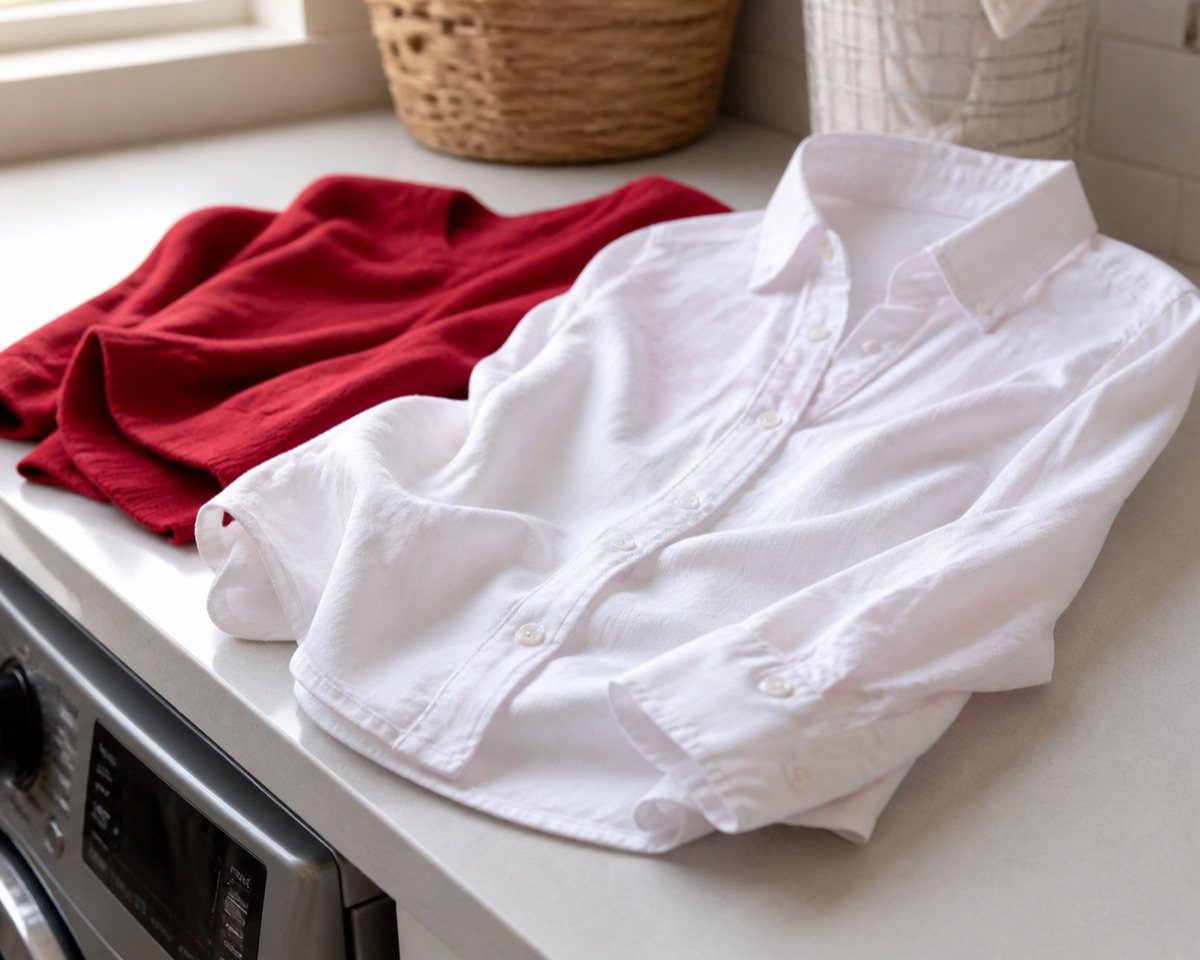
Deep reds, indigos, blacks and anything new are the garments that bleed. Test before you risk a load: press a damp white cloth firmly against an inside seam and rub — if colour transfers, wash that item alone. Wash cold, because dye release rises sharply with temperature, and use colour catcher sheets in mixed loads. If a load has already bled, the critical rule is do not let anything dry and never put it in the dryer: heat sets transferred dye permanently. Rewash immediately while still wet.
Colour bleeding is dye leaving one garment and settling on another. It happens because dye that was never properly fixed during manufacture releases when it meets water, agitation and heat — and once it has transferred, you have a short window before it sets permanently.
Which garments actually bleed
Not all colours are equally risky. The ones that release dye are consistent:
- Deep reds, indigos and blacks — the highest-load dyes
- Anything new, particularly the first three or four washes
- Cheaply dyed cotton, where fixing was skipped or rushed
- Hand-dyed and batik fabrics
- Raw and selvedge denim, which is designed to release dye
Testing before you risk a load
Dampen a white cloth, press it firmly against an inconspicuous part of the garment — an inside seam or hem — and rub. If colour transfers to the cloth, wash the item alone until it stops.
The alternative test: soak the garment alone in a basin of warm water for 30 minutes and look at the water.
Preventing it
- Wash new items separately for the first two or three washes.
- Sort properly — whites, lights, darks, and reds as their own group.
- Wash cold. Dye release rises sharply with temperature. 30 °C releases far less than 40 °C.
- Do not overload. Crowded fabric rubs, and friction accelerates transfer.
- Get laundry out promptly. Damp fabric sitting together in a drum is exactly the condition dye transfer needs.
- Use colour catcher sheets in mixed loads. They work — the sheet is treated to absorb loose dye from the water before it reaches other fabric.
The salt and vinegar myth
Adding salt or vinegar to “set” dye is repeated everywhere and does essentially nothing on commercially dyed modern fabric. Salt is used as a dye-bath additive during manufacture, at concentrations and temperatures no washing machine reproduces. It will not hurt anything; it will not help either.
Rescuing a bled load
Speed is everything. Dye that is still wet is far more removable than dye that has dried.
- Do not put anything in the dryer. Heat sets transferred dye permanently. This is the mistake that turns a recoverable load into a ruined one.
- Rewash immediately, without letting anything dry, on the same or slightly cooler setting with detergent and a colour-run remover.
- If that is not enough, soak: oxygen bleach for whites and colourfast items, several hours in warm water.
- For whites only, a dedicated colour run remover (usually sodium hydrosulphite based) is considerably stronger. Follow the packet exactly and do not use it on wool, silk or elastane.
- Check before drying, every time. Repeat rather than accept a partial result.
What not to reach for
- Chlorine bleach — it will remove some dye and simultaneously damage the fabric, yellow any elastane and set some dyes. It is not a colour-run remover.
- Heat of any kind until the dye is out.
When it is not bleeding at all
A whole load coming out uniformly dingy grey is usually not dye transfer. That is detergent and mineral residue — the mechanism is in Hard Water and Laundry, and the fix is a strip wash rather than a colour-run remover.
Similarly, a single garment fading evenly all over is light or heat damage, not bleeding.
Common questions
Do colour catcher sheets actually work?
Yes. They are treated to attract and hold loose dye suspended in the wash water before it can deposit on other fabric. They are not a licence to wash a bleeding red shirt with white sheets, but for ordinary mixed loads they work as advertised.
Does salt set the dye?
No, not in a washing machine. Salt is used during commercial dyeing at concentrations and temperatures a domestic wash does not approach. It is harmless but it does nothing for colourfastness on a finished garment.
My load has already bled. What is the first thing to do?
Keep it wet and rewash immediately. Do not let anything dry and above all do not put it in the dryer — heat sets transferred dye permanently, and that single step is the difference between recoverable and ruined.
Can I use bleach to fix a pink white wash?
Chlorine bleach is the wrong tool. It damages fibres, yellows elastane and can set some dyes. Use a purpose-made colour run remover on whites, or an oxygen bleach soak on anything colourfast.
How many washes before a new red shirt is safe with others?
Usually two or three, but test rather than count. Rub a damp white cloth on an inside seam — when no colour transfers, it is safe. Raw denim is the exception and may release dye for a long time.