The short answer
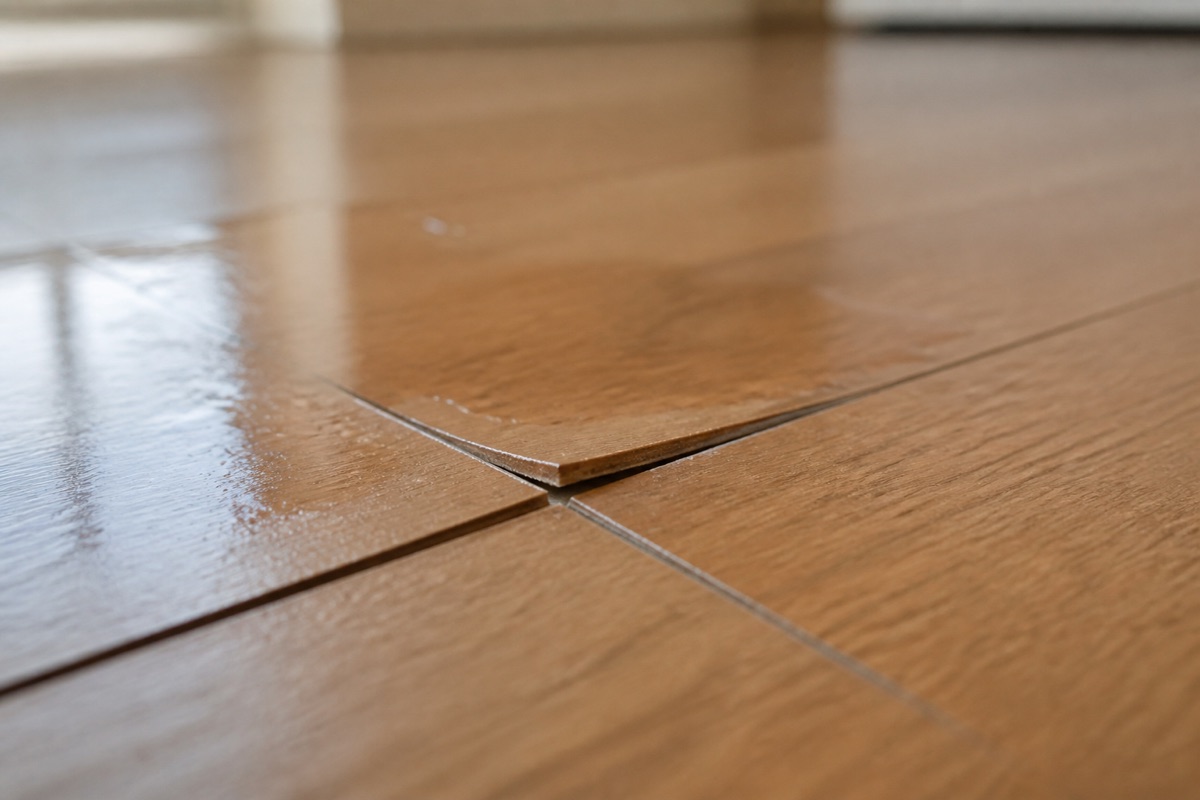
Laminate swelling is permanent because the core is high-density fibreboard: once the compressed fibres absorb water and expand, they do not compress again. Never wet-mop and never use a steam mop, which forces moisture into the joints and voids effectively every manufacturer’s warranty. Damp clean with a well-wrung microfibre mop and wipe spills immediately. A water-resistant rating of 24 or 72 hours is a grace period for an unnoticed spill, not permission to mop. Damaged boards are replaced, not repaired.
Laminate is a photographic layer under a wear coat, bonded to a core that is almost always high-density fibreboard. The wear layer is genuinely tough — laminate resists scratching better than most real wood. The core is compressed wood fibre, and it swells irreversibly when it gets wet.
That combination explains every rule for looking after it. The surface can take a great deal. The edges, the joints, and the core can take almost nothing.
Why swelling is permanent
When HDF absorbs water, the compressed fibres expand and do not compress again when they dry. The visible result is a raised, slightly crumbling ridge along a board edge — the classic laminate failure. There is no repair. The board is replaced, which on a click-lock floor means lifting boards back from the nearest wall to reach it.
Water rules
- Never wet-mop. Damp is the maximum, and the floor should look dry within seconds behind the mop.
- Never use a steam mop. Steam forces hot moisture directly into the joints. Effectively every laminate manufacturer voids the warranty for it, and this is the single most common cause of a ruined laminate floor.
- Wipe spills immediately. Minutes matter at a joint, not hours.
- No standing water, ever — including a pet bowl that gets splashed, a leaking radiator valve, or condensation running down a patio door.
Water resistant is not waterproof
Many current products are sold as water-resistant, with a treated core and sealed joints, and they are meaningfully better than older laminate. The rating is normally expressed as a number of hours of surface water resistance — commonly 24 or 72.
Read that as what it is: a grace period for a spill you have not noticed yet. It is not permission to mop, and it does not apply to water reaching the floor from underneath. If you want a floor that genuinely tolerates water, that is a different product — vinyl or tile.
Routine cleaning
- Dry clean two to three times a week. A microfibre dust mop, or a vacuum with the beater bar switched off. Grit is what wears the surface layer.
- Damp clean every one to two weeks with a well-wrung microfibre flat mop and a laminate-specific cleaner, or plain water. Spray onto the mop head or lightly onto the floor, never pour.
- Dry any area that still looks wet with a cloth, particularly along joints.
What not to use
| Product | Why not |
|---|---|
| Steam mop | Moisture into the joints. Voids warranty |
| Oil soap, wax, polish | Laminate is not wood; these leave a film that cannot be removed and makes the floor slippery |
| Abrasive cleaners, scouring pads | Scratch the wear layer, which cannot be refinished |
| Bleach and ammonia | Can dull and discolour the surface |
| Vinegar | Repeated use degrades the wear layer |
| Wet string mop | Far too much water |
Marks and how to remove them
| Mark | Method |
|---|---|
| Scuffs | Pencil eraser, or a dry cloth with a little baking soda paste, rubbed lightly |
| Chewing gum, candle wax | Harden with an ice pack, lift with a plastic scraper |
| Ink, marker | Isopropyl alcohol on a cloth, dabbed not scrubbed |
| Grease | Warm water with dish soap, wrung out well |
| Deep scratch | Laminate repair filler in a matching shade. It fills, it does not restore |
Laminate cannot be sanded or refinished. Whatever damage reaches the decorative layer is permanent, so prevention carries all the weight here.
Expansion gaps
Laminate is a floating floor. It is not fixed down, and it expands and contracts with temperature and humidity. The installer leaves a gap of roughly 10–12 mm around every wall, pipe and fixed obstacle, hidden by skirting or beading.
If that gap gets bridged — by a skirting nailed through the floor, a heavy bookcase pinning the boards at one end, or silicone squeezed into the gap — the floor cannot move, and it peaks along a joint instead. If your laminate has developed a ridge running across a room, this is usually why, and the fix is to find and free whatever is trapping it.
Prevention
- Felt pads on all furniture, checked every six months for embedded grit
- Mats at every external door, and a waterproof tray under pet bowls
- Keep humidity between 35% and 55% — the same range as wood, for the same reason
- Lift furniture rather than dragging, especially near joints
- Blinds on strong direct sun — laminate fades, and an unevenly faded floor is as permanent as a swollen one
- Never use rubber-backed mats; they can trap moisture and mark the surface. Use a breathable rug pad
When a board has already swollen
There is no drying it back. Replacing a single board on a click-lock floor means unclipping from the nearest wall inward, swapping the damaged plank, and clipping back. It is tedious rather than difficult — which is the argument for keeping a spare pack from the original batch, because laminate decors are discontinued constantly and a later batch rarely matches.
Common questions
Can a swollen laminate board dry back out?
No. The core is compressed wood fibre, and once those fibres absorb water and expand they do not compress again. The raised, slightly crumbling ridge along the board edge is permanent, and the only fix is replacing the plank.
My laminate says water-resistant. Can I mop it now?
No. The rating is a stated number of hours of surface water resistance — a grace period for a spill you have not noticed yet, not permission to wet-mop. It also says nothing about water reaching the floor from underneath.
Why has my floor developed a ridge across the middle of a room?
Something is trapping it. Laminate is a floating floor that expands and contracts, and the installer leaves a 10–12 mm gap at every wall and fixed obstacle. If skirting has been nailed through the boards, silicone squeezed into the gap, or a heavy unit is pinning one end, the floor peaks instead of moving.
Can scratches be sanded out?
No — the decorative layer is a printed film, and sanding goes straight through it. Repairs are cosmetic concealment with a matching filler or wax stick. This is the strongest argument for keeping a spare pack from the original batch, since laminate decors are discontinued constantly.
Are rubber-backed mats a problem on laminate?
Yes. They trap moisture against the surface and can mark it. Use a breathable rug pad instead — the same advice applies to wood floors, and for the same reason.