The short answer
Most blunt knives are not blunt — the edge has rolled to one side and needs honing, not sharpening. Five or six light strokes each side on a steel at 15–20° takes fifteen seconds and restores most knives. Only sharpen when honing makes no difference. On a whetstone, hold a consistent angle — 15° for Japanese knives, 20° for Western — and work until you feel a burr along the full length of the far side, then flip. Avoid pull-through carbide sharpeners, which tear metal out rather than grinding an edge.
A knife that will not cut is usually not blunt. It is bent. Distinguishing between the two is the single most useful thing to understand about knife maintenance, because the fixes are entirely different and one of them takes fifteen seconds.
Honing versus sharpening
A knife edge is extremely thin — a few microns at the apex. Under normal use that apex rolls over to one side. The steel is all still there; it is simply no longer pointing the right way. The knife feels blunt because you are pushing the side of the edge through the food rather than the edge itself.
- Honing pushes the rolled edge back into alignment. It removes essentially no metal. Do it often — every few uses.
- Sharpening grinds away steel to form a new apex. Do it rarely — a few times a year for a home cook.
Most people sharpen when they should hone, which removes metal unnecessarily and shortens the knife’s life.
Honing
A honing steel — the rod that came with your knife block — is the tool. Ceramic rods are gentler and slightly more aggressive at truing; grooved steel rods are the traditional choice.
- Hold the rod vertically, tip resting firmly on a cutting board.
- Set the blade against the top of the rod at roughly 15–20° — a quarter of a right angle, halved again.
- Draw the blade down and toward you, heel to tip, with light pressure.
- Alternate sides. Five or six strokes each side is plenty.
Light pressure is the point. Honing is alignment, not grinding, and leaning on the rod does nothing useful.
Sharpening on a whetstone
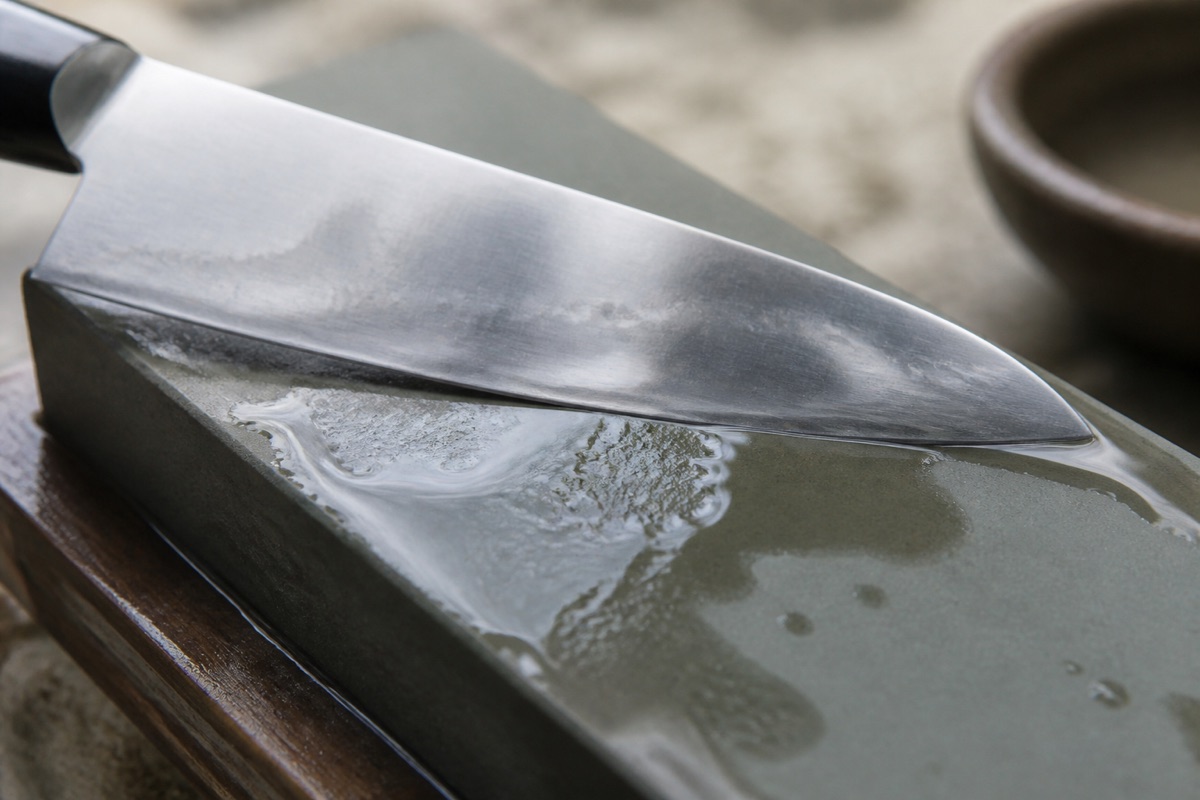
Whetstones give the best result and the most control. A combination stone of 1000 grit on one side and 3000–6000 on the other covers everything a home kitchen needs.
- Soak the stone for 5–10 minutes, or until bubbles stop rising. Some stones are splash-and-go — check.
- Set it on a damp cloth so it cannot slide.
- Establish the angle: about 15° for Japanese knives, 20° for most Western knives. A useful reference is two stacked coins under the spine.
- Work the coarse side. Push the blade away from you as though shaving a thin layer off the stone, keeping the angle constant. Move along the blade so the whole edge gets worked.
- Feel for the burr. Run a thumb across — never along — the back of the edge. A slight wire catching your thumb along the full length means that side is done.
- Flip and repeat until a burr forms on the other side.
- Move to the fine side and repeat with lighter pressure to refine the edge and remove the burr.
- Strop on leather, cardboard or the fine stone with very light trailing strokes.
Consistent angle matters more than technique, grit, or stone quality. A mediocre stone used at a consistent angle beats an excellent stone used at a wandering one.
The other tools
| Tool | Verdict |
|---|---|
| Whetstone | Best result, most control. Requires practice |
| Guided rod system | Excellent results with no skill. Slow, and fiddly to set up |
| Pull-through carbide sharpener | Avoid. Tears metal out rather than grinding. Fast, and it wrecks the edge geometry |
| Electric sharpener | Convenient. Removes a lot of steel; fixed angle may not match your knife |
| Professional service | Sensible once or twice a year for good knives |
The pull-through carbide type is worth avoiding specifically. The two carbide wedges scrape metal off in strips, leaving a ragged edge that feels sharp for a week and then fails. On a good knife it does real damage.
Testing
- Paper: hold a sheet of printer paper by one edge and slice down through it. A sharp knife glides; a dull one tears or slips.
- Tomato: the edge should break the skin under the knife’s own weight with no pressure.
- Thumbnail: rest the edge on a thumbnail at a shallow angle. Sharp bites; dull slides.
Keeping an edge longer
- Use a wooden or plastic board. Glass, stone, ceramic and metal boards destroy edges instantly — a single meal on a glass board undoes a sharpening
- Never put knives in the dishwasher. Detergent pits the steel, and knocking against other items chips the edge
- Hand wash and dry immediately
- Store in a block, on a magnetic strip, or with edge guards — loose in a drawer is how edges get chipped
- Do not scrape food off the board with the edge. Turn the knife over and use the spine
- Cut, do not twist. Lateral force is what chips and rolls an edge
Angle by knife type
| Knife | Angle per side |
|---|---|
| Japanese (gyuto, santoku) | 10–15° |
| Western chef, utility | 15–20° |
| Cleaver, heavy-duty | 20–25° |
| Serrated | Do not sharpen at home — professional or replace |
A shallower angle cuts better and dulls faster. A steeper angle holds up longer and cuts less cleanly. Match it to the knife’s steel and to what you actually do with it.
Common questions
How do I know whether to hone or sharpen?
Hone first, always — it takes fifteen seconds. If five or six light strokes each side on a steel restore the cutting, the edge was rolled rather than blunt. If honing makes no difference, then it needs sharpening. Most people sharpen when honing would have done.
Are pull-through sharpeners really that bad?
The carbide type, yes. The two wedges scrape metal out in strips rather than grinding an edge, leaving a ragged apex that feels sharp for about a week and then fails. On a good knife it does real damage to the edge geometry.
What angle should I use if I do not know the knife?
15° per side for Japanese knives, 20° for Western. If you cannot tell, 17° is a safe compromise for almost anything. Consistency matters far more than the exact figure — a wandering angle at any setting produces a worse edge than a slightly wrong angle held steadily.
What is the burr and why does it matter?
It is a thin wire of steel pushed to the far side of the edge, and it tells you the two bevels have met — which is the definition of having sharpened that side. Feel for it by running a thumb across, never along, the back of the edge. No burr means you have not finished.
What ruins an edge fastest in normal use?
Cutting board material. Glass, stone and ceramic boards destroy an edge in a single meal. After that, the dishwasher, and scraping food off a board with the edge instead of the spine. Wood or plastic boards and hand washing solve most of it.