The short answer
Dishwasher safe means an item will survive, not that the machine is good for it. A dishwasher runs 55–75 °C water for over an hour with detergent at pH 10–12; hand washing is 40 °C and near-neutral. Keep out: bare and anodised aluminium, cast iron and carbon steel, wood, good knives, crystal, copper and hand-painted china. Cloudy glass has two opposite causes — mineral film from hard water, which vinegar clears, and etching from soft water, which is permanent corrosion no product reverses.
“Dishwasher safe” means the item will not be destroyed by a dishwasher. It does not mean the dishwasher is good for it, and it does not mean it will look the same in five years.
Understanding why comes down to what a dishwasher actually does, which is considerably harsher than hand washing: water at 55–75 °C, sustained for an hour or more, with a strongly alkaline detergent at pH 10–12, sprayed at pressure, followed by a hot dry cycle.
Hand washing is 40 °C water, near-neutral soap, and two minutes.
What survives, and what does not
| Item | Verdict | Why |
|---|---|---|
| Stainless steel | Yes | Dulls slightly over years. Otherwise fine |
| Bare aluminium | No | Alkaline detergent reacts with it — permanent dull grey, chalky finish |
| Anodised aluminium | No | Strips the anodised layer |
| Cast iron, carbon steel | No | Strips seasoning and causes rust |
| Non-stick | Technically yes | Heat and alkali shorten coating life significantly. Hand wash |
| Wood | No | Cracks, warps, delaminates. Usually the first time |
| Good knives | No | Detergent pits the steel; the edge chips against other items |
| Crystal and fine glass | No | Etches permanently — the cloudiness never comes off |
| Everyday glass | Yes | May cloud in soft water — see below |
| Copper and brass | No | Discolours and tarnishes badly |
| Hand-painted or gold-trimmed china | No | Decoration applied over the glaze wears off |
| Plastic containers | Top rack only | Heating element warps them on the bottom rack |
| Insulated flasks | Usually no | Heat and moisture can breach the vacuum seal |
The cloudy glass problem
There are two entirely different causes and they need opposite fixes.
Mineral film — hard water
A deposit sitting on the glass. Test: soak the glass in white vinegar for 15 minutes. If it clears, it was film.
Fix: use rinse aid, keep the dishwasher’s salt reservoir topped up, and descale the machine periodically.
Etching — soft water
Microscopic corrosion of the glass, caused by soft water plus alkaline detergent plus heat. It is permanent — vinegar does nothing, and no product reverses it.
Prevention, since there is no cure: use less detergent in soft water areas, choose a lower-temperature cycle, skip the heated dry, and hand wash anything you care about. Detergent overdosing in soft water is the usual trigger.
Loading, which affects results more than detergent choice
- Scrape solids, do not rinse clean. Enzymatic detergents need soil to act on, and soil sensors read a rinsed load as clean and select a weaker cycle
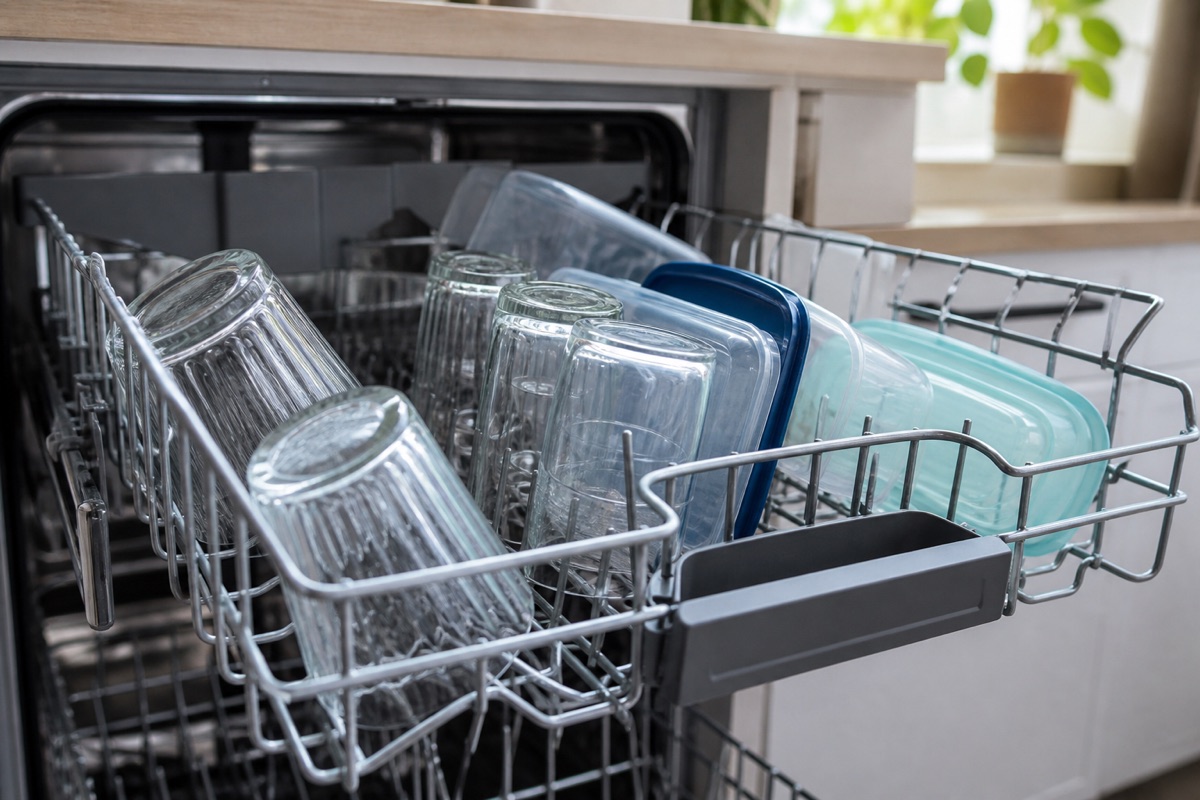
- Bowls and cups face down and angled so water drains rather than pooling
- Do not let items nest. Two spoons spooned together come out dirty every time
- Plastics on the top rack, away from the element
- Knives point down in the basket if they go in at all
- Do not block the spray arms. Spin each one by hand after loading — this catches most of the “the dishwasher isn’t cleaning properly” complaints
- Do not overload. Water has to reach every surface
Detergent, salt and rinse aid do three different jobs
- Detergent cleans
- Salt regenerates the machine’s built-in water softener. Only needed in hard water areas, and frequently never filled by anyone. If your machine has a salt reservoir and your water is hard, this is doing nothing for you empty
- Rinse aid reduces water surface tension so water sheets off rather than beading — this is what prevents spotting and improves drying
All-in-one tablets contain versions of all three, but in fixed proportions. In very hard water, separate salt and rinse aid outperform them.
Maintaining the machine
- Clean the filter — monthly at minimum. This is the single most impactful maintenance job on a dishwasher
- Clear the spray arm jets with a cocktail stick every few months
- Wipe the door edge and seal, which the spray never reaches
- Run a dishwasher cleaner or a hot empty cycle monthly
- Descale in hard water areas
A reasonable rule
Put in the dishwasher anything that is genuinely replaceable and mass-produced: everyday plates, glasses, cutlery, stainless pans, plastic storage. Hand wash anything that is sharp, wooden, coated, aluminium, seasoned, decorated, or that you would be annoyed to replace.
The dishwasher is more hygienic and uses less water than hand washing. It is simply a harsher environment, and knowing which of your things can take it is the whole skill.
Common questions
Why does my dishwasher-safe plastic keep warping?
Almost always because it is on the bottom rack. The heating element is under the lower basket and radiant heat there far exceeds the water temperature. Dishwasher-safe plastics are rated for the top rack unless the manufacturer says otherwise.
Can I reverse cloudy glasses?
Only if the cause is mineral film. Soak one glass in white vinegar for 15 minutes — if it clears, the fix is rinse aid and dishwasher salt. If it does not clear, the glass has been etched, which is permanent corrosion of the glass surface and no product will reverse it.
Is it worth using dishwasher salt if I have a water softener?
If your whole house is softened, no — the machine’s internal softener has nothing to remove, and you can usually turn its setting down or off. In every other hard-water household with a salt reservoir, filling it makes a visible difference and it is routinely neglected.
Does the dishwasher really use less water than hand washing?
For a full load, yes, by a wide margin — a modern machine uses roughly 10–15 litres for a load that would take considerably more under a running tap. The comparison only fails if you run the machine half empty.
My knives say dishwasher safe. Should I trust it?
The blade will survive, so the claim is technically accurate. What suffers is the edge, which chips against other items in the basket, and the steel surface, which pits from alkaline detergent over time. A knife you sharpen is a knife you should hand wash.