The short answer
Every appliance has one component that decides its lifespan, and it is rarely the one people clean. The eight that matter: the washing machine drain pump filter, the dishwasher filter, the microwave waveguide cover, the air fryer heating element above the basket, the refrigerator condenser coils and drain pan, the blender gasket under the blade assembly, the coffee grinder burrs, and the espresso group head above the shower screen. Most are behind a panel that has never been opened, and each produces a distinctive symptom when neglected.
Every appliance has a component that decides its lifespan, and in most cases it is not the one people clean. The visible surfaces get wiped; the part actually doing the work sits behind a panel that has never been opened. Here are eight of them.
1. The washing machine drain pump filter
Where: behind a small access panel at the bottom front.
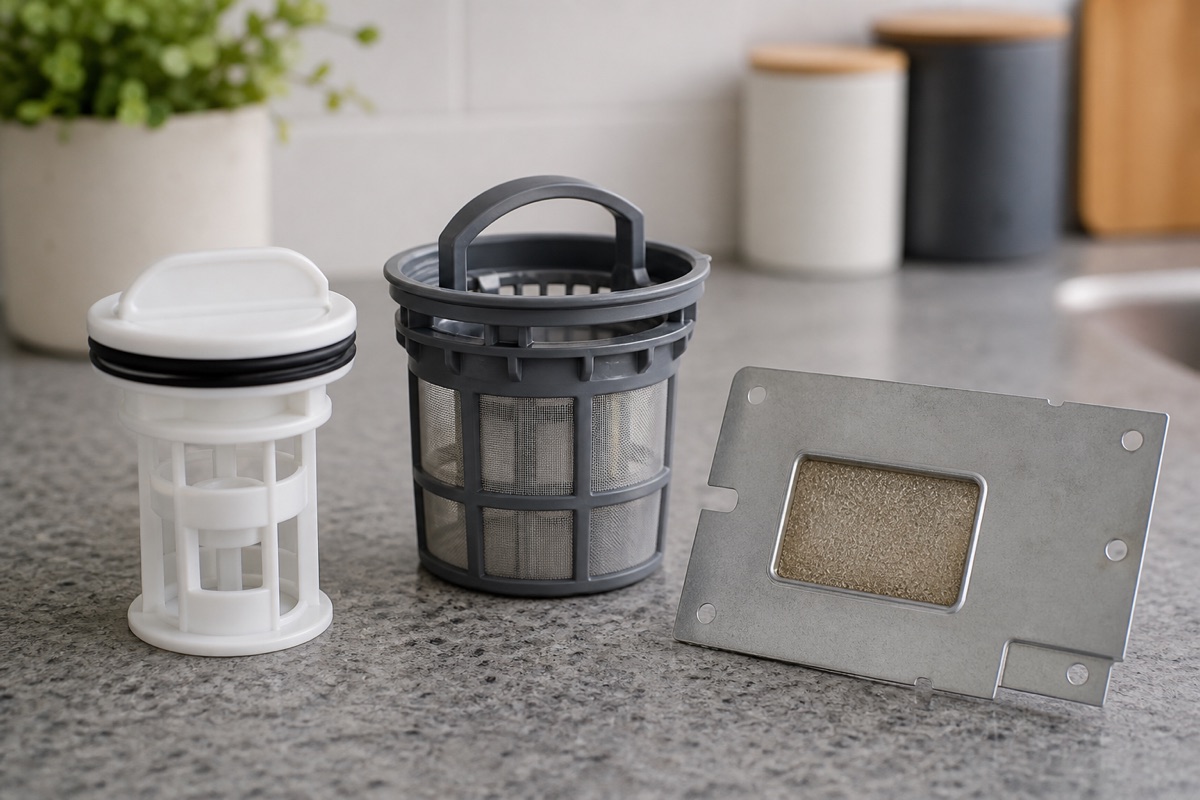
It holds a reservoir of standing water that never empties on its own, and it collects coins, hair grips and fabric. On a machine that has never had it opened, this is frequently the actual source of a smell people blame on the drum.
Warning: put towels and a shallow tray down first — up to a litre comes out. Full guide
2. The dishwasher filter
Where: the centre or rear of the tub floor, under the lower rack.
Machines built before roughly 2010 had a food grinder. Manufacturers replaced it with a manual filter for efficiency and noise, and never told anyone. Gritty glassware and standing water are the symptoms.
Do not use a wire brush — the fine mesh is thin stainless and holes easily. Full guide
3. The microwave waveguide cover
Where: a beige or grey rectangle on the side wall, about the size of a playing card.
Made of mica. Splatter carbonises on it, carbon absorbs microwave energy rather than passing it, and enough of it produces arcing that can take the magnetron with it.
Do not soak it — wet mica delaminates. Full guide
4. The air fryer heating element
Where: above the basket. Turn the whole unit upside down to reach it.
Fat aerosolises during cooking and carbonises on the element. That layer insulates it, so the fryer runs hotter and longer, and eventually smokes from its own deposits rather than the food. An air fryer that has started smoking almost always has a loaded element, not a fault.
5. The refrigerator condenser coils and drain pan
Where: behind the kick plate at the bottom front, or on the back of older units.
Dust blankets the fins, heat cannot leave, and the compressor runs almost continuously. The drain pan underneath collects sludge and is a common source of a persistent smell people chase inside the cabinet for months.
Unplug first — the condenser fan starts without warning. Full guide
6. The blender gasket, under the blade assembly
Where: unscrew the blade unit from the base of the jug.
Dried food in the gasket groove is invisible with the assembly in place. It is what lets liquid past the seal and into the bearing — and once liquid reaches the bearing, the blender is finished.
7. The coffee grinder burrs
Where: under the hopper, behind a retaining ring.
Coffee is roughly 15% oil by weight, and that oil coats every internal surface and then goes rancid. It taints every subsequent grind. Everything here must stay dry — burrs are steel and washing them causes rust.
8. The espresso machine group head, above the shower screen
Where: reached by backflushing with a blind basket, not by wiping.
Coffee oils accumulate above the shower screen where no cloth reaches. Six months of them produce a bitterness that no adjustment to grind, dose or beans will fix.
Schedule
| Part | Interval | Symptom when neglected |
|---|---|---|
| Dishwasher filter | 2–6 weeks | Grit on glasses, standing water |
| Espresso group head | Weekly | Bitter shots |
| Blender gasket | 2–4 weeks | Leaking at the base |
| Air fryer element | 2–4 weeks | Smoking with no food to explain it |
| Microwave waveguide | Monthly inspection | Sparking, burnt smell |
| Coffee grinder burrs | 3–6 months | Stale, rancid taste |
| Washer drain filter | 3 months | Musty laundry |
| Fridge coils and pan | 6–12 months | Compressor never stops; persistent smell |
Common questions
Why are all of these hidden behind panels?
Because they are service components rather than user-facing ones, and manufacturers assume they will be reached during a service visit that most households never book. The dishwasher filter is the clearest case: it replaced a self-cleaning mechanism, and the change was never communicated to owners.
Which one causes the most complaints?
The washing machine drain pump filter, because it produces a symptom — musty laundry — that people attribute to the machine being old or the detergent being wrong. It is usually a litre of stagnant water behind a panel they have never opened.
Is it safe to open these myself?
All eight are user-serviceable and none require tools beyond a screwdriver. Unplug anything electrical first, and note that the fridge condenser fan can start without warning if the appliance is still connected.
My appliance smells and I have cleaned everything visible. What now?
Work through the hidden part for that appliance from this list. Musty laundry means the drain pump filter and door gasket; a fridge smell that survives cleaning the interior usually means the drain pan; bitter coffee means the group head or the burrs.
Does cleaning these actually extend appliance life?
For some, measurably. Condenser coils determine how hard a compressor works, and compressors are the point at which replacing a fridge beats repairing it. A blender bearing that gets wet is a dead blender. Others — the microwave waveguide, the air fryer element — are about preventing a specific failure rather than gradual wear.