The short answer
Grease filters are washed; carbon filters are replaced and must never be washed, because washing saturates rather than regenerates the carbon. For grease filters, use a quarter cup of washing soda — not bicarbonate — plus dish soap and boiling water, soak 20–30 minutes, then brush along the channels. Aluminium filters discolour permanently in a dishwasher. Clean grease filters monthly with typical cooking, fortnightly with heavy frying; replace carbon every 3 to 6 months.
A cooker hood works by pulling air through a filter. When that filter is saturated with grease, the airflow drops, the fan works harder, and the extraction that was the entire point of the appliance stops happening. Grease then goes where it would have gone without a hood — onto cabinet doors, the ceiling, and the wall behind the hob.
There is a second reason, less often mentioned: a grease-loaded filter directly above a gas hob or a pan of hot oil is a fire path. Commercial kitchens have mandatory cleaning schedules for exactly this reason.
Know which filters you have
Nearly all hoods have a grease filter. Recirculating hoods — those that vent back into the room rather than outside — have a carbon filter as well. They are cleaned completely differently.
| Filter | Looks like | Treatment |
|---|---|---|
| Baffle | Heavy stainless panel of interlocking vertical channels | Wash. Lasts the life of the hood |
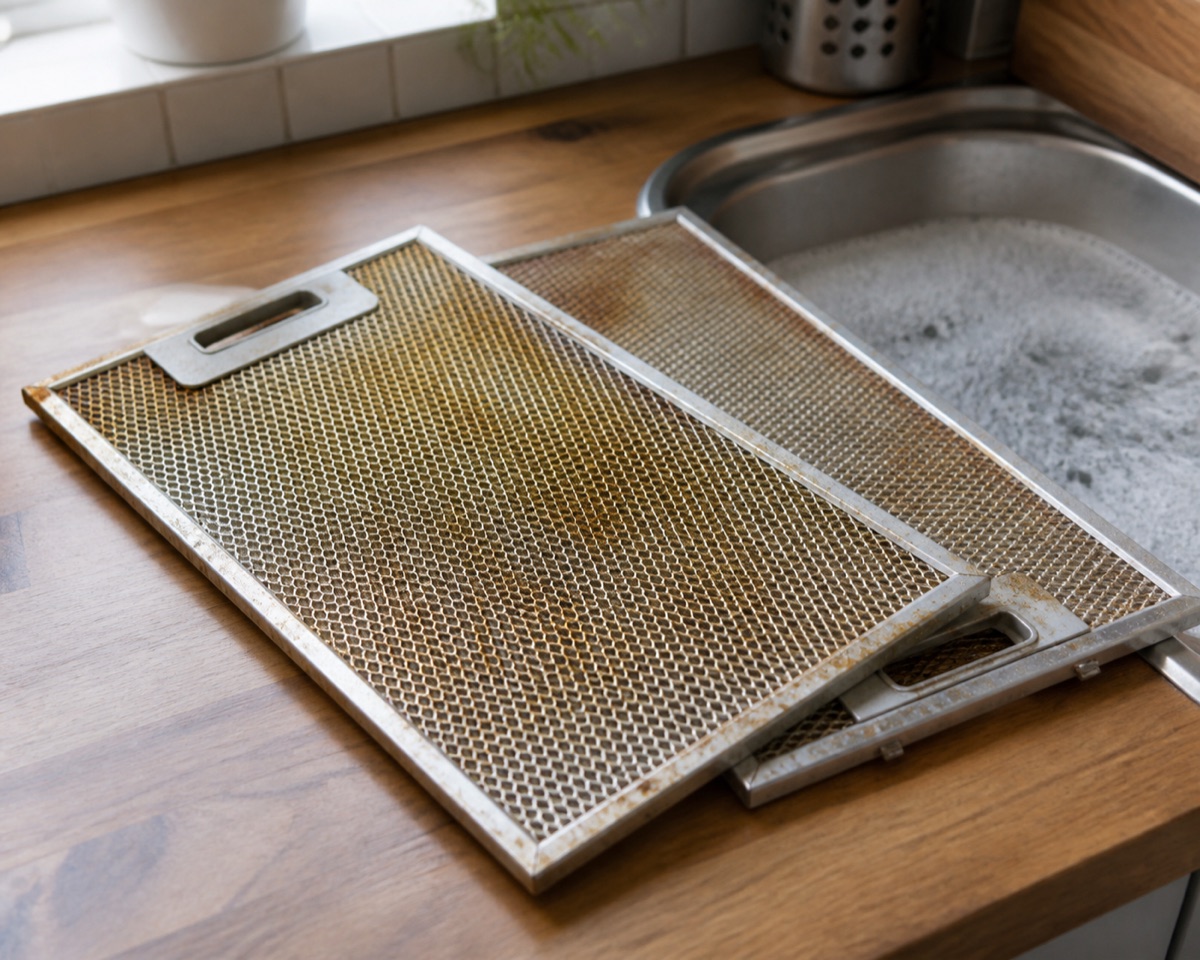
| Mesh | Layered aluminium or stainless mesh in a frame | Wash. Replace when misshapen or torn |
| Carbon / charcoal | Solid black cassette, often behind the grease filter | Replace. Never wash |
The carbon filter point is the one that catches people. Carbon filters remove odour by adsorption. Washing them does not regenerate the carbon — it saturates and clogs it. They are consumables, replaced every three to six months depending on use.
Cleaning a grease filter
Removing it
Grease filters release with a spring catch or a small handle on the underside. Support the filter as it comes free — a saturated baffle filter is heavy and drips.
Method 1: the boiling water and washing soda soak
This is the most effective method for heavy build-up, and it needs no specialist product.
- Put the filter in a sink or a large basin. If it does not fit flat, do it in two halves, or use a bath with a towel down to protect the enamel.
- Add a quarter cup of washing soda (sodium carbonate) and a squeeze of dish soap.
- Pour over boiling water to submerge it. The heat matters as much as the chemistry — grease has to be liquid to be lifted.
- Leave 20 to 30 minutes. You will see the grease release and float.
- Brush with a stiff nylon brush, working along the channels of a baffle filter rather than across them.
- Rinse with hot water and dry completely before refitting.
Use washing soda, not bicarbonate of soda — they are different compounds and washing soda is considerably more alkaline, which is what cuts the grease.
Method 2: the dishwasher
Convenient, and adequate for light soil. Two cautions:
- Run it on the hottest cycle, alone. A filter shares its grease with everything else in the machine.
- Aluminium mesh filters will discolour — going dull grey or chalky white — because dishwasher detergent is strongly alkaline and attacks aluminium. It is cosmetic and it does not affect function, but it is permanent. Stainless filters are unaffected.
What to avoid
- Oven cleaner on aluminium filters. Caustic soda dissolves aluminium, visibly and quickly.
- Wire brushes and steel wool — they open up mesh and scratch baffles.
- Refitting damp. Water sitting in a filter frame corrodes it from the inside.
The rest of the hood
With the filter out, degrease the surfaces the filter was hiding: the underside of the canopy, the light housings, and the fan intake if you can see it. Warm water with a little washing-up liquid and a cloth handles most of it; a degreaser is worth it once a year.
On the outside, wipe stainless steel along the grain, not in circles, and finish with a dry cloth to avoid streaking.
Ducted or recirculating — and why it matters
If your hood vents outside, the duct itself accumulates grease over years and should be inspected periodically. Check that the external flap or damper opens fully when the fan runs; a stuck damper reduces a ducted hood to an expensive light fitting.
If it recirculates, the carbon filter is doing all the odour work and it has a hard service life. A recirculating hood with an exhausted carbon filter removes grease and nothing else.
How often
| Cooking pattern | Grease filter | Carbon filter |
|---|---|---|
| Light — occasional cooking, little frying | Every 3 months | Every 6 months |
| Typical household | Monthly | Every 4 months |
| Heavy frying, wok cooking, daily | Every 2 weeks | Every 3 months |
Getting more out of the hood
- Switch it on before you start cooking, not after. A hood captures a rising plume; it cannot chase grease that has already spread across the room.
- Leave it running for 10 minutes after you finish. Most of the residual moisture and odour leaves in that window.
- Use the back burners where the canopy coverage is best.
- Cover pans when you are not actively working in them.
Common questions
Can I wash a carbon filter to make it last longer?
No. Carbon filters work by adsorption, and washing does not regenerate the carbon — it saturates and clogs it. They are consumables, replaced every three to six months depending on how much you fry. This is the most common cooker hood mistake.
Why did my aluminium filter go chalky in the dishwasher?
Dishwasher detergent is strongly alkaline and reacts with aluminium. The dull grey or white finish is permanent, though it is cosmetic and does not affect how the filter works. Stainless filters are unaffected. Wash aluminium ones by hand.
Is washing soda different from bicarbonate of soda?
Yes — different compounds. Washing soda is sodium carbonate and considerably more alkaline, which is what cuts baked-on grease. Bicarbonate is much milder and will not do the job on a heavily loaded filter.
How do I tell if my hood is ducted or recirculating?
Look for an external vent on the wall or roof above it, and check whether there is a carbon filter fitted behind the grease filter. A carbon filter almost always means recirculating. If in doubt, run the fan and go outside to see if air is discharging.
Does it matter when I switch the hood on?
Considerably. A hood captures a rising plume; it cannot chase grease that has already spread across the room. Switch it on before you start cooking and leave it running for ten minutes after you finish — that final window removes most of the residual moisture and odour.